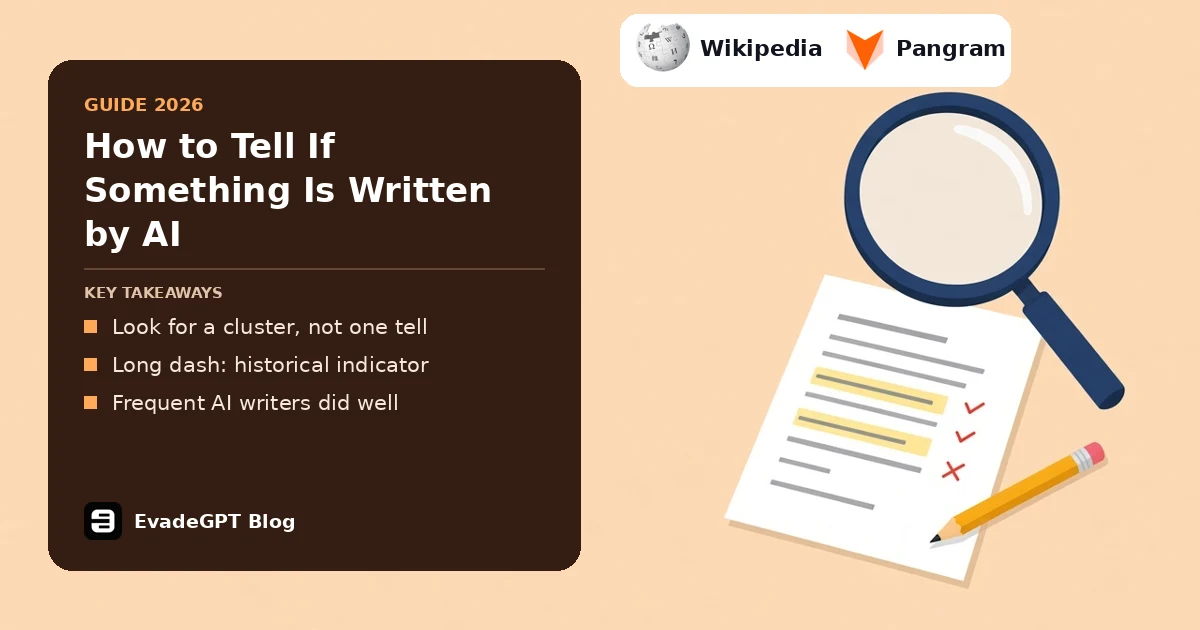
Short answer: look for a cluster of tells, never one. Pangram found 9 patterns at 2 to 12 times the human rate, but no tell is proof. General participants, healthcare educators and readers with little AI writing experience each scored near chance in separate studies. Search engines judge it differently from readers, as our post on Google's AI content rules shows.
Knowing how to tell if something is written by AI matters most when a mark rides on it. I read Wikipedia's editor guide, Pangram's counts and 6 studies, then ranked each tell.
How to tell if something is written by AI: which signs matter?
Pangram compared human and AI documents per 10,000 words. Markdown symbols and stock AI phrases led at 12 times the human rate, the long dash came next at 10 times, and emojis trailed at 2 times. All 9 are below.
| Tell | AI vs human rate |
|---|---|
| Markdown symbols in plain text | 12x |
| Stock AI phrases | 12x |
| The long dash | 10x |
| Bulleted lists | 9x |
| Ideas grouped in threes | 4x |
| "Not just X but Y" | 3x |
| Unusual Unicode characters | 3x |
| Chatty helper headers | 2x |
| Emojis | 2x |
Most guides on how to tell if something is written by AI stop here, but Pangram adds: "No single tell of AI writing is a giveaway" (Pangram). Pangram also runs a detector, and our review of Pangram's accuracy claims checks it against independent tests. On LinkedIn the signs look a little different, as our guide on why a LinkedIn post sounds like AI explains. Hidden marks are one signal that only a matching detector can read, which our text watermark guide explains.
Is the long dash still a sign of AI writing?
Wikipedia's editor guide files overuse of the long dash under historical indicators (2022 to September 2026). That placement isn't a measured decline. Pangram measured AI using it 10 times as often as humans. I'd note it only next to other tells. Em dashes come up a lot, and our guide on why AI uses em dashes looks at the evidence.
Should you rely on a word list?
Only as a first clue. Dmitry Kobak, Rita González-Márquez, Emőke-Ágnes Horvát and Jan Lause scanned more than 15 million PubMed abstracts and found "delves" appeared 28 times as often in 2024 as expected, "underscores" 13.8 times and "showcasing" 10.7 times (Science Advances).
Lists go stale; Wikipedia notes the words "have changed over time." Grammar matters too: Alex Reinhart's team found models used "present participial clauses at 2 to 5 times the rate of human text" (PNAS), like sentences trailing an "-ing" clause.
Can you learn how to tell if something is written by AI by eye?
Experience was associated with better results. In Jenna Russell, Marzena Karpinska and Mohit Iyyer's 2025 study, 5 frequent AI writing users caught 92.7% of AI articles in its first test and wrongly flagged 3.3% of human ones. In that test, 4 readers with little AI writing experience flagged 52.5% of human articles.
Maurice Jakesch, Jeffrey T. Hancock and Mor Naaman tested 4,600 people and found "only 50 to 52% accuracy" (PNAS). Adam Cheng's team saw educators label 13 of 18 fully human introductions as AI, after setting aside ones they called mixed (Advances in Simulation).
Wikipedia's guide on how to tell if something is written by AI agrees: "Humans are notoriously bad at distinguishing human and LLM-generated text."
Why do human tells lead to false accusations?
Careful human writing shares many of the same habits. Weixin Liang's team found 7 detectors flagged 91 TOEFL essays by non-native English writers 61.3% of the time (Patterns), and Jakesch's participants read grammar errors as AI, though flawed texts were 15% less likely to be AI.
Turnitin says its report "should not be used as the sole basis for adverse actions against a student" (Turnitin). A hunch deserves less. See our Turnitin false positive guide and whether AI detectors are accurate. Detector scores move with each model version, and our look at whether Originality AI is accurate explains what its 2026 update means for older test results.
What's a fair checklist for how to tell if something is written by AI?
Run 7 checks and act only on a cluster. Each comes from Wikipedia's editor guide, Pangram's counts or a published study. One hit means little; a page that trips most of them earns a conversation with the writer, not an accusation.
- Check the date. Before 30 November 2022, "AI use can be safely ruled out", says Wikipedia.
- Spot stray formatting. Asterisks and hash headers in an email.
- Count stock words. One "delves" means nothing; a cluster does.
- Listen to the rhythm. Threes and "not just X but Y" add up.
- Check citations. Wikipedia flags DOIs that lead to unrelated articles.
- Drop misleading tells. Perfect grammar proves nothing.
- Ask the writer. Drafts help, as in how to prove you didn't use AI.
FAQ
Do teachers know how to tell if something is written by AI?
Not reliably. In Cheng's 2025 study, educators "fared no better than chance."
How to tell if something is written by AI without a detector?
Check the date, stray formatting, stock words, rhythm and citations, then ask the writer for drafts.
Which words make writing sound like AI?
"Delves", "underscores" and "showcasing" surged in 2024 abstracts, per Kobak's study. Treat them as a nudge.
Who knew how to tell if something is written by AI in Russell's study?
Frequent AI writing users caught 92.7% of AI articles in the first test. This was an association with existing experience, not a tested learning method.
Do AI detectors spot AI writing better than people?
Not always. Russell's experts beat most detectors tested. See how AI detectors work and our Grammarly AI detector guide.