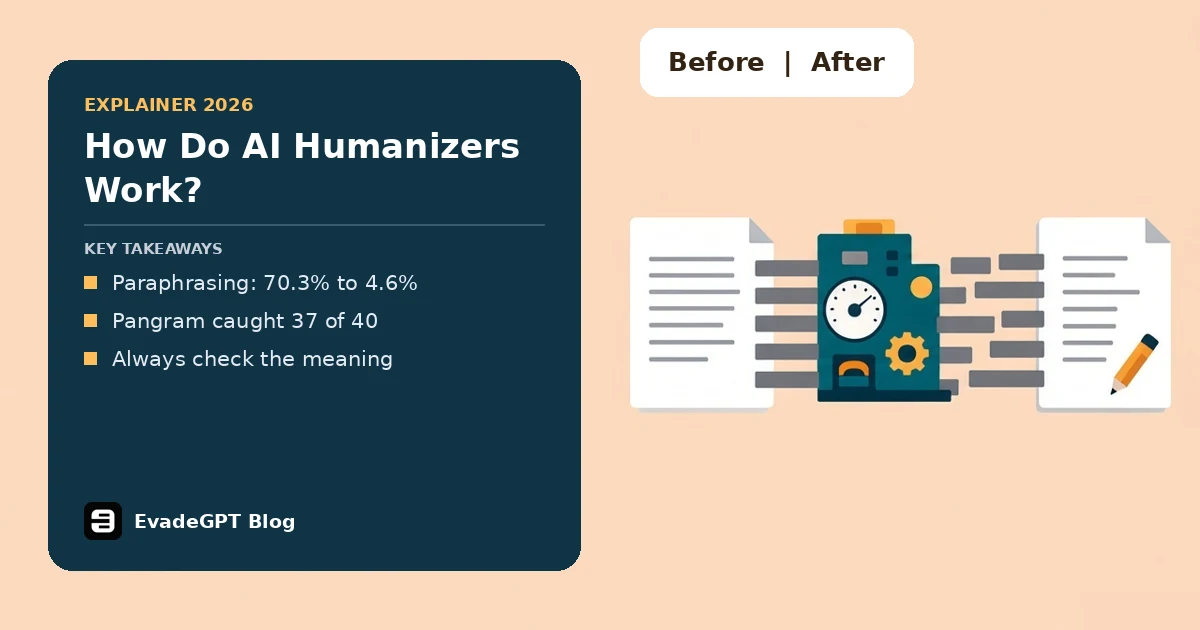
Short answer: here's how AI humanizers work: they rewrite a draft to change the patterns detectors score: predictable word choice, even sentence lengths and stock connectors. In one NeurIPS 2023 study, paraphrasing cut one detector's detection rate from 70.3% to 4.6%. Newer detectors train on humanised text, though, so nothing is guaranteed.
I went back through the research, because most takes on how AI humanizers work are a sales page or a scare story.
How do AI humanizers work under the hood?
Each vendor keeps its recipe private, but the research describes 1 shared goal: change the signals a detector measures without changing the meaning. GPTZero's 2023 explainer calls burstiness "a measure of how much writing patterns and text perplexities vary over the entire document." AI drafts tend to keep that variation low.
Perplexity, in the same explainer, is "how likely an AI model would have chosen the exact same set of words as found in the document." That's how an AI humanizer works in practice: it swaps expected words and breaks up an even rhythm, while keeping names and figures. GPTZero now notes it stopped using both measures in autumn 2023, moving to a deep-learning model.
A synonym spinner is cruder, as our comparison of humanizers and paraphrasers explains.
What does a humanizer actually change in a paragraph?
The biggest change is rhythm. In the example below, the 4 original sentences run 8, 11, 9 and 10 words, a narrow band that reads as machine-made. The rewrite runs 10, 21 and 9 words, cuts 2 stock openers and stops repeating "time management". I wrote both versions to show the edit types.
Before: Time management is an important skill for students. Good planning helps students balance their studies and their personal lives. It also helps reduce stress and improves academic performance. Overall, time management plays a key role in student success.
After: Students who map out their week tend to cope better. A simple weekly timetable makes room for study and a life outside it, and it takes some pressure off before deadlines. That's most of what good time management buys you.
| What changed | Before | After |
|---|---|---|
| Sentence lengths | 8, 11, 9, 10 words | 10, 21, 9 words |
| Stock openers | "It also", "Overall" | none |
| "Time management" repeats | 2 | 1 |
| Claims kept | 5 | 4 |
The rewrite dropped "improves academic performance". That loss is part of what an AI humanizer does, so check every rewrite. Our guide on how to stop your essay sounding like AI shows how.
Why do detector scores move after humanising?
Scores move because the rewrite changes the exact signals being scored. In Krishna and colleagues' NeurIPS 2023 study, their paraphrasing model dropped DetectGPT's detection rate from 70.3% to 4.6% at a 1% false positive rate, "without appreciably modifying the input semantics."
Perkins and colleagues ran 805 tests across 7 detectors in late 2023: average accuracy fell from 39.5% on plain AI text to 22.14% after simple changes, though error-filled text "would very likely receive poor marks." Weber-Wulff's team saw accuracy fall from 74% on unedited AI text to 26% after machine paraphrasing.
Detectors weigh signals differently, as our explainer on how AI detectors work shows.
Can AI detectors still catch humanised text?
Some can, and the gap is huge. In a June 2026 study of 40 humanised papers, Pangram caught 37 and GPTZero caught 1. Both have released newer models since, and GPTZero says its 5.0b improves on paraphrased text. Turnitin added AI bypasser detection on 27 August 2025, aimed at text "intentionally modified by AI humanizer tools", English only.
In Russell, Karpinska and Iyyer's ACL 2025 study, the majority vote of 5 expert readers was right on all 60 humanised articles, which overused titles like Dr. and Prof. That's the limit of how AI humanizers work: they change the surface, and some habits survive.
It cuts both ways: a Notre Dame team found that "After humanization, more than 96% of AI-labeled rewrites evade Pangram and GPTZero," with one commercial humanizer. See our Pangram vs GPTZero comparison and whether Turnitin can detect AI humanizers.
What is an AI humanizer good for, and where does it fall short?
A humanizer is good at the 2 things detectors and readers notice first: flat rhythm and stock phrasing. It's weaker on substance: it can't add your examples or argument, and in every study I've cited, at least one detector or reader still caught some humanised text.
It suits genuine work you drafted with AI support. Non-native English writers face extra false flags: a 2023 Stanford study found 7 detectors flagged 61.3% of TOEFL essays as AI on average. If your course bans AI drafting, a rewrite doesn't change the rules, and our guide on how to prove you didn't use AI covers keeping evidence.
How can you test a humanizer on your own writing?
To learn what an AI humanizer does to your writing, run a small test: 6 samples of 300 words or more, each checked in the same 2 detectors. Log the label and the date, because detectors update often. I haven't run this set myself.
- 2 paragraphs you wrote yourself before 2023.
- 2 plain AI drafts on the same topics.
- The same 2 AI drafts after one humanizer pass.
Then count the facts that survived. A lower score that drops a fact is a worse essay, and our writing with AI guide covers fixes by hand.
Tired of second-guessing every sentence? Try EvadeGPT on your next draft
You did the work, and a checker still calls 1 paragraph AI, or your marker says it reads robotic. False flags like that are stressful, and a stiff rhythm can drag a grade down even when every idea is yours.
Start with the EvadeGPT AI detector, which uses our own custom-trained model, to see where your draft reads flat. Then use the EvadeGPT humanizer to pick a rewriting model and tone, with your names and key terms kept. For the research, lean on EVE chat. Try it tonight with the button below.
FAQ
What is an AI humanizer?
A tool that rewrites AI-assisted text so it reads more like a person wrote it. In short, that's how AI humanizers work: they change word choice and sentence rhythm while trying to keep the meaning.
Do AI humanizers work against every detector?
No. In a June 2026 study, Pangram still caught 37 of 40 humanised papers while GPTZero caught 1.
Can Turnitin detect humanised text?
Turnitin says it can. It added AI bypasser detection for English submissions on 27 August 2025.
Is a humanizer the same as a paraphraser?
Not quite. A paraphraser rewords sentences one at a time, while a humanizer targets rhythm and phrasing across a whole draft.
Can humanising change the meaning of my text?
Yes. Any rewrite can drop a claim or change a figure, so check the output against your original.