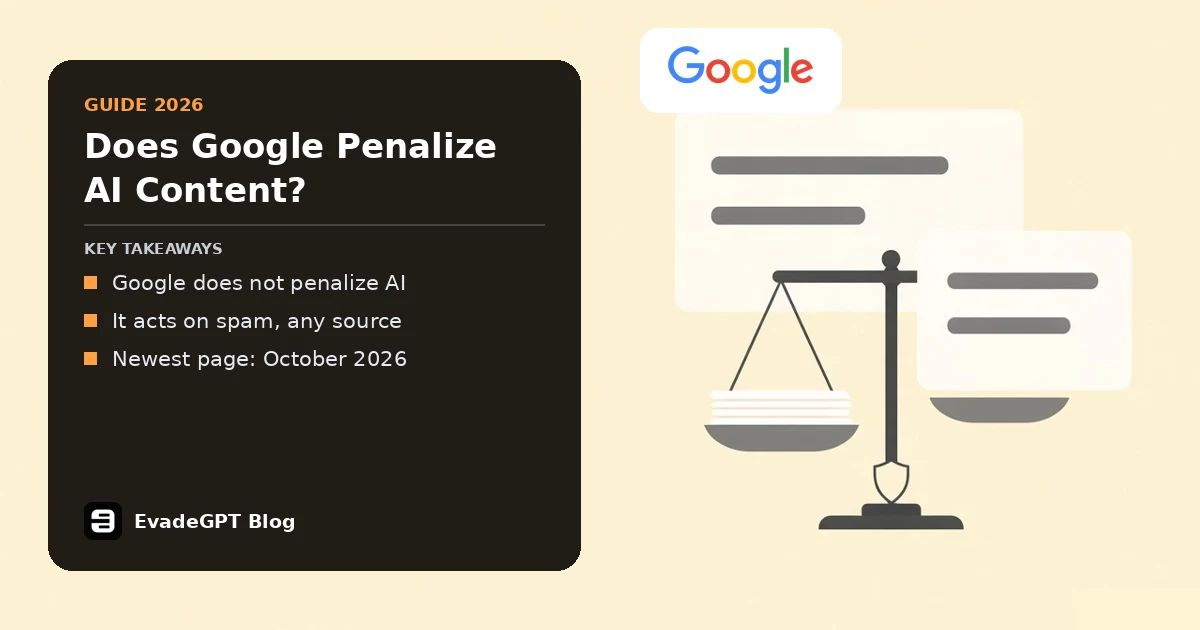
Short answer: no. Google does not penalize AI content for being AI. It acts on pages made "with the primary purpose of manipulating" rankings, whatever tool produced them. A 2025 Ahrefs study of 600,000 top-ranking pages found a correlation of 0.011 between AI share and position, effectively zero. The real risk is mass-producing thin pages.
I read 6 of Google's own pages on AI content and spam, the newest updated in October 2026.
Does Google penalize AI content or only spam?
Only spam. Google's February 2023 guidance says "Appropriate use of AI or automation is not against our guidelines." What breaks its rules is using automation, AI included, "with the primary purpose of manipulating" rankings. Google judges the quality of content "rather than how content is produced".
| Source | Date | What it says about AI content |
|---|---|---|
| AI-generated content guidance | 8 Feb 2023 | AI use is fine unless it's meant to manipulate rankings |
| March 2024 update post | 5 Mar 2024 | Scaled content rules cover automation, humans or both |
| March 2024 spam policies post | 5 Mar 2024 | Breaking spam policies can drop a site from results |
| Spam policies | Updated 28 Aug 2026 | Scaled content abuse applies "no matter how it's created" |
| Using generative AI content | Updated 1 Oct 2026 | Fact-check all AI output, metadata included |
| Creating helpful content | Updated 5 Oct 2026 | Think about who made it, how and why |
The 2023 FAQ puts it in 3 words: "It's just content." So Google does not penalize AI content as a category, and "Using AI doesn't give content any special gains."
What counts as scaled content abuse?
Google added this spam policy in March 2024. It covers cases where "many pages are generated for the primary purpose of manipulating" rankings and not helping users, and it applies "no matter how it's created". The first example on Google's list is using AI tools to generate many pages.
It covers content made at scale "whether automation, humans or a combination are involved." On 26 April 2024, Google said "You'll now see 45% less low-quality, unoriginal content in search results."
Sites that break spam policies "may rank lower in results or not appear in results at all". A manual action brings a Search Console notice, and you can "apply to have the action reconsidered" after fixing the pages.
Do AI-written pages still rank on Google?
Yes, often. In July 2025, Ahrefs pulled the top 20 results for 100,000 random keywords and scanned 600,000 pages with its own AI detector. It rated 4.6% "pure AI" and 13.5% "pure human", so 86.5% of top-ranking pages contained some AI-generated text.
The correlation between AI share and ranking "was 0.011, effectively zero," wrote Si Quan Ong at Ahrefs. Position 1 pages carried slightly less AI, but "the correlation is very weak." On this data, Google doesn't penalize AI content either.
Two awkward limits: detectors misread text, as our roundup of whether AI detectors are accurate shows (how AI detectors work explains why), and the study only saw pages that already rank.
Does Google penalize AI content that's been humanized?
No. Google penalizes AI content only when it's spam, and rewording doesn't turn spam into help. Google's spam policy lists "automated transformations like synonymizing, translating, or other obfuscation techniques" as scaled content abuse when they're used to churn out pages that do little for users. The test is usefulness, in 1 draft or 1,000.
Swapping words across scraped pages is still spam. Fact-checking one draft and rewriting it in your voice is editing.
Our writing with AI guide covers that edit, AI humanizers vs paraphrasers shows why word swaps fall short, and readers spot stock phrasing too (how to tell if something is written by AI).
Should you label AI content or give it a byline?
Label it when readers would expect it, and keep AI off the byline. Google's 2023 FAQ says disclosures are useful where someone might ask "How was this created?", and that "Giving AI an author byline is probably not the best way" to be open about AI's role.
Its helpful content page adds 3 questions: who made it, how and why.
Does Google penalize AI content you've fact-checked?
By its own account, Google doesn't penalize AI content that meets its quality bar. Its generative AI page, updated 1 October 2026, says "It is critical to manually factcheck and review all AI-generated content for accuracy and trustworthiness before publishing." The check covers titles, meta descriptions, structured data and alt text.
Run 4 checks before you publish an AI-assisted page:
- Check every fact and figure against a source you can link.
- Read the title, meta description and alt text for errors.
- Add something only you know, such as a test or photo.
- Ask if you'd publish it without search engines.
When I compared these checks with Google's rater guidance, they lined up: raters mark down pages with "little to no effort, little to no originality".
Check your draft before you publish
Sound familiar? Google won't punish AI for being AI, but generic machine-written pages still read like scaled filler. EvadeGPT is the fix: a custom-trained model that helps you spot robotic sentences and rewrite them in your voice. Click the EvadeGPT AI detector or EVE chat and try it in 1 go.
FAQ
Does Google penalize AI content automatically?
No. Google says appropriate use of AI "is not against our guidelines." It acts on spam from any source.
Can Google tell if content was written by AI?
Google doesn't say it scores AI use. It says SpamBrain and other systems "analyze patterns and signals to help us identify spam content".
What happens if Google finds spam on my site?
Pages can rank lower or drop out. A manual action comes with a Search Console notice.
Do Google's quality raters change rankings?
Not directly. Google says "their ratings don't directly influence ranking."
Does Google penalize AI content made at scale?
Only when pages are mass-made to game rankings. Google calls that scaled content abuse.