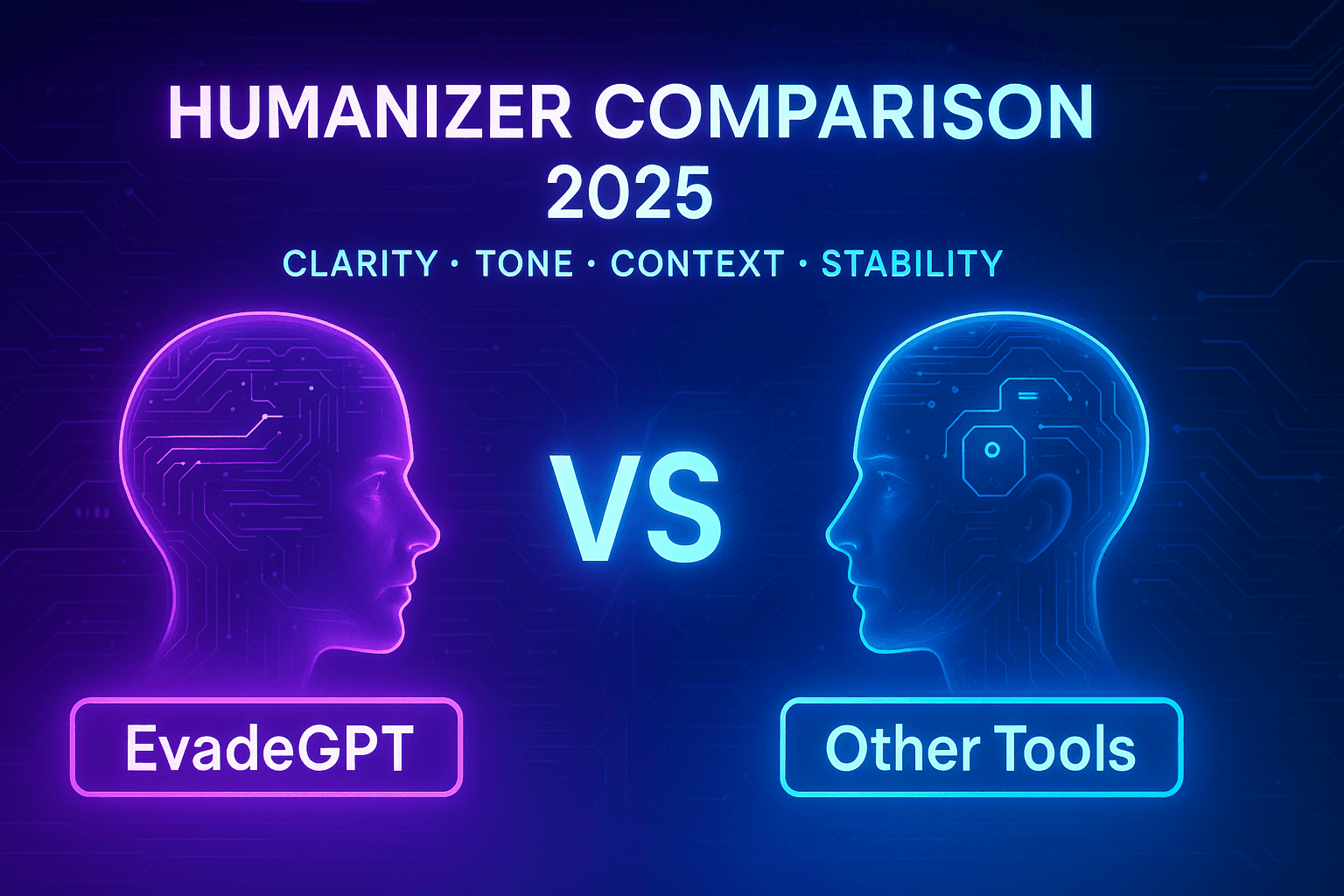
If you’ve ever asked “Do I need an AI humanizer or a paraphraser?” you’re already ahead of most teams. The terms get used interchangeably, but they solve different problems. A paraphraser rewords sentences. An AI humanizer rewrites for voice, structure, credibility, and publishability-and that difference determines whether your content ranks, converts, and passes review.
In 2025, organisations rely on ChatGPT and other LLMs to draft first passes. The challenge is turning that AI-shaped draft into something that sounds like you, respects your outline, keeps claims intact, and doesn’t create legal or privacy headaches. This guide explains the technical and editorial differences between basic paraphrasers and true humanizers-using EvadeGPT.ai as the model for what a humanizer should do.
Quick Definitions
-
Paraphraser: Swaps words and alters sentence structure to “say the same thing differently.” Helpful for small rewrites and style tweaks.
-
AI Humanizer: Rewrites at the document level-preserving headings and lists, varying cadence to remove “AI tells,” adding connective logic, and protecting facts via fact-locking. Output aims to be publish-ready.
What Paraphrasers Do Well-and Where They Break
-
✅ Short snippets: captions, microcopy, quick synonyms.
-
✅ Grammar smoothing: tidy phrasing on a sentence or paragraph.
-
❌ Long-form cohesion: they often flatten H3s, merge bullets, and lose scannability.
-
❌ Brand voice: outputs feel neutral, robotic, or “template-like.”
-
❌ Accuracy under pressure: heavy rewording can nudge numbers, quotes, or dates.
-
❌ Detector “tells”: uniform sentence length and repeated transitions remain.
What AI Humanizers Do Differently
-
Structure awareness: preserve H2/H3 hierarchy, nested lists, callouts, and FAQs.
-
Tone control: apply selectable presets (e.g., Aussie casual-pro, analytical mentor, clinical technical, direct-response) and keep them consistent across sections.
-
Rhythm variation: vary sentence openings and lengths to reduce “AI tells.”
-
Continuity stitching: join chunks so the article reads like a single author.
-
Fact-locking: freeze KPIs, quotes, citations, dates, and policy phrases to prevent drift.
-
Privacy-first processing: redact identifiers locally and avoid model training on your data.
The 10 Practical Differences That Matter
-
Goal: Paraphrasers aim for difference; humanizers aim for credibility.
-
Unit of work: Paraphrasers focus on sentences; humanizers refactor the document.
-
Information architecture: Paraphrasers often lose it; humanizers preserve it.
-
Voice: Paraphrasers neutralise; humanizers lock brand tone.
-
Cadence: Paraphrasers remain uniform; humanizers vary rhythm.
-
Accuracy: Paraphrasers can drift; humanizers fact-lock claims.
-
Editorial speed: Paraphrasers add repair work; humanizers output review-ready drafts.
-
Detector resilience: Paraphrasers chase tricks; humanizers reduce AI tells naturally.
-
Privacy: Paraphrasers rarely explain retention; humanizers emphasise non-training + redaction.
-
ROI: Paraphrasers are cheap per click; humanizers are cheaper per published article.
SEO Reality: IA Beats Tricks
Search performance is won on information architecture and usefulness. If a tool collapses H3s, merges bullets, or blurs callouts, readers skim sooner and internal-link placement suffers. A real humanizer keeps the skeleton intact and then improves clarity, examples, and transitions. EvadeGPT was built to preserve headings and nested lists explicitly, then apply continuity stitching so sections flow like one mind.
Accuracy: Why Fact-Locking Changes Everything
A single drifted metric or softened compliance phrase can hold up legal approval for days. Fact-locking solves this: you mark KPIs, citations, dates, and policy text as anchors. The model rewrites around those anchors while claims remain exact. Paraphrasers have no concept of “claims.” Humanizers like EvadeGPT.ai do.
Detectors & Myths: Scores Don’t Ship, Content Does
-
Myth: “If the detector score drops, the job is done.” Reality: teams still reject drafts for voice, structure, and accuracy.
-
Myth: “Synonym spinning beats detectors.” Reality: detectors look at rhythm, predictability, and structure-synonyms alone don’t fix cadence.
-
Myth: “Perfect grammar is safest.” Reality: flawless, uniform writing can look machine-like; humanizers deliberately vary rhythm.
Workflow Cost: Minutes That Decide Budget
Most content budgets vanish in editing time, not licenses. With paraphrasers, editors rebuild H3s, re-nest lists, restore voice, and re-check claims-20–40 minutes per draft. Multiply by 15 posts a month and you’re paying hundreds of hidden minutes. Humanizers like EvadeGPT produce review-ready drafts, so teams spend time adding examples, screenshots, internal links, and schema-the activities that actually move KPIs.
Condensed Before/After Examples
Original: “Additionally, organisations should institutionalise cross-functional feedback loops to sustain improvement.”
Paraphraser: “Additionally, companies should establish cross-functional feedback loops to maintain improvement.” Clean but generic.
Humanizer (EvadeGPT): “Make feedback a ritual. Support, sales, and product share notes weekly so today’s bug doesn’t headline next month’s roadmap.” Specific, human, and usable.
Original: “Export environment variables before launching the worker.”
Paraphraser: “Export the environment variables before launching the worker.” Accurate but flat.
Humanizer (EvadeGPT): “Export the variables now. Skip it and the worker boots-then fails on the first request.” Same facts, clearer consequence.
Buyer Checklist: 12 Questions Before You Pick a Tool
-
Does it preserve H2/H3s, nested lists, and FAQs?
-
Can you lock tone across sections with presets?
-
Does it vary cadence to reduce AI tells?
-
Is there fact-locking for KPIs, quotes, citations, and dates?
-
Can it stitch continuity across chunks?
-
What privacy posture does it offer (non-training, client-side redaction)?
-
Does it respect internal links and callouts?
-
How much repair work do editors still do?
-
Can it produce schema-friendly FAQs and steps?
-
Does it keep numerical precision intact?
-
Can you import from ChatGPT or existing drafts easily?
-
Do real users ship more content per month with the same headcount?
Use Cases: Pick the Right Tool for the Job
-
Use a paraphraser for captions, emails, microcopy, and quick tone softening.
-
Use an AI humanizer for SEO pillars, landing pages, technical docs, policy explainers, and academic summaries where voice, structure, and accuracy must hold.
-
EvadeGPT.ai excels when the deliverable is “publishable content,” not “different words.”
Why EvadeGPT.ai Is the Humanizer Standard
-
Structure-aware humanization: preserves outlines, lists, callouts, and FAQs.
-
Tone presets + rhythm variation: consistent brand voice without “AI cadence.”
-
Fact-locking: protect KPIs, quotes, citations, dates, and regulatory text.
-
Continuity stitching: multi-chunk long-form reads like one author.
-
Privacy-first: explicit non-training policy and client-side redaction options.
-
Publisher outcomes: fewer repairs, faster approvals, better reader signals.
An Editor-Proven EvadeGPT Workflow (8 Steps)
-
Draft with ChatGPT (or import an existing piece).
-
Pick an EvadeGPT tone preset aligned to your style guide.
-
Mark anchors (numbers, quotes, citations, policy text) for fact-locking.
-
Enable structure preservation to keep headings/lists intact.
-
Process 800–1,200-word sections; run continuity stitching afterward.
-
Add entity-rich internal links and relevant schema (FAQ/HowTo).
-
Insert examples/screenshots; run an accessibility and clarity pass.
-
Publish, monitor dwell time and scroll depth, iterate in sprints.
Bottom Line: Paraphrasers Change Words. Humanizers Ship Work.
If your KPI is “we published a credible article that ranks and converts,” a paraphraser won’t get you there. You need an AI humanizer that keeps your structure, sounds like your brand, and protects your claims. That’s what EvadeGPT.ai was built to do.
Frequently asked questions
Is a paraphraser the same as an AI humanizer?
No. Paraphrasers reword sentences. AI humanizers refactor the entire document: preserve structure, control tone, vary cadence, and protect facts via fact-locking so the result is publish-ready.
How does EvadeGPT reduce AI detector flags?
EvadeGPT focuses on natural cadence and structural variation, which reduces common “AI tells” used by detectors. No tool is 100% perfect-adding personal examples and doing a final human pass yields the best results.
What is fact-locking and why is it important?
Fact-locking lets you tag KPIs, quotes, citations, dates, and regulatory phrases so those claims stay exact during rewriting. It stops micro-drift that causes legal or academic rework.
Will a humanizer change my brand voice?
A good humanizer won’t. EvadeGPT uses tone presets to keep voice consistent-Aussie casual-pro, analytical mentor, clinical technical, direct-response, and more.
Do AI humanizers help SEO more than paraphrasers?
Yes. SEO wins come from information architecture and usefulness. Humanizers preserve H2/H3 hierarchy, lists, callouts, and FAQs while improving clarity, which supports dwell time and internal linking.
What privacy protections does EvadeGPT offer?
EvadeGPT provides an explicit non-training stance and optional client-side redaction, allowing teams to scrub identifiers locally before processing-friendlier to InfoSec and MSAs.
When should I still use a paraphraser?
Use a paraphraser for quick, low-stakes phrasing changes on short text (emails, captions). For SEO pillars, landing pages, product docs, policy explainers, or academic summaries, a humanizer like EvadeGPT is the better fit.