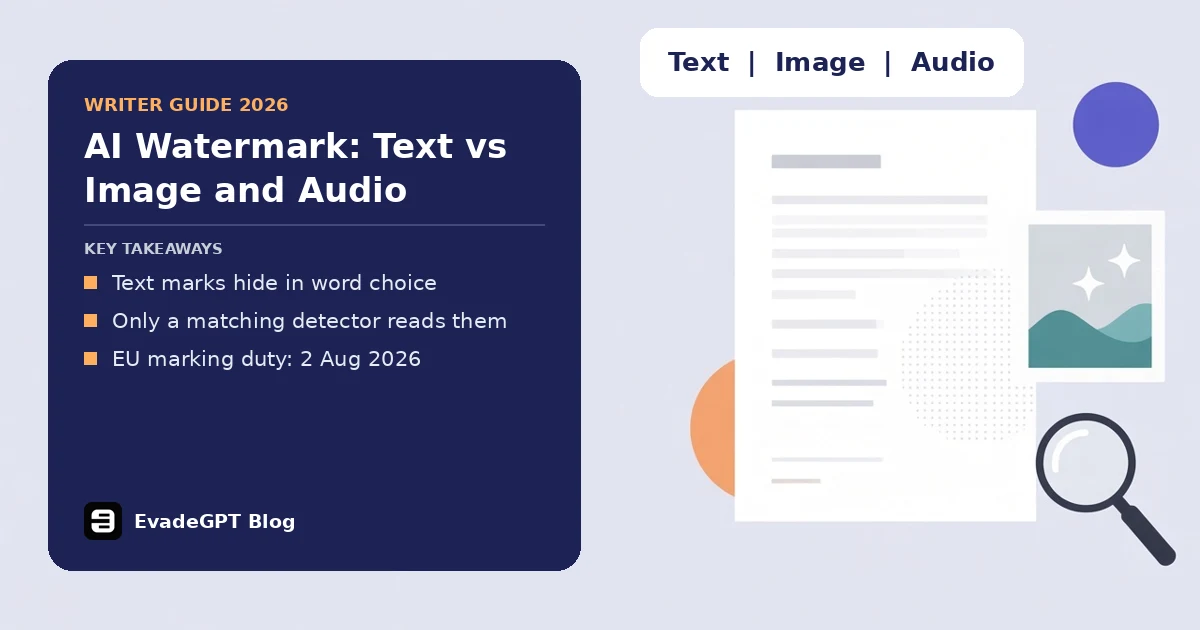
Short answer: an AI watermark is a hidden signal added to AI output so a matching detector can find it later. Images and audio carry it in pixels or sound. Text carries it in word choice, and Google's SynthID Text needs a detector trained for that exact setup. The EU's marking duty began on 2 August 2026.
I spent 17 November 2026 in the Nature paper, Google's SynthID pages, the European Commission's FAQ and the C2PA specification.
How does an AI watermark work in text?
It nudges which words the model picks. In Google's SynthID Text, published in Nature on 23 October 2024, each next word comes from a tournament. In the paper's example with 3 rounds, 8 candidate words are sampled and knocked out in pairs by secret-key scoring functions. Detection scores the finished text against the same functions.
The Nature paper says "longer texts contain more watermarking evidence, and so we have more statistical certainty". A short factual answer, where the model has little choice of words, carries a weak AI watermark.
How are image and audio marks different from text?
They hide in pixels or sound waves rather than in word choice. Google says SynthID adds an invisible mark to AI images and video, and lists 4 edits it should survive: "cropping, adding filters, changing frame rates, or lossy compression".
| Type | Where the mark lives | What the maker says it survives | Where weaker |
|---|---|---|---|
| Text (SynthID Text) | Word choice, as a statistical pattern | Cropping, "modifying a few words, or mild paraphrasing" | Thorough rewrites or translation; factual answers |
| Image, video, audio | Invisible pixel or sound pattern | Cropping, filters, frame rate changes, compression, added noise | Not detailed |
| Signed text credential (C2PA) | Hidden Unicode characters | Copy and paste, by design | Edits that drop the characters |
Can anyone check a text for a hidden mark?
Not in public, as far as I can see. A text watermark can only be read by whoever holds the matching detector, and Google's SynthID Detector invites you to "check if an image, video, or audio file was made with AI from Google or our partners": 3 file types, and no mention of text.
The EU's Code of Practice on AI-generated content, published 10 June 2026, could change that for marked output: signatories "will make available a detection solution" for people including "end-users exposed to the content".
Google's open-source release says each setup "needs to have a detector trained to recognize the mark".
For text from anyone who doesn't mark it, the Nature authors say "other approaches are required, such as post hoc detection", which we cover in how AI detectors work.
Does a missing AI watermark prove text is human?
No. The 2024 Nature paper calls watermarks "complementary to other approaches", not a full answer to detection, and only some tools mark their text at all. Our guide to how to tell if writing is AI covers the other signals people use.
ETH Zurich's SRI Lab reported in December 2024 that SynthID Text was "easier to scrub than other SOTA schemes even for naive adversaries". A detector's percentage is a different thing again, as our roundup of detector accuracy shows.
Does the EU AI Act require AI text to carry a watermark?
Partly. Under Article 50, the AI watermark duty sits with the companies that build AI systems and release them under their own name. From 2 August 2026 their outputs must carry machine-readable marks that can be detected, and systems already on the market before then have until 2 December 2026.
The European Commission's FAQ describes a separate duty for anyone using AI "under their authority, excluding use for personal, non-professional activities", freelancers included. They must "clearly label deepfakes and AI-generated or manipulated text published on matters of public interest without human review or editorial control", and "spell-checking or grammatical correction" doesn't count as review.
The marking duty also "does not apply when the AI system performs an assistive function for standard editing". This isn't legal advice, and I haven't checked how these rules apply outside the EU.
Are content credentials the same as a hidden mark?
No, they're signed metadata. C2PA's specification lets a signed manifest sit inside plain text as hidden Unicode characters "not visually rendered". The method is optional and "remains under review", the spec says. To cite AI properly, see how to cite AI.
What should writers do about AI watermarks?
Go to the source: your own tools and rules, not rumours about invisible characters. I'd follow these 4 steps, none of which needs a detector, and all of which hold up whether your AI tool marks its output or not.
- Search your AI tool's help pages for "watermark", "SynthID" and "content credentials".
- Read your course or publisher AI policy.
- Keep dated drafts and version history.
- Disclose AI use the way your rules ask, with how to prove you didn't use AI as your backup record.
A watermark isn't what trips writers up. Your draft is.
Hidden marks are rarely what lands a writer in trouble. The usual culprit is a detector misreading honest work, or a draft stiff enough to raise eyebrows. Once the EU grace period ends on 2 December 2026, more AI output should carry a machine-readable mark flagging it as AI-generated or manipulated.
What you can shape is the writing. Our custom-trained model checks each draft in the EvadeGPT AI detector, and EvadeGPT helps you smooth robotic patches until it sounds like you. EVE chat can help with the research side. Go on, try it.
FAQ
Does AI text have a hidden watermark?
Some does. Google says it applies AI watermarking to text from its own chat app using SynthID.
Can you see an AI watermark in text?
No. Google's open-source release says the mark is "imperceptible to humans but is visible to a trained model".
Is a hidden-character block the same as a watermark?
No. C2PA's text method is signed metadata in hidden Unicode characters, not a pattern in the wording.
Does AI watermarking survive paraphrasing?
Mild changes, partly. Google says its mark handles "cropping pieces of text, modifying a few words, or mild paraphrasing", but confidence "can be greatly reduced" after a thorough rewrite or translation.
Are image marks the same as text marks?
No. Image marks sit in pixels, while text marks sit in word choice.