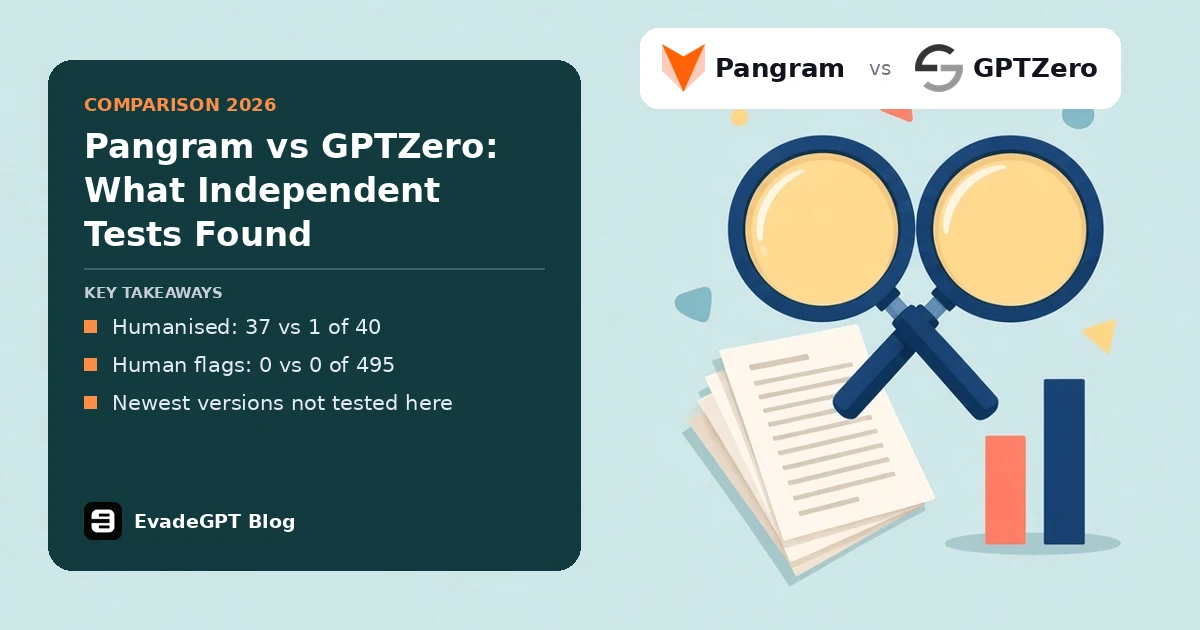
Short answer: in independent Pangram vs GPTZero tests from 2025 and 2026, both rarely flag plain human writing, but Pangram catches far more humanised AI: 37 of 40 humanised papers in one 2026 study, against 1 for GPTZero. GPTZero went easier on human abstracts that AI had only polished, flagging 37.6% to Pangram's 64.4%.
I put four independent studies that ran Pangram and GPTZero on the same texts into one table and re-read the results on 18 November 2026. Pangram catches more AI, and GPTZero is sometimes gentler on edited writing.
Pangram vs GPTZero: what do independent tests show?
Pangram caught more AI text in most of these tests. In a June 2026 study of 40 humanised papers, Pangram caught 37 and GPTZero 1. The 37 of 40 result makes more sense once you know how humanizers rewrite text. In Epoch AI's July 2026 test the gap nearly vanished: 30 against 32 missed style imitations, out of 297.
| Study (Pangram figure first) | Human writing flagged as AI | AI writing |
|---|---|---|
| Epoch AI, July 2026 | 0 of 495 for both | style imitations missed: 30 vs 32 of 297 |
| Van Vlasselaer et al., June 2026 | 0 of 40 for both | humanised papers caught: 37 vs 1 of 40 |
| Karr et al., 2026 | AI-polished human abstracts: 64.4% vs 37.6% | new AI abstracts missed: 2.7% vs 14.9% |
| Russell et al., 2025 | 2.0% vs 0.7% | caught overall: 98.0% vs 85.3% |
Each row used different texts. Epoch also tested Originality.ai, covered in our Originality AI accuracy review.
Which one flags human writing as AI more often?
Neither flags much untouched human writing. Epoch AI saw 0 false flags from Pangram and GPTZero across 495 human passages, and the June 2026 study found the same on 40 human papers. The small gaps run both ways: GPTZero flagged 0.71% of 1,992 human passages in one 2025 study, Pangram 2.0% of human articles in another.
In the Notre Dame study, Pangram flagged 64.4% of AI-polished human abstracts from 2013 to 2015, and GPTZero 37.6%. Our GPTZero false positive guide covers next steps if it flags you, and our GPTZero vs Turnitin comparison helps if your school runs Turnitin.
Which one catches humanised or edited AI text?
Pangram, by a wide margin in most tests. Russell's team found Pangram caught 90.0% of their hardest humanised articles against 46.7% for GPTZero. A 2025 working paper found GPTZero missed around half or more of AI text after one humanizer's rewrite, while Pangram's results stayed largely unaffected.
Still, the Notre Dame team found that "After humanization, more than 96% of AI-labeled rewrites evade Pangram and GPTZero." Our Pangram AI detector review has more.
Why do Pangram and GPTZero disagree on the same text?
Pangram and GPTZero are built differently and label results differently. Epoch describes Pangram as "a trained neural classifier that does not use perplexity", and says GPTZero "relies on perplexity and burstiness". GPTZero's support page says a 75% score means 75% confidence that the whole document is AI.
Epoch counted a Mixed verdict as a miss; counting it as a catch drops the style-imitation miss rates to 6.1% for Pangram and 8.8% for GPTZero. See how AI detectors work and whether AI detectors are accurate.
What do the companies claim about each other?
Pangram and GPTZero each win their own tables. Pangram's January 2026 comparison lists its false positive rate as 0.01% against 1% for GPTZero. GPTZero's October 2026 launch post reruns Epoch AI's benchmark and reports 0.0% false positives for both, with GPTZero 4o missing 2.69% of AI text and Pangram 4 missing 2.86%.
Pangram's page admits "these numbers are not from the same exact documents". GPTZero's 10 November comparison puts GPTZero 5.0b ahead of Pangram 4 on Epoch's set too, 98.82% to 97.14% of AI text detected. None of the four independent tests in my table used Pangram 4, launched on 29 July 2026, or its 4.1 update of 19 October, or GPTZero's newer models: 4o, its default from 20 September, and 5.0b, released on 4 November.
How can you compare Pangram and GPTZero on your own writing?
Use 8 samples of 300 words or more, because GPTZero says its accuracy "increases as more text is submitted". Score each one in Pangram and GPTZero on the same day. Note the label as well as the percentage. I haven't run this set myself.
- 2 pieces you wrote before late 2022.
- The same 2 pieces after an AI tool has only fixed the grammar.
- 2 plain AI drafts on the same topics.
- 2 AI drafts you've reworded by hand.
Watch the grammar-fixed pair, where the Notre Dame study saw the tools split. A third read from the EvadeGPT AI detector helps you spot a quirk. Dated drafts help, as our guide on how to prove you didn't use AI explains.
Stuck between two detectors? Get your own read first
Here's what stings. Pangram flagged 64.4% of human abstracts that AI had only polished in the Notre Dame study, and GPTZero missed 14.9% of fully AI-written ones. Pick either tool and you inherit its blind spot, with no say over which one your teacher or editor opens.
So check the draft yourself first. The EvadeGPT AI detector runs on our custom-trained model, so the read isn't tied to either vendor. Where a section reads flat, the EvadeGPT humanizer helps you put your voice back. For the research, EVE chat can help too. Hit the button and try it today.
FAQ
Is Pangram or GPTZero more accurate?
On AI text, Pangram has the stronger independent record. On plain human writing they're close: both flagged 0 of 495 passages in Epoch AI's test.
Does Pangram flag human writing more than GPTZero?
Sometimes, on edited text. In the Notre Dame study Pangram flagged 64.4% of human abstracts lightly polished by AI, against 37.6% for GPTZero.
Can GPTZero detect humanised AI text?
Not reliably. It caught 1 of 40 humanised papers in a 2026 study.
Which is better for teachers, Pangram or GPTZero?
Pangram catches more AI, while GPTZero has flagged fewer AI-polished human texts. The June 2026 study says the tools "should not be used as sole evidence in high-stakes decision-making".
Has anyone tested the newest Pangram model against the newest GPTZero model?
Not in a peer-reviewed study yet. A small outside check used the previous versions: in Transept's October 2026 translation test, Pangram 4 and GPTZero 4o labelled every translated sample human, even a plain AI translation. GPTZero's own November comparison favours its 5.0b model over Pangram 4.