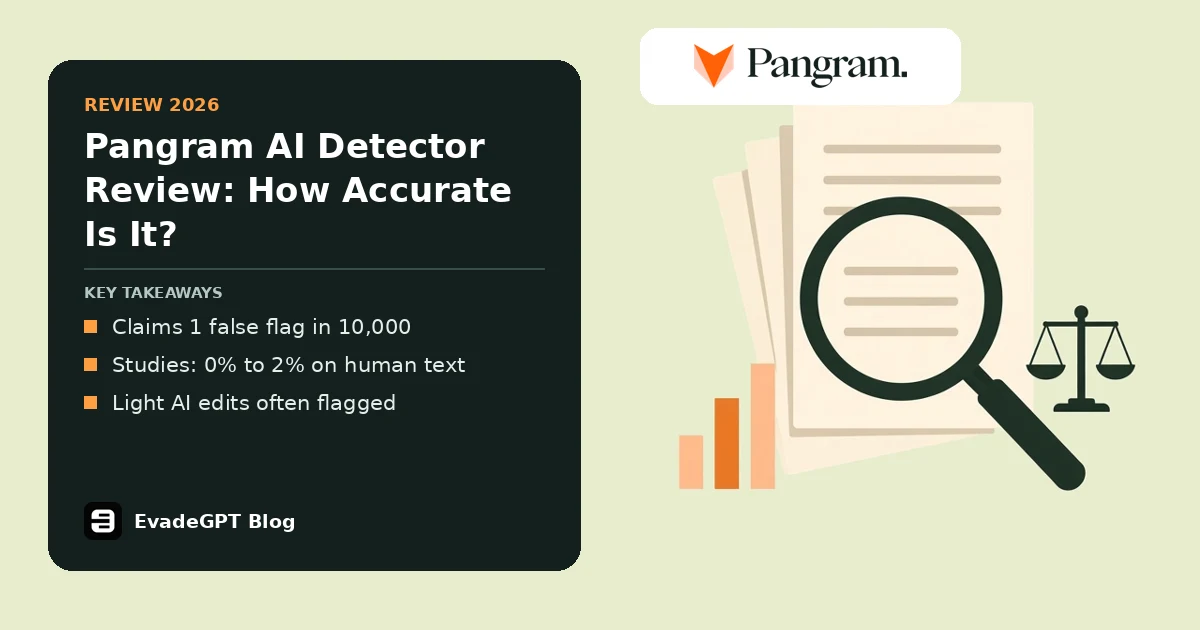
Short answer: on long, unedited text, the Pangram AI detector is the most accurate tool in the independent studies I could find. Pangram claims a 0.009% false positive rate for version 4.1. Four outside tests found 0% to 2% on known human writing, but a 2026 Notre Dame test flagged 64% to 80% of lightly AI-edited abstracts.
I read Pangram's accuracy page, Wired's "gold standard" feature and 4 independent studies, then wrote a fixed test you can rerun. I report no scores of my own. The table shows how Pangram's claims compare with the studies.
| Source | Sample | Human writing flagged | AI or AI-edited text flagged |
|---|---|---|---|
| Pangram 4.1, own benchmark | 1.3 million documents | 0.009% | All but 0.365% |
| Jabarian and Imas 2025 | 1,992 human passages | 0% at thresholds of 0.5 and up | Near-zero misses on longer text |
| Russell et al. 2025 | 300 articles | 2% | 98.0% |
| Van Vlasselaer et al. 2026 | 160 papers | 0 of 40 | 97.5%, counting partial hits |
| Karr et al. 2026 | 642 abstracts | 0% (2013 to 2015) | 64% to 80% of light AI edits |
How accurate is the Pangram AI detector by its own numbers?
Very, on paper. Pangram's accuracy page, dated 16 October 2026, says version 4.1 flagged 0.009% of 781,981 human documents and missed 0.365% of 520,000 AI documents. Its target is 1 false positive in 10,000. It deliberately leans towards misses, because "a false positive can cause real harm."
Wired reported a claimed 0.0041% for the new model, so the figure shifts by source. By type of writing, poetry had Pangram's highest false positive rate, 0.078%.
These figures are vendor benchmarks on Pangram's own data. Its 6 November post says its largest third-party evaluation was "performed over a year ago using Pangram 3."
What did independent tests of Pangram find?
Mostly good news on human writing. Across 4 independent studies from 2025 and 2026, the Pangram AI detector flagged between 0% and 2% of known human texts and missed little plain AI text. The weak spot is editing: one 2026 study found most lightly AI-polished writing flagged as AI.
Brian Jabarian and Alex Imas at Chicago Booth used 1,992 human passages from before 2020. Pangram "achieves essentially zero FPRs and FNRs" on medium to long passages (NBER). Jenna Russell's team found it caught 98.0% of 300 articles with 2% false positives (ACL 2025).
Marijke Van Vlasselaer's Brussels team found the Pangram AI detector flagged none of 40 human papers by graduate students writing in a second language before 2019 (IJEI). The authors declare no connection with any tool tested.
Jonathan Karr Jr's Notre Dame team scored 642 published abstracts with Pangram 3.2 (arXiv). It flagged 0% from 2013 to 2015 and 14.9% from 2023 to 2025, though those aren't confirmed false positives. Light AI refinement was flagged 64.4% and 80.1% of the time, depending on the period.
Results on humanised text split: 2 studies found Pangram's AI detector held up, but Karr's team found under 4% of AI rewrites still flagged after one commercial humanizer. Our roundup of whether AI detectors are accurate covers older studies. Set against GPTZero, Pangram caught 37 of 40 humanised papers to GPTZero's 1 in a 2026 study, as our Pangram vs GPTZero comparison details.
Is Pangram as accurate as Turnitin?
In the one study that tested both, the Pangram AI detector did far better on AI text. Van Vlasselaer's team found both tools cleared all 40 human papers. Turnitin scored every one of the 40 fully AI papers between 0% and 20%, while Pangram caught 97.5% counting partial hits and placed 37 of 40 hybrid papers correctly.
Turnitin managed 60% on hybrid papers and 50% on humanised ones. What surprised me: Turnitin did worse on fully AI papers than on hybrid ones, which the authors link to the newer AI model behind them. The AI papers date from May 2025, and the authors call their results valid "only for a specific snapshot in time." Both tools plug into Canvas, as our guide to whether Canvas can detect AI explains, and our Turnitin false positive guide covers Turnitin's side.
How does Pangram detect AI?
With a trained classifier, not a perplexity score. Pangram's 2024 technical report, by co-founders Bradley Emi and Max Spero, pairs human texts with close AI copies and retrains on its own mistakes. The classifier returns 1 of 3 predictions, human, AI or AI-assisted, for each part of a document.
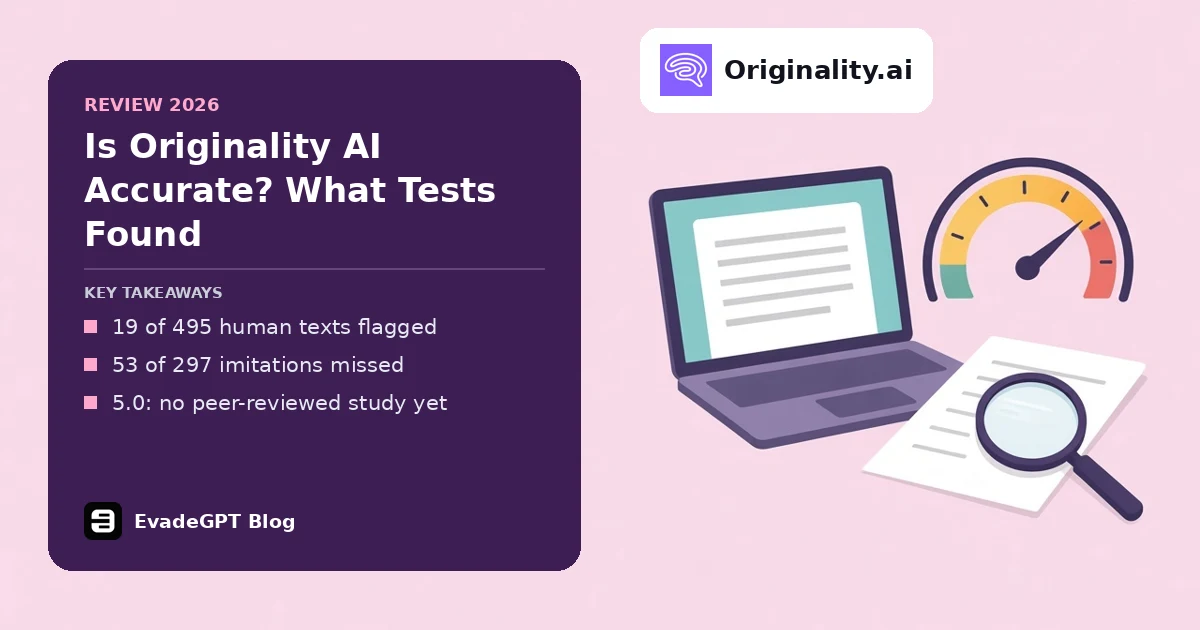
Pangram's AI detector "only looks at the content of the text submitted," its FAQ says, so a score says nothing about your drafts. Our explainer on how AI detectors work compares other tools, and our guide to spotting AI writing covers the tells readers look for. Pangram and Originality.ai were compared on the same 495 human passages in a 2026 test, which our Originality AI accuracy guide walks through.
Where does the Pangram AI detector get it wrong?
On edited, short and out-of-scope text. By Pangram's own benchmark, 41.37% of human essays with substantial AI edits still came back human-written, not AI-assisted. It needs 50 words of prose, and its false positive rate on 50 to 99 words, 0.02%, is more than double the 100 to 249 word rate.
Pangram lists 7 kinds of text as out of scope, including machine translations, reference lists and poetry. It says PDF results "should always be double-checked". Karr's team found Pangram flagged 26.6% of recent theology abstracts against 2.1% in chemistry.
Is Wired's gold standard label backed by evidence?
Partly. Lexi Pandell's 2 September 2026 Wired feature paired the label with a question, "Should You Trust It?", and the evidence fits. 3 of 4 independent studies ranked Pangram's AI detector first among the tools they tested, but none I found tested version 4.1, and Pangram's own November post asks for new outside tests.
Independence is the other gap. Wired reports that researcher Tuhin Chakrabarty is close friends with Spero and gets research access. Imas is quoted on Pangram's homepage, and Karr's team thanks Pangram "for the use of their API".
How can you test the Pangram AI detector yourself?
Run a fixed set of 12 samples so your result lines up with the studies above. I haven't run it, so no scores appear here. Use plain text rather than PDFs, and keep every sample above 300 words of prose, since Pangram says longer text gives better predictions.
- Pick 4 pieces you wrote before late 2022.
- Strip headings, reference lists and tables.
- Ask an AI tool for 4 pieces on the same topics.
- Ask it to lightly polish your 4 human pieces.
- Scan all 12 in the Pangram AI detector one at a time, recording the label and percentage.
- Rescan 1 human piece inside a longer document.
- Note the date and version, and rerun after each release.
A human piece labelled AI or AI-assisted is a false positive. An AI piece labelled human is a miss.
Is Pangram a reliable AI detector for your coursework?
Reliable as a lead, not as proof. Both 2026 academic teams warn against using a score alone: Van Vlasselaer's team says tools "should not be used as sole evidence in high-stakes decision-making," and Karr's team says scores "should not serve as standalone misconduct evidence." Pangram is also sold to recruiters, which our look at AI checks in hiring puts in context.
Older detectors flagged writers whose first language isn't English far more often (Liang et al. 2023), a study that predates Pangram. If the Pangram AI detector flags your work, follow our steps on how to prove you didn't use AI.
FAQ
Is the Pangram AI detector accurate on human writing?
Mostly. Independent tests found it flagged 0% to 2% of known human texts.
Can the Pangram AI detector spot AI-edited writing?
Inconsistently. Pangram's own benchmark called 41.37% of heavily AI-edited essays human, yet Karr's team saw most light AI polish flagged.
Does Pangram work on short text?
It needs at least 50 words, and accuracy improves as text gets longer.
What languages does Pangram check?
More than 20, including Spanish, Arabic, Chinese and Hindi.
Is pangramaidetector.com Pangram's own site?
Nothing on it says so. Its footer reads "© 2026 pangramaidetector" and it never links to pangram.com.