Short answer: only partly. In 6 published studies from 2023 to 2026, the best commercial tools rarely flagged human writing, but detectors missed far more AI text once it was edited. Error rates ran from under 1% to over 60%, depending on the tool, the year and the writing.
I read 6 studies on AI detector accuracy and set their results side by side. For how the tools score text, see how AI detectors work.
Are AI detectors accurate in published studies?
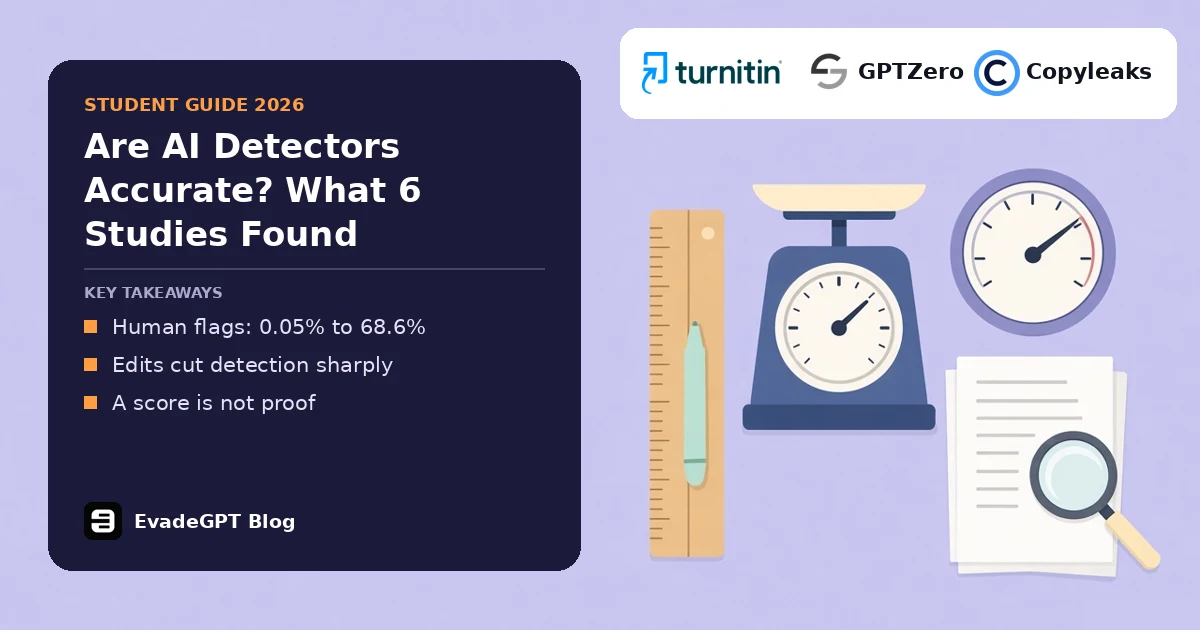
It depends on which error you measure. Across the 6 studies below, human text wrongly flagged as AI ranged from 0.05% to 68.6%, and AI text missed ranged from 0.3% to 99.6%. Newer commercial tools did best on unedited text, and none stayed reliable once it was reworded.
| Study | What was tested | Human text flagged as AI | AI text result |
|---|---|---|---|
| Weber-Wulff et al. 2023 | 14 tools, 54 documents | 2.4% average, 11.1% if machine-translated | About 20% missed, about 50% after edits |
| Liang et al. 2023 | 7 tools, 91 TOEFL and 88 US essays | 61.3% average on TOEFL essays | Not the focus |
| Perkins et al. 2024 | 7 tools, 114 samples, 805 tests | Only 67% of human tests correct | 39.5% accuracy, 22.14% after edits |
| Jabarian and Imas 2025 | 4 tools, 1,992 human passages | Under 1% for the 3 commercial tools | Pangram and GPTZero missed under 4%, Originality.ai up to 42.4% |
| Kramer and Javorková 2026 | Turnitin, 100 psychology introductions | 1% | Misses "substantially higher" |
| Layton et al. 2026 | 5 popular detectors, 6,295 security papers | 0.05% to 68.6% | 0.3% to 99.6% missed |
Debora Weber-Wulff's team called the 14 tools "neither accurate nor reliable" (IJEI). Weixin Liang's team found 7 detectors flagged TOEFL essays 61.3% of the time (Patterns). The best commercial AI detectors are accurate on human writing: Pangram flagged 1% or less in Jabarian and Imas's test. See our Turnitin and ZeroGPT false positive guides.
How often do AI detectors miss AI text?
Less often than students assume. Weber-Wulff's team estimated "approximately 20% of AI-generated texts would likely be misattributed to humans." In Mike Perkins's 2023 tests, 6 of 7 detectors missed over half the AI samples, and even the strongest, Copyleaks, missed 39%.
Jabarian and Imas found Pangram and GPTZero missed under 4% of AI passages and Originality.ai up to 42.4% (NBER). Kramer and Javorková found Turnitin flagged 1% of human texts, but its misses were "substantially higher" (Open Information Science).
Weber-Wulff's team found a "main bias towards classifying the output as human-written", so fewer false accusations means more missed AI.
Are AI detectors accurate after paraphrasing or editing?
Mostly not. In Weber-Wulff's tests, overall accuracy fell from 74% on unedited AI text to 42% after human edits and 26% after machine paraphrase. In Perkins's 2024 study, average accuracy dropped to 22.14% after simple changes, and Turnitin fell furthest, by 42.1%.
On reworded text, AI detector accuracy falls sharply. In Perkins's tests, spelling errors made text "almost undetectable," but it would "very likely receive poor marks." RAID found "current detectors are easily fooled by adversarial attacks." See also can Turnitin detect AI humanizers.
Have AI detectors improved since 2023?
They're better than in 2023, but not settled. In 2023 no tool Weber-Wulff tested reached 80%, and none in Perkins's study beat 73.9% on unedited text. By 2025 and 2026, the best commercial tools kept human false positives near 1% or below, yet misses still rose on newer AI writing.
In 2026, Seth Layton's team asked for "more complex vocabulary" and saw detection fall "from 94.2 % to 2.5 %" (IEEE paper). Perkins's team warned that "our results are valid only for a specific snapshot in time," so any AI detector accuracy figure holds only for the version and year tested.
Are AI detectors accurate on short or non-English text?
Less so. The 3 commercial tools Jabarian and Imas tested "lost accuracy on passages under 50 words," says the Chicago Booth Review, and Turnitin's AI Writing Report guide needs 300 words of prose. Weber-Wulff's team saw accuracy drop by 20% when human text was machine-translated into English.
Translation also lifted false accusations from 2.4% to 11.1%. If English is your second language, Liang's result is a reason for caution, and our Copyleaks false positive guide covers Spanish tests.
What do accuracy studies mean for your writing?
A score is a hint, not proof. All 6 studies found real errors, and Turnitin says its report "should not be used as the sole basis for adverse actions against a student." If flagged, your drafts, notes and version history count for more than any single percentage.
Tools often disagree (GPTZero vs Turnitin). Keep dated drafts, and see how to prove you didn't use AI if flagged.
How can you test a detector on your own writing?
Check AI detector accuracy on your own work first. I can't score your essay, so this page shows no invented results. The 4 steps below use your own older writing as a baseline, showing how a detector reads your normal style.
- Scan 300 or more words you wrote before 2022.
- Scan your draft in 2 detectors and note where they disagree.
- Check each flagged section runs past 50 words.
- Rewrite flagged lines in your own voice, using our GPTZero false positive guide for GPTZero.
FAQ
Are AI detectors accurate enough to prove cheating?
No. Error rates in 6 studies ran from under 1% to over 60%, and Turnitin says its report shouldn't be "the sole basis for adverse actions."
Are AI detectors accurate on human writing?
The best commercial tools usually are, at under 1% false positives, but Layton's team saw up to 68.6% across 5 detectors.
Are AI detectors accurate for non-native English writers?
Less so. Liang et al. found a 61.3% average false positive rate on TOEFL essays.
Which AI detector is most accurate?
Turnitin topped Weber-Wulff's 2023 test, Copyleaks led Perkins's, and Pangram led Jabarian and Imas's 2025 test.
Why do AI detectors give different scores for the same text?
Each tool is trained and tuned differently, so one essay can score high in one and low in another.