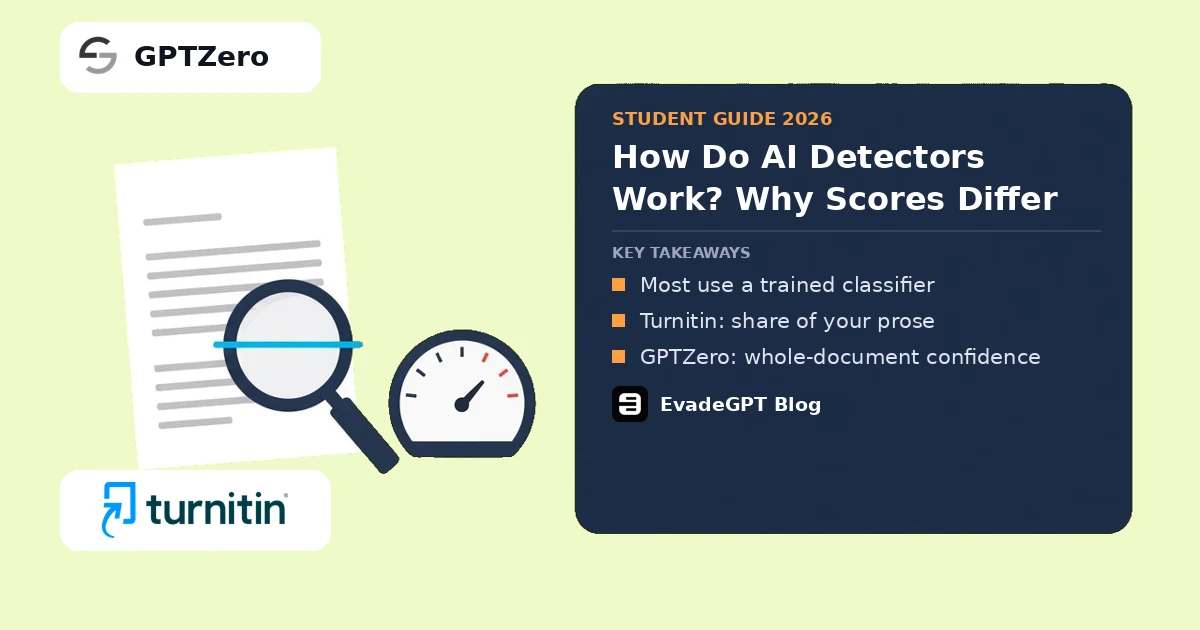
Short answer: How do AI detectors work in 2026? Most run a trained classifier that compares your text with human and AI examples and predicts which it resembles. Turnitin scores each sentence from 0 to 1 and reports the share of your prose it flags. GPTZero reports its confidence about the whole document, so one number can mean 2 things.
If you searched "how do AI detectors work" after a flag, start with what each tool scores. I read each vendor's own documents first.
| Detector | How it scores | What its percentage means |
|---|---|---|
| Turnitin | Transformer scoring each sentence from 0 to 1 | Share of qualifying prose predicted as AI |
| GPTZero | Deep-learning classifier since autumn 2023 | Confidence about the whole document |
| Pangram | Classifier trained on human texts paired with AI copies | A prediction for the whole text |
| Early perplexity tools | How predictable each word is to a language model | Even, predictable wording reads as AI |
How do AI detectors work at the word level?
The first generation measured predictability. Perplexity is how surprised a language model is by each next word, and burstiness, in GPTZero's words, "is a measure of how much the perplexity varies over the entire document." Its old guidance: "a perplexity above 85 is more likely than not from a human source."
GPTZero dropped both in autumn 2023. Pangram explains the flaw: the Declaration of Independence appears so often in training data that every word looks predictable, so perplexity tools call it AI.
Weixin Liang, Mert Yuksekgonul, Yining Mao, Eric Wu and James Zou ran 91 TOEFL essays by non-native English writers through 7 detectors in 2023. The average false positive rate was 61.3%, and richer word choice cut it to 11.6%.
How do AI detectors work when they use a trained classifier?
Modern tools learn from labelled examples. Turnitin's October 2026 white paper says its transformer is "not explicitly programmed to evaluate specific signals such as 'burstiness,' 'perplexity'" and beats simpler models that rely "primarily on hand-curated measures that do not capture many higher order deviations." It gives each sentence a score from 0 to 1.
GPTZero's 2026 technical report, by George Alexandru Adam, Edward Tian and colleagues, sorts text into Human, AI or Mixed, at document and sentence level.
Pangram's technical report, by co-founders Bradley Emi and Max Spero, describes "hard negative mining with synthetic mirrors": write AI doubles of human texts the model gets wrong, then retrain.
Why do AI detectors give different results?
Each tool answers a different question. "A score of '75% AI' means our model is 75% confident the entire document was written by AI," GPTZero's help centre says. A Turnitin score of 40% means 40% of your qualifying sentences were predicted as AI.
Turnitin's AI Writing Report guide says it skips bulleted lists and tables. It hides scores from 1% to 19%, while GPTZero calls 40% to 70% not enough for a confident classification. Pangram adds that "a detector calibrated on one generator produces inaccurate results on another."
Can AI detectors detect paraphrasing?
Sometimes. In 2023, Kalpesh Krishna, Yixiao Song, Marzena Karpinska, John Wieting and Mohit Iyyer showed their DIPPER paraphraser drops the academic detector DetectGPT's accuracy "from 70.3% to 4.6% (at a constant false positive rate of 1%)". Across 14 tools, Debora Weber-Wulff, Tomáš Foltýnek and 6 co-authors found 26% accuracy on machine-paraphrased AI text.
Turnitin's AI Writing Report guide says its English detector also flags AI text changed by bypasser tools and word spinners, but its Spanish and Japanese detectors don't. If your question is "how do AI detectors work on reworded text?", read can Turnitin detect AI humanizers and does Turnitin detect QuillBot.
Is 20% AI detection bad?
Not on its own. 20% is where Turnitin starts showing a number, because its AI Writing Report guide says testing found "a higher incidence of false positives" below it. Its white paper labels a document AI only when 20% or more of its sentences are flagged, with thresholds set to keep the document false positive rate below 1%.
The "30% rule" has no official source. BGR says it "is not defined by Turnitin, but rather a common interpretation."
How do AI detectors work on your own writing?
I can't run Turnitin on your essay, so no score here is invented. Try this 4-step test a week before a deadline and keep dated screenshots, since a record made before any flag carries more weight than one made after it.
- Scan 300 words you wrote before 2022 in 2 detectors.
- Read the highlighted sentences in your draft, using our GPTZero false positive guide.
- Keep 300 words of paragraphs, since Turnitin skips lists (Turnitin false positive guide).
- Rewrite only flagged lines in your own words, then stop.
Our GPTZero vs Turnitin comparison shows how 2 tools differ, and how to prove you didn't use AI helps if you're flagged.
FAQ
How do AI detectors work out a percentage?
Turnitin gives the share of prose sentences predicted as AI. GPTZero gives its confidence that the whole document is Human, AI or Mixed.
How do AI detectors work differently from plagiarism checkers?
A plagiarism check finds matching text. An AI detector predicts from writing patterns, so neither GPTZero nor Turnitin treats it as proof.
How do AI detectors work on short answers?
Poorly. Turnitin needs 300 words of prose, and Pangram says more words give a more precise prediction.
What is the 30% rule for AI?
An informal rule that work should score under 30% AI. Turnitin doesn't define it, and GPTZero's guides set no such line.
How do AI detectors work in a misconduct case?
As a reason to look closer, not proof. Turnitin says its report "should not be used as the sole basis for adverse actions against a student," and GPTZero agrees.