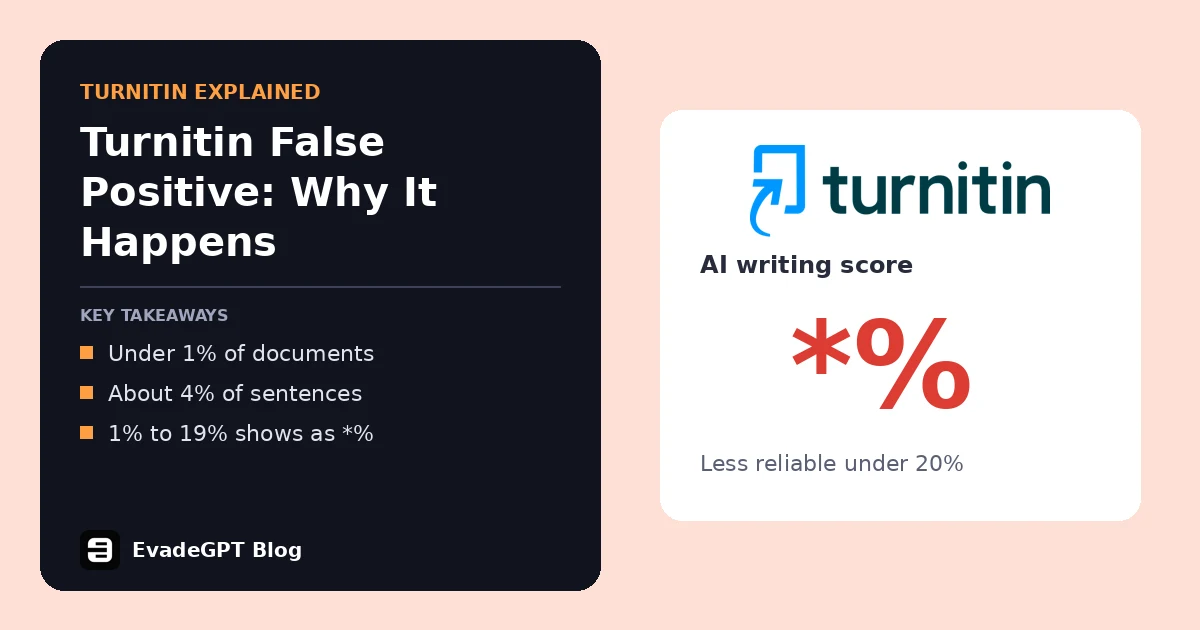
Short answer: A Turnitin false positive is when human writing gets labelled as AI. Turnitin says it happens in under 1% of documents and around 4% of highlighted sentences. Scores from 1% to 19% now show only as *% because they are less reliable.
How often does a Turnitin false positive happen?
Turnitin publishes 2 rates. Its document-level false positive rate is under 1% for documents with 20% or more AI writing, and its sentence-level rate is around 4%. A Turnitin false positive is rare per essay, but across a big cohort it still lands on real students.
Turnitin tested 800,000 academic papers written before AI chatbots went mainstream to check those numbers (Turnitin). Its own chief product officer wrote that "behind each false positive instance is a real student". At under 1 in 100, a unit of 300 students could see up to about 3 honest essays flagged.
What does the *% asterisk mean?
The asterisk means Turnitin found some AI-like text but less than 20%, so it hides the number. Since 8 July 2024, scores between 1% and 19% show as *% with no highlights, because Turnitin found a higher false positive rate in that range (Turnitin).
An asterisk is a reliability warning, not an accusation. Turnitin also raised its minimum length from 150 to 300 words for the same reason, since short texts give the model less to judge. Turnitin scores each sentence from 0 to 1 before it reports a percentage, and our explainer on how AI detectors work shows why that differs from other tools.
Which writing triggers a Turnitin false positive?
Predictable writing triggers most flags, and 4 patterns come up again and again. Formulaic structure, grammar tool polishing, non-native English writing (Liang et al. 2023) and mixed documents all raise the odds of a Turnitin false positive, because detectors reward variety and penalise smooth, even phrasing.
| Pattern | Why it scores as AI |
|---|---|
| Five paragraph essay structure | Highly predictable shape and transitions |
| Heavy grammar tool edits | Smooths out natural variation |
| Non-native English writing | Simpler, more regular word choice |
| Mixed human and AI text | Flags spill into nearby human sentences |
Turnitin found that 54% of wrongly flagged sentences sit right next to actual AI writing (Turnitin). If you used AI for a single paragraph, nearby sentences you wrote can be caught too. Our guide to humanizers versus paraphrasers explains how rewrite tools change a score.
Some schools run Copyleaks instead of Turnitin, and a Copyleaks false positive shows up in different kinds of writing.
Is a Turnitin AI score proof of cheating?
No, and Turnitin says so in 1 clear line. Its report guide states the AI score "should not be used as the sole basis for adverse actions against a student". A Turnitin false positive should start a conversation with your marker, not end with a penalty.
Independent research backs this up. A Springer study tested 14 AI detectors and found none above 80% accuracy. Our GPTZero vs Turnitin comparison shows how the 2 detectors differ on the same text.
Many markers run a second check in GPTZero, and a GPTZero false positive follows different rules.
What should you do after a Turnitin false positive?
Act quickly, ideally before the marking deadline, and take 2 steps. Ask which sentences were highlighted and request a meeting. Then gather your process evidence before it. After a Turnitin false positive, stay polite and specific, and reply in writing so there is a record.
Your strongest evidence is version history, notes and drafts. We walk through each one, plus what to say in the meeting, in how to prove you didn't use AI. Quote Turnitin's own guidance on the sole basis rule, and check your university's appeal policy before you accept any outcome.
How can you lower the risk before you submit?
Run your own check about 1 day before the deadline, while there is still time to revise. Read any flagged sentence aloud. Then add a specific example or source, or vary sentence length. Small edits in your own voice usually beat a full rewrite.
The EvadeGPT humanizer has a built-in AI detector, so you can see which lines read as machine-written and fix them yourself. For hands-on editing tips, see our writing with AI guide. Keep a dated screenshot of the result with your version history.
FAQ
How common is a Turnitin false positive?
Turnitin says under 1% of documents with 20% or more AI writing and around 4% of highlighted sentences.
Why does Turnitin show *% instead of a score?
Scores from 1% to 19% show as *% with no highlights, because Turnitin found false positives more likely in that range.
Can I be penalised for a Turnitin false positive?
Turnitin says its AI score should not be the sole basis for adverse action, so ask for the full evidence and use your appeal rights.
Does Grammarly cause a Turnitin false positive?
Heavy grammar tool edits can smooth out natural variation, which can raise an AI score. Light spelling fixes are less likely to matter.
How long does an essay need to be for Turnitin AI detection?
Turnitin raised its minimum from 150 to 300 words, because short texts give the model too little to judge.