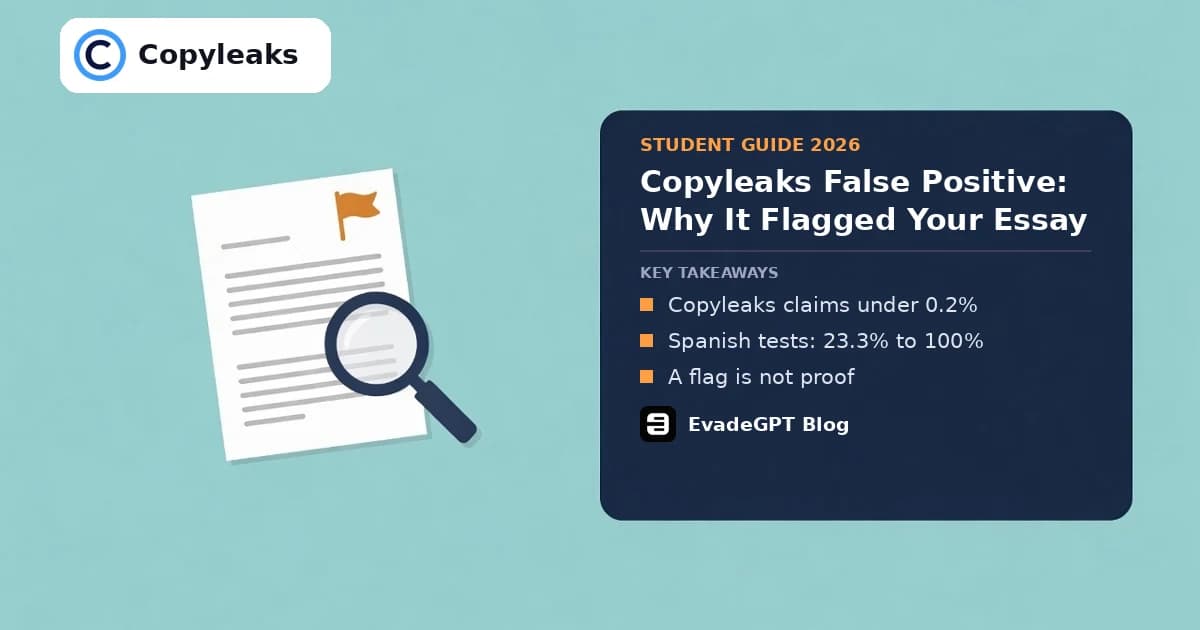
Short answer: A Copyleaks false positive is when writing you did yourself is labelled AI. Copyleaks advertises a .03% false positive rate, and its own FAQ says less than 0.2%. Independent tests found 0 of 42 human essays flagged in 2023, but 7 of 30 human Spanish texts (23.3%) in 2025. A flag is a signal, not proof.
How often does a Copyleaks false positive happen?
Copyleaks quotes 2 different figures, and independent tests swing far more widely. Its AI detector page claims "an industry-low .03% false positive rate", while its AI Detector FAQs from June 2025 say less than 0.2%. Here is every figure we could verify.
| Source | Human writing tested | Copyleaks false positives |
|---|---|---|
| Copyleaks detector page | Its own testing | .03% |
| Copyleaks FAQs, June 2025 | Its own testing | Less than 0.2% |
| Walters 2023 | 42 first-year composition essays | 0 of 42 |
| Chaka 2024 | 40 English L1 and L2 university essays | 0 of 40 |
| Orenstrakh et al. 2023 | 114 English computer science submissions | 1 of 114 |
| Orenstrakh et al. 2023 | 10 Spanish thesis submissions | 10 of 10 |
| Bloomberg 2024 | 500 application essays, Copyleaks and GPTZero | 1% to 2% across both tools |
| Queralt et al. 2025 | 30 Spanish texts written before generative AI | 7 of 30 (23.3%) |
On English student essays, Copyleaks has a strong record. In his 2023 study at Manhattan College, William H. Walters found Copyleaks and Turnitin were the only 2 of 16 detectors to label all 126 documents correctly. Chaka Chaka's 2024 test of 30 detectors found only Copyleaks and Undetectable AI read all 40 essays as human-written. A Copyleaks false positive is more likely in the cases those tests left out.
Why does Copyleaks flag human writing?
Copyleaks reads statistical patterns, so anything that changes those patterns can tip a score into a Copyleaks false positive. Its June 2025 FAQs list 2 common triggers when a student says no AI was used: translation tools that rewrite whole passages, and writing assistants that offer rewriting, auto-complete or paraphrasing features. Simple spelling fixes usually don't trigger it.
The same document admits that length and form matter. "For best results, we recommend scanning text that's at least 350 words," the Copyleaks FAQs say, and poems, song lyrics and highly stylised writing are harder to classify. Copyleaks' web platform accepts as little as 255 characters, so a short answer can be scanned well below the length its own team recommends. Copyleaks is one of many tools that read statistical patterns, and our AI detector explainer walks through how those patterns become a score.
Is a Copyleaks false positive more likely in another language?
The evidence says yes, at least for Spanish. Copyleaks' FAQs claim 99.85% accuracy on human Spanish text and note that English yields its highest accuracy. Two independent studies of Spanish writing found a Copyleaks false positive far more often than that, which is the biggest gap between the vendor's claims and outside testing.
The first is the 2023 study Copyleaks cites as evidence of its accuracy. Michael Sheinman Orenstrakh, Oscar Karnalim, Carlos Aníbal Suárez and Michael Liut ran 8 detectors on student work collected from 2016 to 2018, long before AI chatbots. Copyleaks wrongly flagged only 1 of 114 English submissions. On the 10 human-written Spanish thesis submissions, its accuracy was 0.00%, meaning every one was marked as AI.
The second came in September 2025. Sheila Queralt and colleagues tested 30 Spanish texts written before generative AI existed and found a Copyleaks false positive rate of 23.3%, or 7 of 30. GPTZero flagged 3.3% of the same texts and Originality.ai flagged 10%. The authors noted the gap between the advertised 99% accuracy and what they observed.
What should you do if Copyleaks flagged your essay?
Start with Copyleaks' own position, because it supports you. In a 2024 Bloomberg Businessweek investigation, Copyleaks CEO Alon Yamin described a flag as a reason for teachers to look closer and talk with the student. Its FAQs say the detector works best alongside human judgment.
Bloomberg's own test shows why a Copyleaks false positive matters at scale. Reporters ran 500 Texas A&M application essays from summer 2022 through Copyleaks and GPTZero, and the tools falsely flagged 1% to 2% of them, some with near-total certainty. At a large uni, even 1% of essays becomes dozens of students.
If a Copyleaks false positive lands on your work, ask your marker which sentences were highlighted and what score triggered concern. Then bring evidence: version history, notes, outlines and earlier drafts. Our guide on how to prove you didn't use AI walks through each one. Mention any translator or rewriting tool you used, since Copyleaks names both as triggers.
How can you test for a Copyleaks false positive yourself?
Run a 4-step check a few days before the deadline. It shows how Copyleaks reads your natural style and gives you a dated record if a Copyleaks false positive lands on your work later. Keep each screenshot with the date showing, because a record made before any accusation carries more weight.
- Scan at least 350 words you wrote before 2022, such as an old assignment. If Copyleaks flags that, you have seen its error on your own style.
- Scan your current draft in full and note the highlighted sentences, not just the headline result.
- Compare with a second detector. Our GPTZero false positive guide and ZeroGPT false positive guide explain why scores differ between tools.
- Rewrite only the highlighted lines with your own examples and varied sentence length, then stop.
If your school also runs Turnitin, our Turnitin false positive guide covers its rules, and our GPTZero vs Turnitin comparison shows how 2 detectors read the same work differently.
FAQ
What is the Copyleaks false positive rate?
Copyleaks advertises .03% on its detector page and less than 0.2% in its June 2025 FAQs. Independent tests range from 0 of 42 English essays in 2023 to all 10 human Spanish thesis submissions in another 2023 study.
Does Copyleaks give false positives on English essays?
Rarely, in published tests. Walters found 0 false positives on 42 composition essays, Chaka found none on 40 university essays, and Orenstrakh's team found 1 in 114 computer science submissions.
Why did Copyleaks flag my essay when I wrote it?
Copyleaks says translators and rewriting or paraphrasing features can trigger it, and that short or highly stylised text is harder to classify. It recommends at least 350 words for reliable results.
Is a Copyleaks false positive proof that I cheated?
No. Copyleaks' CEO has described a flag as a reason to talk with the student, and its FAQs say results work best with human judgment. Drafts and version history are far stronger evidence.
Is Copyleaks AI detection wrong more often in Spanish?
The studies so far say yes. Copyleaks flagged all 10 human Spanish thesis submissions in a 2023 study and 7 of 30 Spanish human texts in a 2025 study, well above its English results.