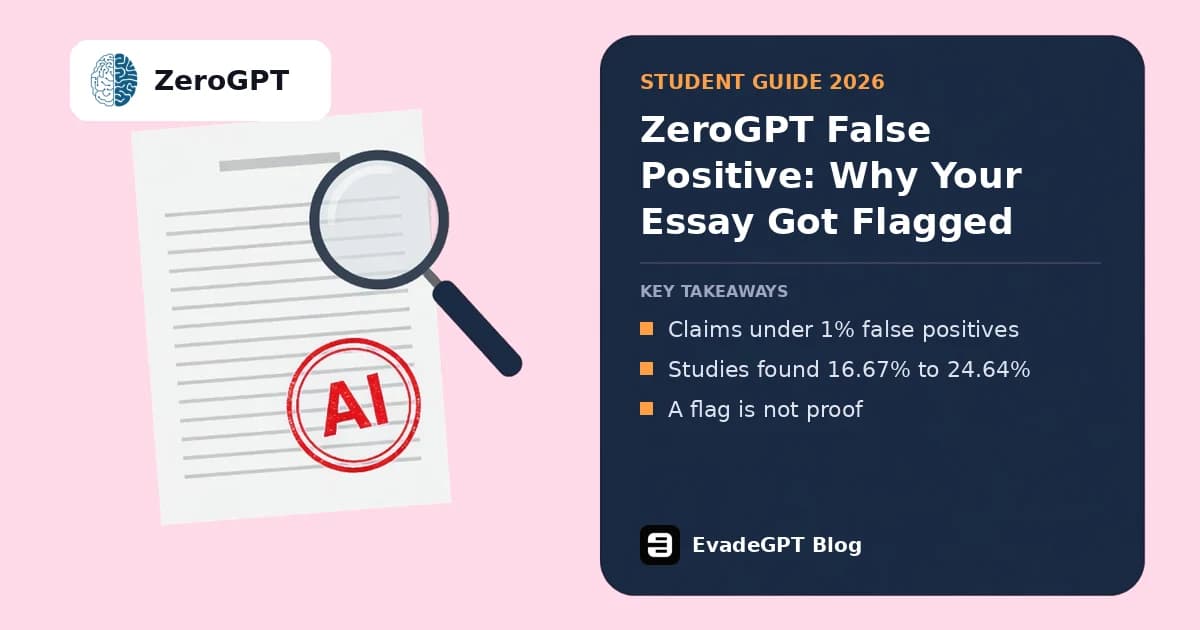
Short answer: A ZeroGPT false positive is when writing you did yourself comes back as AI. ZeroGPT's homepage claims a false positive rate under 1%, but independent tests on human writing found rates of 16.67% and 24.64%. One study saw it get only 47.2% of human texts right. A flag is a guess, not proof.
How often does a ZeroGPT false positive happen?
Far more often than the homepage suggests. ZeroGPT advertises "98.4% Detection accuracy" and a "<1% False positive rate" on zerogpt.com. Four independent studies tested it on writing with a known human author, and none came close to that figure. Here is what each one measured.
| Study | Human writing tested | What ZeroGPT did |
|---|---|---|
| Zhou 2023, IEEE URTC | Human-written samples | Classified 47.2% of them correctly |
| Weichert and Dimobi 2024 | Student papers from 2004 to 2009 | 24.64% false positive rate |
| Pratama 2025, PeerJ | Human scholarly abstracts | 16.67% false positive rate |
| Liang et al. 2023 | 91 TOEFL essays, 7 detectors | 61.3% average false positive rate across all 7 |
The 2004 to 2009 papers matter most. They were written years before AI chatbots existed, so every flag in that set is a ZeroGPT false positive by definition. The authors wrote that ZeroGPT and a watermarking method left "at least one in every five human texts being misclassified as an AI-generated text".
GPTZero is a different detector with different error rates, so read our GPTZero false positive guide if that is the tool that flagged you.
Why does ZeroGPT flag human writing?
ZeroGPT leans on predictability. In the 2024 DUPE study (Weichert and Dimobi), ZeroGPT's AI score tracked text perplexity with a correlation of -0.60, so the more predictable your wording, the higher your score. Clear, tidy, well-edited prose is exactly what scores as low perplexity.
ZeroGPT's own FAQ admits it: "Highly polished, formulaic, or low-entropy writing can resemble AI." For the mechanics behind these flags, from perplexity to trained classifiers, read how do AI detectors work.
Famous text trips it too. In July 2023, Ars Technica showed ZeroGPT reading part of the US Constitution and replying "Your text is AI/GPT Generated".
If a Copyleaks scan flagged you instead, our Copyleaks false positive guide compares its claims with independent tests.
Which essays are most likely to get a ZeroGPT false positive?
Your subject matters more than most students expect. In the DUPE study, ZeroGPT wrongly flagged 3.70% of English papers but 39.39% of Philosophy papers, with Biology at 31.91% and Political Science at 23.53%. Same detector, same pre-AI era, roughly ten times the risk.
A few other patterns raise the odds:
- Non-native English writing. Across 7 detectors including ZeroGPT, Liang et al. found an average 61.3% false positive rate on TOEFL essays.
- Short answers. ZeroGPT's FAQ recommends at least 150 to 200 words for its best results.
- Formulaic structure. Template essays, lab reports and method sections all read as predictable.
- Heavy grammar tool polishing. It smooths out the variation detectors look for.
It isn't only an ESL problem, though. Pratama's 2025 study found ZeroGPT's false positive rate was higher for native authors (19.44%) than non-native ones (13.89%).
Can a teacher fail you for a ZeroGPT false positive?
A ZeroGPT score alone is weak evidence, and ZeroGPT's FAQ tells users to "review the highlighted passages alongside the overall score". If your marker used it, ask which 2 or 3 sentences were highlighted and why those lines worried them. Stay polite, and reply in writing so there's a record.
Then bring proof of how you wrote it. Version history, notes and early drafts carry far more weight than any score, and we cover each one in how to prove you didn't use AI. If your uni also runs Turnitin, our Turnitin false positive guide explains its separate rules.
How can you test for a ZeroGPT false positive yourself?
Run a 4-step check a day or two before you hand anything in. It takes the guesswork out of a single score and gives you something concrete to show your marker if a ZeroGPT false positive ever lands on your work.
- Paste in 200+ words you wrote before 2022, such as an old assignment. If ZeroGPT flags that, you've seen its error rate on your own style.
- Check your current draft and note which sentences turn up highlighted.
- Run the same draft through a second detector. Our GPTZero vs Turnitin breakdown shows why scores differ between tools.
- Rewrite only the highlighted lines with your own examples and varied sentence length, then check again.
FAQ
Does ZeroGPT give false positives?
Yes. Independent studies found ZeroGPT false positive rates of 16.67% on human abstracts and 24.64% on student papers written between 2004 and 2009, well above the under 1% figure on its homepage.
What is the ZeroGPT false positive rate?
It depends on the text. One 2024 study measured 24.64% overall, ranging from 3.70% for English papers to 39.39% for Philosophy papers. ZeroGPT itself claims under 1%.
Why did ZeroGPT flag my essay when I wrote it?
ZeroGPT's FAQ says highly polished, formulaic or low-entropy writing can resemble AI. Predictable structure, short answers and heavy grammar tool edits all raise your score.
Is a ZeroGPT false positive proof that I cheated?
No. A ZeroGPT score is a probability, and studies show it often misreads human writing. Your version history, notes and drafts are much stronger evidence of how you wrote it.
Is the ZeroGPT false positive rate higher than GPTZero's?
In one test, yes. On the same human scholarly abstracts, Pratama's 2025 PeerJ study (Table 4) found GPTZero had a 0.00% false positive rate and ZeroGPT had 16.67%.