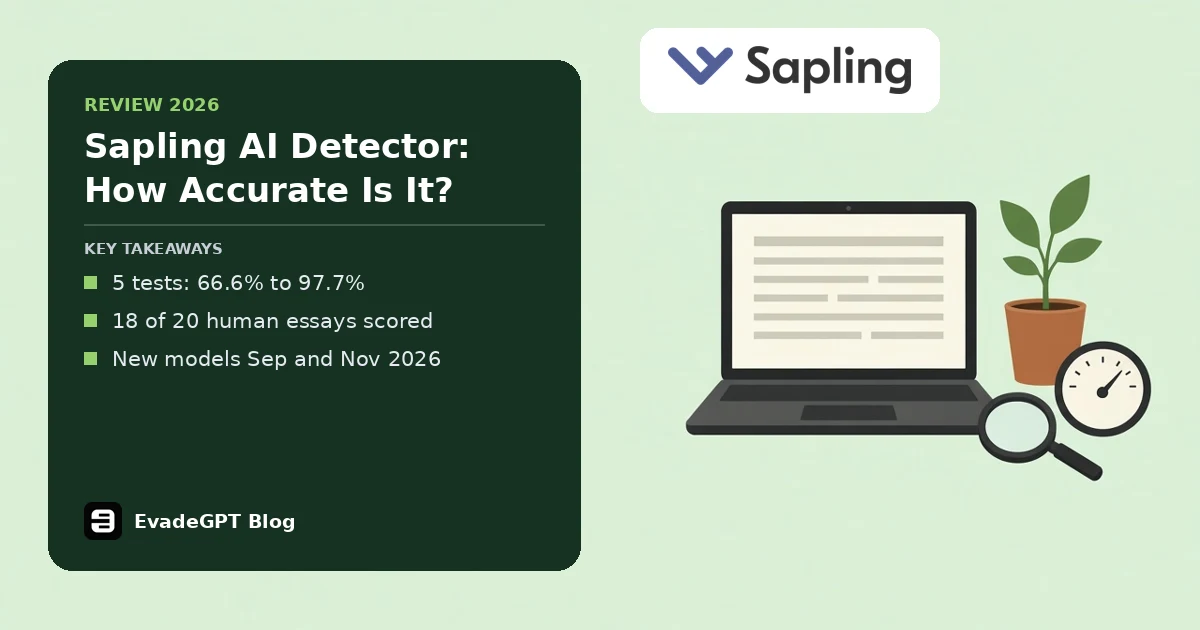
Short answer: the Sapling AI detector catches plain AI text well but can misread human writing. A 2026 nine-tool study scored it 97.7% accurate, yet it got 88.2% of human texts right, and a 2025 Texas A&M study saw 18 of 20 human essays get some AI score.
I read Sapling's detector page, changelog and evaluation guide on 16 November 2026, then worked through 5 published tests. The twist: Sapling changed its models in September and November 2026, so every test below checked an older version.
How accurate is the Sapling AI detector in published tests?
It depends on the year and the sample. Published tests put the Sapling AI detector anywhere from 66.6% accuracy in a 2023 study of 11,580 texts to 97.7% in a 2026 study of 9 detectors. Newer tests catch nearly all plain AI text, while human writing is where results split.
| Study | Sample | Human writing | AI writing |
|---|---|---|---|
| Akram, 2023 | 11,580 texts | 94% labelled human | 40% caught, 66.6% accuracy |
| Farmer et al., 2025 | 20 human, 20 AI, 20 hybrid | 18 of 20 got some AI score | 100% caught |
| Makhmutova et al., 2026 | 9 detectors, 20 human excerpts | 88.2% correct | 90.7% to 100% by chatbot |
| Grillo et al., 2026 | 24 human, 12 AI articles | not in abstract | mean score 95.6 of 100 |
| Scribbr's test (published April 2026) | 30 texts | 0 of 5 flagged | 68% overall score |
Arslan Akram's 2023 study is the biggest sample but the oldest. Makhmutova and colleagues gave Sapling 96.0% precision and 100.0% recall.
Scribbr's test comes from a rival vendor, so count it as weak evidence.
Does Sapling flag human writing as AI?
Sometimes. Madison Farmer and colleagues at Texas A&M ran 20 human essays, all written before 30 November 2022, through the Sapling AI detector 10 times each. The average AI score was 25.8%, and only 2 of the 20 essays scored 0%.
I went through the per-sample results in the study's PDF, and that's where its headline "90% resulting in a false positive" comes from: it counts any score above zero, including 3 essays at 0.1%. At the other end, one human essay scored 100%, another 97.6% and another 74.9%.
The Sapling AI detector FAQ explains why: "The shorter the text is, the more general it is, and the more essay-like it is, the more likely it is to result in a false positive." Our guide to Turnitin false positives covers the same pattern elsewhere.
Can Sapling catch paraphrased or reworded AI text?
Plain rewording, mostly yes; learner-style rewrites, no. In the 2026 JAIT study, the Sapling AI detector stayed at 87.2% or higher on paraphrased AI text and 87.0% to 100.0% on back-translated text. When AI text was rewritten to read like a learner with small grammar slips, it caught just 25.0% on average.
The Texas A&M team also tested hybrids, swapping 1 paragraph of each human essay for an AI rewording. Sapling couldn't reliably separate them (p = 0.069). Turnitin struggles too, as our breakdown of whether Turnitin can detect AI humanizers shows.
What does a Sapling score actually mean?
It's a likelihood, not a word count. Sapling's evaluation guide, updated 7 October 2026, says the score "is not the share of words written by AI". A partly AI text "can have a low overall score while some of its sentences score high", so read the sentence scores too.
The guide says: "A detector score is one input to a review, not definitive proof." Our explainer on how AI detectors work shows why each tool's percentage means something different.
Has the Sapling AI detector changed since those tests?
Yes. The changelog on Sapling's detector page says a 17 September 2026 update cut false positives by 60% in its own internal held-out evaluations, and a 3 November 2026 update flags "far less human-written text with bullets or headings as AI". None of the 5 tests above checked either version. Sapling also sells a resume checker, and our guide to AI detectors on resumes explains why bullet lists trip it up.
So the published numbers describe older models, and the 60% figure is Sapling's own. Our roundup of whether AI detectors are accurate explains why version matters.
How does Sapling compare with other AI detectors?
Middle to upper pack. In the 2026 JAIT study, Copyleaks, Originality.ai and GPTZero hit 100% on the baseline set while the Sapling AI detector scored 97.7%. Scribbr's test, published in April 2026, placed it fifth of 12 at 68%, and Grillo's team ranked it second of 8 on AI-written surgery articles.
One oddity I spotted reading the JAIT paper's Table VII: Sapling's row matches the Detecting-ai.com row digit for digit, so hold the 97.7% loosely. For other tools, see our QuillBot AI detector review and our GPTZero false positive guide.
How can you test the Sapling AI detector yourself?
Sapling suggests you "collect a small dataset of say a dozen examples", so build 12 aimed at the weak spots above. Count flagged human writing and missed AI writing separately, and date your run, since the models changed in September and November 2026. I haven't run this set myself.
- 4 of your own essays from before late 2022, short and general.
- 2 human pieces with bullets or headings.
- 3 AI pieces on the same subjects.
- 3 of your own pieces with 1 AI paragraph spliced in.
- Scan each sample twice to check the score holds.
- Log the overall and highest sentence score.
If your own work scores high, keep your drafts and see how to prove you didn't use AI.
You can't control Sapling, but you can control your draft
Short, general and essay-like: that's the text Sapling says is most likely to throw a false positive, and it sounds a lot like the average uni essay. Add 18 of 20 human essays getting an AI score in one 2025 study, and the stress makes total sense.
Here's the good news: EvadeGPT has your back. Run your draft through the EvadeGPT AI detector first, where our custom-trained model gives it a proper look, then rework whatever sounds robotic with EvadeGPT's help. EVE chat covers the research side. Go on, click the button and try it.
FAQ
Is the Sapling AI detector accurate on essays?
On plain AI essays, yes in recent tests. On human essays it's mixed: one 2025 study gave 18 of 20 some AI score, and 3 scored above 70%.
How many words does Sapling need?
Sapling says it "becomes much more accurate after 50 or so words."
What languages does Sapling check?
16 as of 4 November 2026, including English, Spanish, Japanese and Chinese. Others go through the English model.
Does a high Sapling score prove AI use?
No. Sapling says "No current AI content detector (including Sapling's) should be used as a standalone check".
Is an older Sapling review still useful?
Only as history. No published Sapling review or study covers its September and November 2026 models yet.