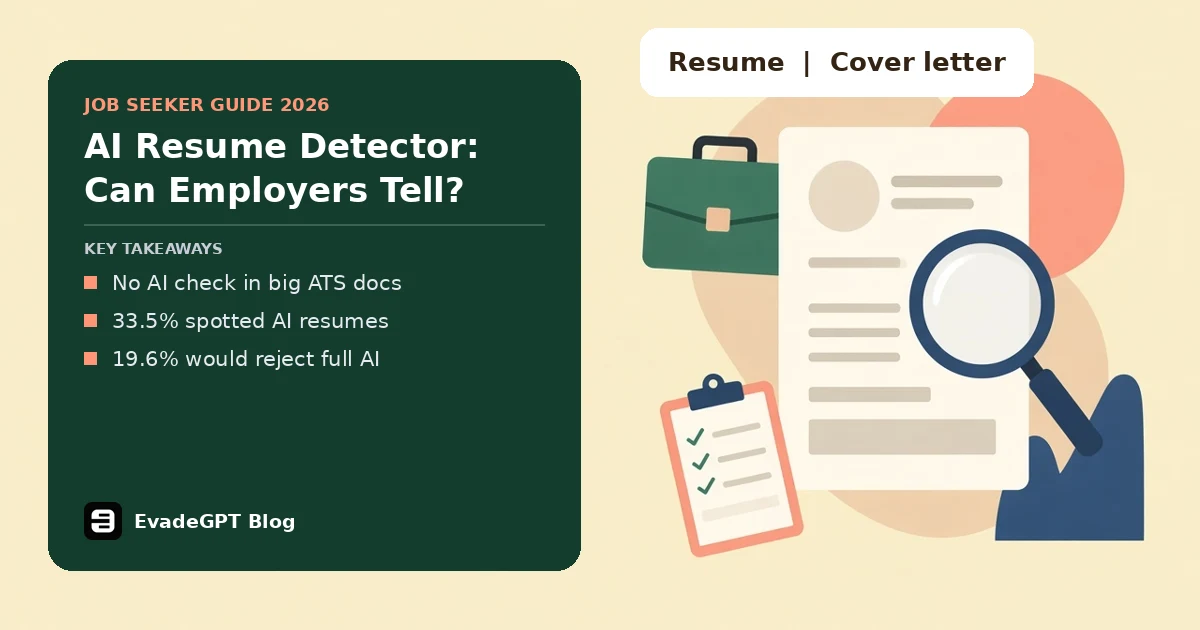
Short answer: AI resume detectors exist, but the big applicant tracking systems I checked don't include one. Workday and Greenhouse rank your fit, not who wrote the words. The real test is a person: in a 2025 survey of 600 US hiring managers, 19.6% said they'd reject a fully AI-generated resume or cover letter.
I spent this week reading what hiring software documents, plus the studies I could verify. Most fear about an AI resume detector targets the wrong robot.
Do employers actually run an AI resume detector?
Some can, through add-ons, but the 2 big systems I checked don't document a built-in one. Workday's HiredScore grades candidates from A to D "based on how well their resumes match the skills and qualifications specified in the job description." Greenhouse's fraud checks look at signals like phone number and email.
Add-ons differ: Pangram scans applications inside the Ashby ATS as they arrive, and Sapling says its resume AI detector can feed results into an ATS. An AI resume detector can sit in the pipeline. It just isn't standard.
| What reads your application | What it checks | Judges AI writing? |
|---|---|---|
| Workday HiredScore | Match to the job's qualifications, graded A to D | No |
| Greenhouse Real Talent | Fraud signals and match to the recruiter's criteria | No |
| Add-on AI resume detectors (Pangram, Sapling) | Likelihood the text is AI-generated | Yes |
| A hiring manager | Fit and wording | Sometimes |
Does ATS software detect AI writing?
Not according to Workday or Greenhouse. Workday says its AI tools only focus "on the qualifications listed in a candidate's job application." Greenhouse says "Talent matching never advances or rejects candidates for you." Both rank fit, and neither of the 2 scores authorship. If the ATS worries you, match the job description first.
Does an AI detector on a resume even work?
Badly, by the detector companies' own account. Sapling warns that "Resumes are short and formulaic" and that bullet lists and sections under about 500 characters "are more likely to be flagged as AI-generated." Turnitin's model skips bullet lists and needs at least 300 words of prose.
GPTZero says its accuracy "increases as more text is submitted." A resume is short, clipped and full of stock phrases people have used for decades. Pangram claims its AI detector for resumes can tell formatting from AI narrative text, but that's a vendor claim.
Cover letters are prose, giving a detector more to work with and more room to get you wrong. See whether AI detectors are accurate and our reviews of Sapling and Pangram.
Can employers tell if a resume is AI-written just by reading it?
Less often than they think. In TopResume's May 2025 survey, 600 US hiring managers were shown 4 resumes and asked which were AI-written, and 33.5% spotted them. Resume Genius's June 2026 survey found 58% of hiring managers had encountered AI-generated resumes or cover letters.
Readers spot generic writing without any AI resume detector: vague claims, buzzwords, identical bullets. Our guide on how to tell if something was written by AI covers those tells, and they're why a LinkedIn post sounds like AI.
Will using AI on your resume hurt your chances?
It depends how you use it. In TopResume's survey, 19.6% of hiring managers said they'd reject a fully AI-generated resume or cover letter, while 52% called AI help with proofreading or drafting acceptable. A field study of nearly half a million jobseekers found writing help lifted hires 8%.
In that study, Wiles, Munyikwa and Horton gave jobseekers algorithmic writing help, with "no evidence that employers were less satisfied."
Twist: in Xu, Li and Jiang's 2025 study, the largest AI screeners picked resumes they wrote themselves over human-written ones by a 67% to 82% gap in selection rates. In simulations across 24 occupations, candidates using the screener's model were 23% to 60% more likely to be shortlisted.
How do you use AI on a resume without it reading like AI?
Use AI for structure, then put your proof back in. Every bullet should carry 1 detail only you could write, like a number or a result. Read it aloud, and if a line could sit on anyone's resume, rewrite it. That test matters more than any AI resume detector.
- Swap every vague verb for what you actually did.
- Add 1 figure per role you could defend in an interview.
- Vary bullet length so the page doesn't read like a template.
- Check the cover letter first; that's where I'd start.
Some employers set rules: Greenhouse tells its own candidates that undisclosed AI use outside its interview guidelines may disqualify them. Our writing with AI guide covers fixes, and how AI detectors work explains scoring.
Job hunting is hard enough. Check your cover letter before you hit send
Job hunting already feels like shouting into a void, and then you read that 19.6% of hiring managers in one survey would bin a fully AI-generated application. Generic lines get skimmed, and a stiff cover letter can undo the work behind it.
Paste your cover letter into the EvadeGPT AI detector to find flat lines. It's driven by our custom-trained model. Smooth them with the EvadeGPT humanizer, which keeps your names and key terms. Researching the company? Ask EVE chat. Try it before your next application goes out.
FAQ
Does ATS detect AI?
Not in Workday's or Greenhouse's documentation. They rank fit, though an AI resume detector can be added on.
Can employers tell if your resume is AI?
Sometimes. In a 2025 TopResume test, 33.5% of 600 US hiring managers spotted the AI-written resumes.
Do AI detectors work on cover letters?
Better than on a resume, because cover letters are prose, but Turnitin still needs 300 words of prose to score anything.
Is it okay to use AI to write a resume?
Light help usually is: 52% of hiring managers in a 2025 survey called AI proofreading or drafting support acceptable.
Should I tell an employer I used AI on my application?
Follow each employer's rules. Greenhouse, for its own hiring, says undisclosed AI use outside its guidelines may disqualify you.