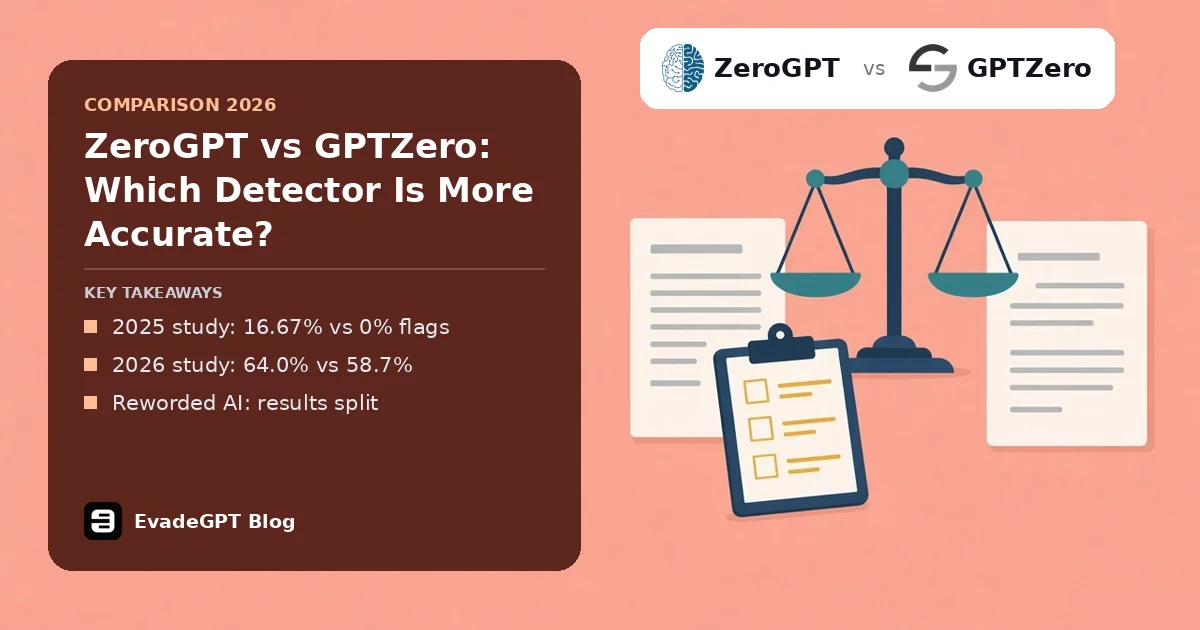
Short answer: in the 3 studies from 2025 and 2026 in my table, GPTZero was the safer pick for human writing: it flagged none of 72 human abstracts in a 2025 study, while ZeroGPT flagged 16.67% of them. ZeroGPT still edged one 2026 test overall, 64.0% to 58.7%, because it flagged more reworded AI text.
I lined up four published studies that ran ZeroGPT and GPTZero on the same texts and re-read each results table on 18 November 2026. Honestly, the pattern surprised me. The better tool in a ZeroGPT vs GPTZero matchup depends on whether you fear a false flag on your own essay or a miss on reworded AI.
ZeroGPT vs GPTZero: what do the head-to-head studies show?
The four studies in my table scored ZeroGPT and GPTZero on identical texts, and they don't agree. GPTZero won a 2025 test on scholarly abstracts, 97.22% to 64.35%. ZeroGPT edged a 2026 Polish and English test, 64.0% to 58.7%, though its authors found no significant gap between the two.
| Study | Human writing flagged as AI | AI writing |
|---|---|---|
| Weber-Wulff et al., 2023, tested March 2023 | GPTZero 9 of 18 human or machine-translated; ZeroGPT 0 | GPTZero missed 3 of 36; ZeroGPT 13 of 36 |
| Pratama, 2025, 72 human abstracts | GPTZero 0.00%; ZeroGPT 16.67% | GPTZero missed 2.78%; ZeroGPT 45.14% |
| Makhmutova et al., 2026, 9 detectors | judged correctly: GPTZero 98.4%, ZeroGPT 94.8% | learner-style rewrites caught: GPTZero 90.0%, ZeroGPT 13.4% |
| Brodacki and Plechawska-Wójcik, 2026, 150 samples | GPTZero 0 of 30; ZeroGPT 6 of 30, plus 8 uncertain | reworded AI flagged: GPTZero 0 of 60, ZeroGPT 22 of 60 |
Each study used different texts and versions of ZeroGPT and GPTZero, so read the table as snapshots, not a league ladder.
Which one flags human writing as AI more often?
ZeroGPT, in 3 of the 4 studies. In Pratama's 2025 test it flagged 16.67% of human abstracts published by 2021, and GPTZero flagged none. In the May 2026 Lublin test, ZeroGPT called 6 of 30 human texts AI and left 8 more uncertain, while GPTZero cleared all 30.
Pratama also spotted something odd about ZeroGPT: "it labeled some original abstracts in Scenario 1 as AI-generated even though their scores were below 30%."
If ZeroGPT already flagged you, our ZeroGPT false positive guide covers next steps.
Which one catches reworded or edited AI text?
It depends on the rewrite. In the 2026 JAIT study, GPTZero caught 90.0% of AI text rewritten to sound like an IELTS Band 6 learner, against 13.4% for ZeroGPT. In the Lublin test it went the other way: GPTZero flagged 0 of 60 AI-paraphrased samples as AI, and ZeroGPT flagged 22.
JAIT's paraphrased set favoured GPTZero too, 93.4% to 80.2%. The Lublin authors added that ZeroGPT "returned the highest number of uncertain results", so some catches came with a shrug.
Lublin also tested Scribbr (see our Scribbr AI detector review), and how AI detectors work explains why rewording swings scores.
Why did GPTZero look worse in 2023?
Because it was a different GPTZero. In March 2023, Weber-Wulff's team saw it misjudge 3 of 9 human texts and 6 of 9 machine-translated ones, and wrote that this "makes this tool unsuitable for the academic environment". ZeroGPT made no false accusations there.
Both ZeroGPT and GPTZero have retrained since. GPTZero made 4o its default on 20 September 2026 and released Model 5.0b on 4 November, while ZeroGPT's homepage and FAQ name no model version. Any result is a snapshot of one model, as our roundup on whether AI detectors are accurate shows.
What do ZeroGPT and GPTZero claim about their own accuracy?
Both claim near-perfect figures on their own tests. ZeroGPT's homepage lists "98.4% Detection accuracy" and a "<1% False positive rate". GPTZero says it keeps its false positive rate "at no more than 1%", and its October 2026 GPTZero 4o post claims "a false positive rate of only 1 in 10,402" on student writing.
Neither figure comes from an outside lab, and Pratama measured 16.67% for ZeroGPT on human abstracts. Even GPTZero's support page says "GPTZero never recommends using a detection score as the sole basis for academic consequences."
Does a 60% score mean the same thing on each tool?
No. GPTZero says a score of "75% AI" means its model is 75% confident the whole document is AI, not that 75% of sentences are. ZeroGPT gives an overall score plus highlighted passages and asks for at least 150 to 200 words. So a 60% on one isn't a 60% on the other.
Pratama says ZeroGPT "relies on a lower, less transparent threshold". Because ZeroGPT and GPTZero define scores differently, comparing raw percentages is apples and oranges. Our GPTZero false positive guide explains its labels, and our GPTZero vs Turnitin comparison helps if your school runs Turnitin.
How can you run your own ZeroGPT vs GPTZero test?
Use 8 samples of at least 200 words each, since ZeroGPT's FAQ asks for 150 to 200 words or more. Score every sample in ZeroGPT and GPTZero on the same day. Log flagged human writing apart from missed AI writing, because those are different risks. I haven't run this set myself.
- 2 pieces you wrote before late 2022, one formal and polished.
- 2 plain AI drafts on the same topics.
- 2 AI drafts you've reworded by hand.
- 2 recent pieces of your own, one written in a hurry.
A third read from the EvadeGPT AI detector shows whether a flag is one tool's quirk. Keep dated drafts, as our guide on how to prove you didn't use AI explains.
Two detectors, two kinds of risk. Check your own draft first
Here's the frustrating bit. ZeroGPT flagged 16.67% of the human abstracts in Pratama's test, while GPTZero misjudged 3 of 9 human texts back in 2023. One essay can get two opposite verdicts, and you rarely get to choose which tool your marker trusts.
So get your own read before anyone else does. Run the draft past the EvadeGPT AI detector first, because our custom-trained model does the checking there. If a paragraph comes back stiff or robotic, the EvadeGPT humanizer helps you rework it until it sounds like you again. EVE chat handles the research side. Click the button and try it on your next essay.
FAQ
Is ZeroGPT or GPTZero more accurate?
On human writing, GPTZero has the better recent record: 0.00% false positives in Pratama's 2025 test against 16.67% for ZeroGPT. On reworded AI, results flip between studies.
Are GPTZero and ZeroGPT the same tool?
No. They're separate tools that just sound alike: GPTZero runs at gptzero.me and ZeroGPT at zerogpt.com.
Which detector is better if I'm worried about false positives?
Recent studies favour GPTZero: it cleared all 30 human texts in the May 2026 Lublin test, while ZeroGPT flagged 6. No score is proof, so keep drafts.
Does ZeroGPT flag human writing as AI?
It can. Its own FAQ says polished or formulaic writing "can resemble AI", and Pratama measured a 16.67% false positive rate on human abstracts.
Can GPTZero detect paraphrased AI text?
Sometimes. It averaged 93.4% on paraphrased AI in the 2026 JAIT study, yet flagged none of 60 in the Lublin test.