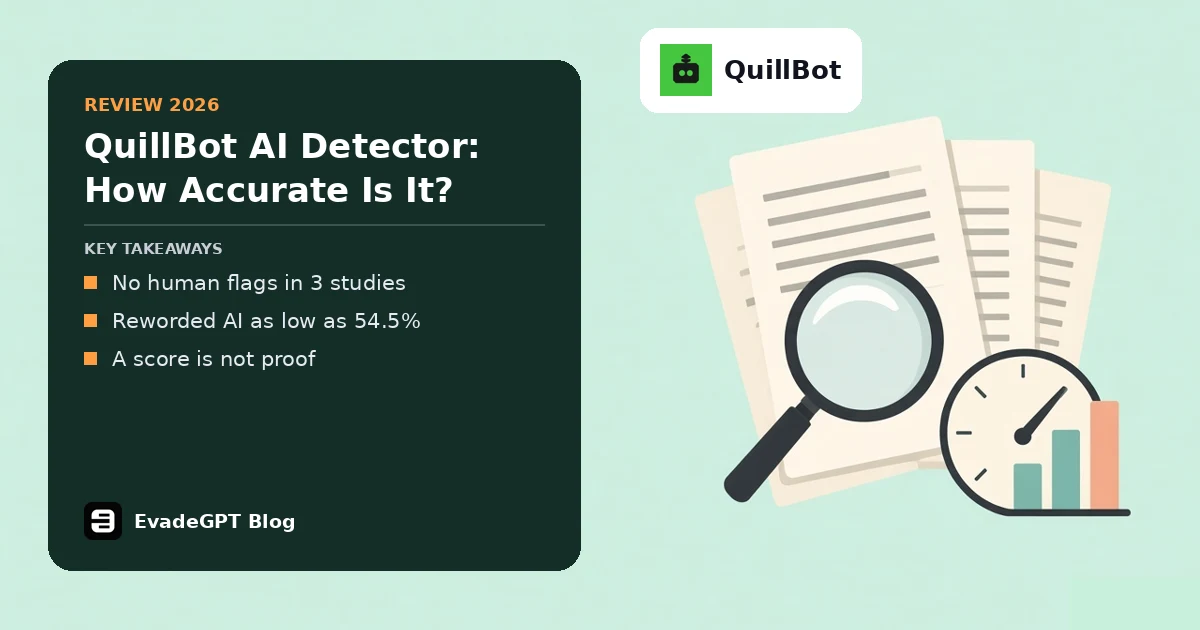
Short answer: the QuillBot AI detector is careful with human writing and weaker on reworded AI text. In 3 independent studies from 2025 and 2026 it wrongly flagged no human text it could scan, but one study saw it fall to 54.5% on AI text reworded with QuillBot's own paraphraser. Treat a score as a signal, not proof.
I read QuillBot's detector page on 10 November 2026 and, honestly, went through all 3 studies line by line. QuillBot's sister company runs its own checker too, and our Scribbr AI detector review sets its own test against 2 independent ones.
How accurate is the QuillBot AI detector on human writing?
Very accurate so far. Across 3 independent tests with 105 human texts between them, the QuillBot AI detector wrongly labelled none of the texts it scanned as AI. The only miss was a 71-word sample it refused to score, marked "not enough text" because it was too short.
| Study | Human texts | Wrongly flagged as AI | AI text caught |
|---|---|---|---|
| Makhmutova et al., 2026 | 20 | 0 (100.0% correct) | 79.5% to 100.0% by chatbot |
| Paullet et al., 2025 | 36 | 0 (1 too short to scan) | 34 of 34 |
| Alshammari and Rao, 2025 | 49 | 0 | 98.4% average AI score |
Makhmutova and colleagues ran 116 texts through 9 detectors. Paullet and colleagues at Robert Morris University used their own writing from before 30 November 2022, and QuillBot "correctly classified 35 of the 36 samples that were created by humans." Alshammari and Rao at the University of Missouri wrote that "QuillBot and Copyleaks did not present false positive cases."
Still, 105 texts is a small base. Grammarly's AI detector posted a similar human-text record in the same 2026 study.
Does QuillBot catch AI text that has been reworded?
The studies disagree sharply. Makhmutova's team reworded AI text "using QuillBot's default settings", and the QuillBot AI detector then caught just 54.5% to 79.2% of it across 4 chatbots. Alshammari and Rao also paraphrased with QuillBot, and the QuillBot AI detector still gave a 95.49% average AI score.
Part of the gap is the measure. Alshammari and Rao's "average accuracy score" is the mean AI percentage the tool returned, while Makhmutova reports detection accuracy. Don't treat them as one number. When I compared the two papers, that was the whole difference.
Both agree on heavier rewrites. A humanising rewrite mode dropped QuillBot's average AI score to 58% for Alshammari and Rao, and Makhmutova's back-translated texts fell as low as 40.3% for one chatbot. Turnitin struggles here too, as our guide to whether Turnitin detects QuillBot shows.
Why does the QuillBot AI detector miss more AI than it flags?
It's built to lean towards human. QuillBot says "When the result is unclear, our model tends to classify texts as human written, which reduces false positives." In the 2026 study that shows up as 100.0% precision but 91.7% recall: every AI call was right, but some AI text got through.
The authors say Grammarly and QuillBot "were more conservative and occasionally failed to detect AI-generated texts despite high precision." For a student, a careful detector is less likely to put your own essay under suspicion. For a teacher, a low score from the QuillBot AI detector proves nothing, which is awkward.
What do QuillBot's 3 result labels mean?
The QuillBot AI detector sorts text into 3 groups rather than a yes or no. It says it separates text that was "entirely AI-written, entirely human-written, or human-written with some AI refinement", then highlights the lines behind the score. The overall result is a percentage from 0 to 100, and it needs at least 80 words.
The middle label matters if you run your own drafts through a grammar checker. QuillBot says its checker "accounts for AI-refined text specifically" to cut false flags. None of the 3 studies tested that label separately, so it's unverified.
It also says "Longer texts (300+ words) produce more reliable scores than short inputs", and admits it "can not verify whether a piece of writing was created by a human".
Which kinds of writing does QuillBot struggle with most?
QuillBot names the risky types itself. It says "Heavily paraphrased or lightly AI-edited content is harder to detect" and that "Formulaic human writing (academic definitions, legal copy, structured templates) can score higher than expected". Lab reports, law essays and method sections fit that second group, so 1 high score there needs a second look.
The 2026 study adds another. When AI texts were rewritten to read like an IELTS Band 6 writer, with small grammar slips, the QuillBot AI detector caught only 22.3% on average. That's missed AI, not a false flag, but it shows the detector leans on polish.
QuillBot says it "supports 20+ languages", but when I checked, all 3 studies scored English text. Our roundup of whether AI detectors are accurate covers other tools and languages. For a smaller rival with 5 published tests behind it, read our Sapling review.
How should you test the QuillBot AI detector yourself?
Run your own human writing through it first. This 4-step check takes one sitting and tells you more about your style than any vendor claim. Use at least 300 words each time, since QuillBot says longer texts score more reliably than its 80-word minimum.
- Paste in an essay you wrote before you used AI tools, and note the score.
- Paste the same essay after a grammar checker pass, and compare.
- Read which sentences the QuillBot AI detector highlights, and why.
- Run the same text through one other detector.
If your own work scores high, keep your drafts and version history. QuillBot says "Never rely on AI detection alone to make decisions that could impact someone's career or academic standing." Our guide on how to prove you didn't use AI covers evidence that holds up, and how AI detectors work explains why tools disagree.
Check your draft before you submit
Sound familiar? QuillBot can miss reworded AI text, with detection as low as 54.5% in one study, and still flag formulaic human writing. EvadeGPT is the fix. Its custom-trained model helps you check and rewrite robotic lines. Try the EvadeGPT AI detector or EVE chat.
FAQ
Is the QuillBot AI detector accurate on essays?
On human essays, yes so far: it wrongly flagged none it could scan. It misses more reworded AI text.
Does QuillBot flag text from its own paraphraser?
Not reliably. One 2026 study saw detection fall to 54.5% to 79.2% on QuillBot-reworded AI text, though a 2025 study saw little drop.
How many words does QuillBot need to scan?
At least 80. QuillBot says texts of 300 words or more give more reliable scores.
Does the QuillBot AI detector check plagiarism?
No. QuillBot says it "does not scan text for plagiarism", so use a separate checker for copied text.
Is a QuillBot score enough to prove AI use?
No. QuillBot says "Scores are signals, not verdicts", and no study backs using one score as proof.