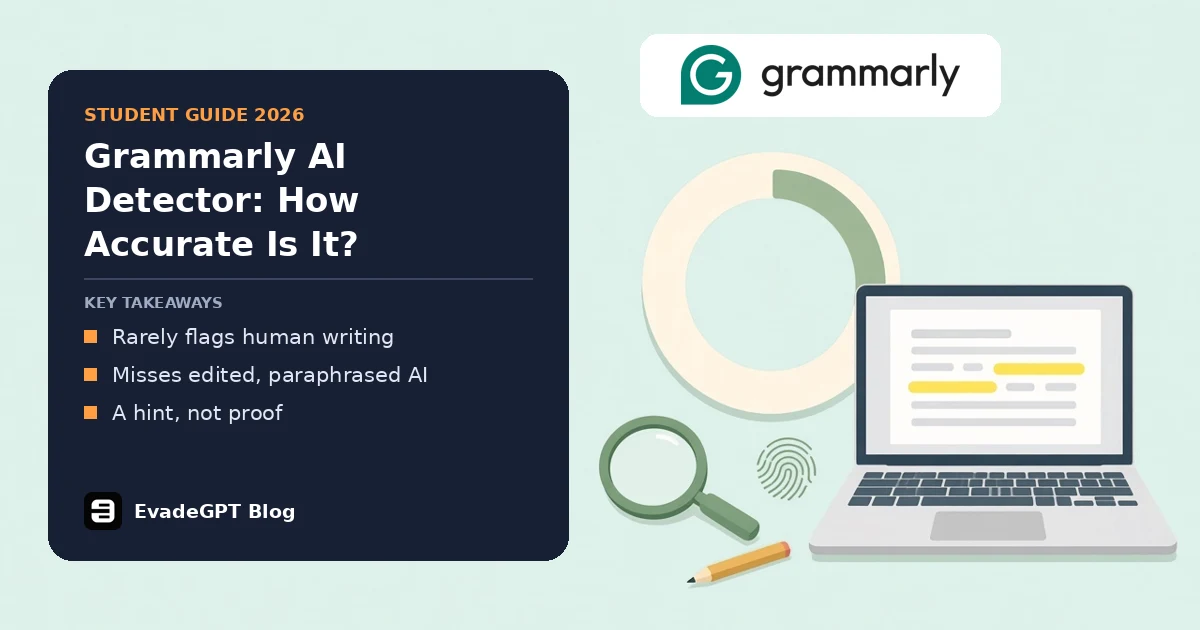
Short answer: Does Grammarly detect AI? Yes. The Grammarly AI detector estimates what share of your text looks AI-generated. Studies show it rarely flags human writing but misses much edited or paraphrased AI text. Grammarly says the percentage "should not be used as an objective source of truth."
I read Grammarly's guide, its API docs and 3 peer-reviewed studies. Worried that Turnitin flags Grammarly edits? See our does Turnitin flag Grammarly guide.
What does the Grammarly AI detector percentage mean?
The score is "the percentage of scanned text that is likely AI-generated," says Grammarly's AI Detector user guide. It checks each section of your writing for "language patterns, syntax, and complexity" and averages the results into 1 number. Grammarly calls it "directionally accurate."
It's "optimized to minimize false positives," so it would rather miss AI text than flag a human. The AI detection API needs at least 30 words.
How accurate is the Grammarly AI detector in independent studies?
I found 3 peer-reviewed studies from 2025 and 2026 that tested Grammarly by name. They agree: it rarely flags human writing, but its score drops sharply once AI text is edited, paraphrased or built from your notes. The table shows what each measured.
| Study | Text tested | Grammarly result |
|---|---|---|
| Dehghan Baghi et al. 2026 | 30 human EFL essays | 0% AI on all 30 |
| Dehghan Baghi et al. 2026 | 30 AI-assisted EFL essays | Mean 90%, range 65% to 100% |
| Cheng et al. 2025 | Human journal introductions | Mean 1.6% AI |
| Cheng et al. 2025 | Fully AI-written introductions | Mean 50% AI |
| Makhmutova et al. 2026 | Unedited AI text | 38.2% to 75.8% detected |
| Makhmutova et al. 2026 | Paraphrased AI text | 40% mean, lowest of 9 tools |
In the IJREE study, Mohammad Amin Dehghan Baghi and 2 Yazd University colleagues had 30 Iranian EFL students write one essay alone and one with AI help. Grammarly averaged 90% on the AI-assisted essays. Turnitin averaged 99.33%.
Across 60 MA theses, scores rose from 0.43% (2010 to 2015) to 5.20% (2020 to 2025), which the authors say "suggests either actual, undisclosed AI use or algorithmic bias."
Adam Cheng and 8 colleagues tested 30 journal introductions in Advances in Simulation. Grammarly averaged 3.0% after light AI editing, 11.5% after heavy editing and 62.5% for AI text written from notes, and only 50% on "a wholly AI written text."
In the Journal of Advances in Information Technology, Alfira Makhmutova and 3 colleagues compared 9 detectors. The Grammarly AI detector got 99.4% of human texts right, with 100.0% precision.
Grammarly's detector page claims "99% detection accuracy" on the RAID benchmark of "over 670,000 texts," per its February 2026 announcement. The RAID leaderboard wouldn't load for me, so that's Grammarly's claim.
Does Grammarly detect AI after paraphrasing or editing?
The Grammarly AI detector mostly missed it in the 2026 JAIT study. After a QuillBot paraphrase, its accuracy on AI text fell to a 40% mean (19.0% to 54.0%), the lowest of 9 tools. Back-translated AI text, run into another language and back, was caught only 30.3% to 48.7% of the time. The same 2026 study tested QuillBot too, which we cover in our QuillBot detector review. Scribbr also labels text as AI-refined, which our Scribbr detector guide unpacks.
AI text rewritten to read like IELTS Band 6 non-native writing was caught just 2.1% of the time. Style cuts both ways: in the Patterns study, Weixin Liang and colleagues found 7 detectors flagged human TOEFL essays 61.3% of the time on average.
The RAID paper by Liam Dugan and colleagues found "current detectors are easily fooled by adversarial attacks." Our guide to how AI detectors work explains why, and our Copyleaks false positive guide covers another tool Grammarly names.
Which Grammarly features raise your Grammarly AI detector score?
Grammarly's guide splits its tools into 2 groups. Fixing red and blue underlines "should typically not impact the percentage score." Meaningful rewrites with its writing agents or generative assistant "will raise the percentage score." It offers no "dedicated feature to reduce the AI score", so rewrite flagged parts yourself.
How does the Grammarly AI detector compare with Turnitin and GPTZero?
The 3 tools report different things, so 20% in one isn't 20% in another, and Grammarly says its scores "may differ from those of other solutions like Turnitin, GPTZero, Copyleaks". The table compares what each percentage means, using each vendor's own documents.
| Grammarly | Turnitin | GPTZero | |
|---|---|---|---|
| What the % means | Share of scanned text likely AI | Share of qualifying prose flagged | Confidence the whole document is AI |
| Minimum length | 30 words (API) | 300 words of prose | Not stated in the guide I read |
| Vendor caution | Not "an objective source of truth" | Not "the sole basis for adverse actions" | No score alone should decide a case |
Turnitin's AI Writing Report guide shows 1% to 19% as an asterisk, and GPTZero's result guide scores the whole document. Our GPTZero vs Turnitin comparison and Turnitin false positive guide go deeper.
Is Grammarly Authorship better evidence than a score?
Often, yes, because it records process. Grammarly's Authorship page says AI detectors "just analyze your text in a moment in time." Authorship works in 3 places, Google Docs, Microsoft Word and the Grammarly Editor, and its report "color-codes your entire assignment to show each sentence's source."
It's opt-in, so switch it on first. Grammarly "doesn't auto-send it to your professor." Our guide on how to prove you didn't use AI covers other records.
How can you test the Grammarly AI detector yourself?
I can't run Grammarly on your essay, so I show no invented scores. Its API docs set a 30-word minimum, so scan whole paragraphs. Try this 4-step check a week before a deadline and keep dated screenshots, since records made before any flag carry more weight than ones made after.
- Scan 300 words you wrote before 2022 to see how Grammarly reads your style.
- Scan your current draft and note which sections score highest.
- Undo generative rewrites there, since Grammarly says they raise the score.
- Rewrite flagged lines yourself, then compare with a second tool using our GPTZero false positive guide.
FAQ
Does the Grammarly AI detector work?
Partly. It rarely flags human writing but catches AI text unevenly: 90% on AI-assisted essays in one study, 40% on paraphrased AI text in another.
Is Grammarly AI detector accurate on edited AI text?
Not very. It averaged 11.5% on heavily AI-edited introductions in Cheng et al. 2025.
Is the Grammarly AI detector the same as Turnitin?
No. They score differently, so a low Grammarly score doesn't predict a Turnitin report.
Does fixing grammar raise my Grammarly AI detector score?
Usually not. Grammarly says underline fixes "should typically not impact the percentage score," but meaningful generative rewrites raise it.
Can a Grammarly AI detector score prove I used AI?
No. Grammarly says "AI detection of any kind can be prone to errors." Drafts and an Authorship report are stronger evidence.