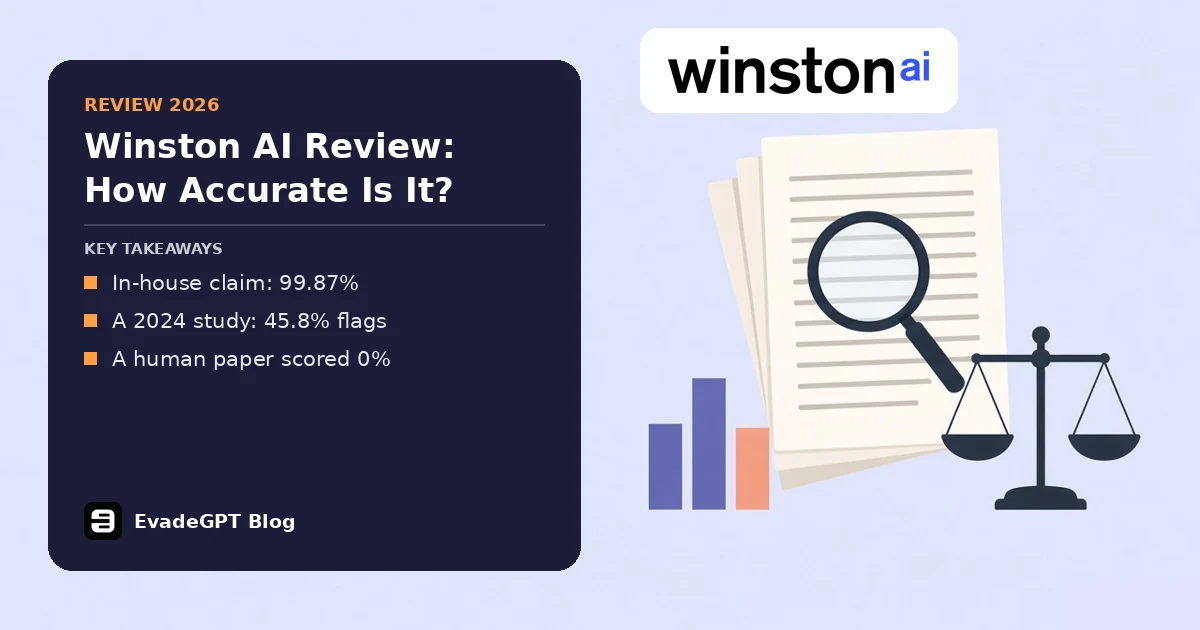
Short answer: Winston AI's own 2026 report claims 99.87% accuracy, with 7 false flags in 6,000 human documents. Independent tests are older and much harsher: a 2024 study saw it flag 45.8% of student essays, and a 2026 audit saw it score a human paper "0% human". Treat its score as a lead, not proof.
For this Winston AI review, I read Winston's 5.0 report and 4 independent studies that name it, from March 2023 to September 2026. I weighted one error above the rest: calling a person a machine. That stings.
Which Winston AI review results come from Winston itself?
Most of the best ones. Winston released version 5.0 on 24 September 2026. In a "held-out evaluation conducted in-house on 12,000 English documents," it reports 99.87% overall accuracy, "correctly classifying 11,984 samples with just 16 errors." It ran 3 public benchmarks itself too.
| Test | Who ran it | Date | Result on human writing |
|---|---|---|---|
| Winston 5.0 internal set | Winston | Sep 2026 | 7 false flags in 6,000 documents |
| PERSUADE 2.0 essays | Winston | Sep 2026 | All 25,996 essays called human |
| DetectRL-X | Winston | Sep 2026 | 97.08% of human documents called human |
| Weber-Wulff et al. | 8 academics | Mar 2023 | No false accusations on 18 texts |
| Paustian and Slinger | 2 academics | Fall 2023 | 45.8% of student essays flagged |
| Angelier | 1 academic | Aug 2026 | A known human paper scored "0% human" |
Winston publishes its misses, which most vendors don't. Yet many Winston AI reviews repeat the 99.87% headline without the "in-house" label.
How did Winston AI do in independent tests?
Mixed, and far below its own numbers. In the 2023 Weber-Wulff study, Go Winston made no false accusations on 18 human and machine-translated texts. It still missed 7 of 9 paraphrased AI texts and ranked 5th of 14, at 67% accuracy.
In the 2024 Frontiers study, 153 US university students wrote essays of "approximately 500 words" in Fall 2023. The authors wrote: "The Winston detector failed badly when examining human text, flagging nearly half as false positives." Its rate was 45.8%, against 9.8% to 17.6% for 3 other detectors, and a total nightmare for a student.
The RAID benchmark, a 2024 academic test, put Winston at 71.0% accuracy at a 5% false positive rate, and 52.6% on paraphrased text. Winston now claims first place on RAID, at 99.89% with a 1% false positive rate. That figure isn't in the 2024 paper.
In an AI and Ethics audit published 18 September 2026, Winston v4.18 rated the author's own manuscript "0% human." In March, v4.15 had scored 3 of his other pieces at 78 to 88% human. He notes these were single runs.
Is a Winston AI review from 2023 still useful?
Only as history. Every independent test above used a version older than 5.0, which arrived 6 days after the audit was published. I found no peer-reviewed test of 5.0 yet, so the old studies can't tell you how today's model will score your essay.
They do show that scores swing between versions. Read any Winston AI review, this one included, as a snapshot with a date on it.
What does a Winston AI score actually mean?
It depends on the screen. Winston's home page talks about a "human score", and the 2024 study noted that "Winston's AI detector returned a %Human score," so a high number there is good news. Its 5.0 report instead describes an AI score with a 0.5 classification threshold.
Winston needs 500 characters to scan and reports 99.98% accuracy on documents of at least 2,000 characters.
Which writing does Winston AI misread most?
On Winston's own data, formulaic human writing. Of its 7 false flags, "Three came from the medical category, two were poems, and two were recipes." On DetectRL-X, it says "Results varied more on human web and SEO texts." Set phrases trip most detectors, as how AI detectors work explains.
On this data, technical, formulaic or short writing gets the most noise.
How can you check a Winston AI review against your own writing?
Run a small test of your own, because a Winston AI review can't test your genre. It takes 3 steps, and it tells you more about how Winston reads your writing than any headline figure, including the ones in this post:
- Scan 3 pieces you wrote before 2022, each over 2,000 characters.
- Scan them again a week later and note the version.
- Compare the scores with a second detector.
Already flagged? How to prove you didn't use AI covers version history. Our posts on whether AI detectors are accurate, the GPTZero false positive and the Turnitin false positive show the same pattern.
Check your writing with a second detector
Sound familiar? Independent tests have flagged nearly half of student essays and scored a human paper at 0% human. That's why EvadeGPT is the fix. Run your text through its custom-trained model, then rewrite the lines that sound off. The EvadeGPT AI detector and EVE chat are 1 click away: try it.
FAQ
Is Winston AI accurate?
On its own 2026 tests, very. Independent tests found anywhere from no false flags to nearly half.
Is this Winston AI review independent?
No rival's review is. EvadeGPT makes its own AI detector, so this Winston AI review links every figure to its source.
Does Winston AI give false positives?
Yes. Winston reports 7 in 6,000 human documents. A 2024 study measured 45.8% on student essays.
What is the minimum length for Winston AI?
500 characters. Winston reports higher accuracy on longer texts.
Can Winston AI detect paraphrased text?
Less reliably. Older independent tests found it missed most paraphrased AI text.