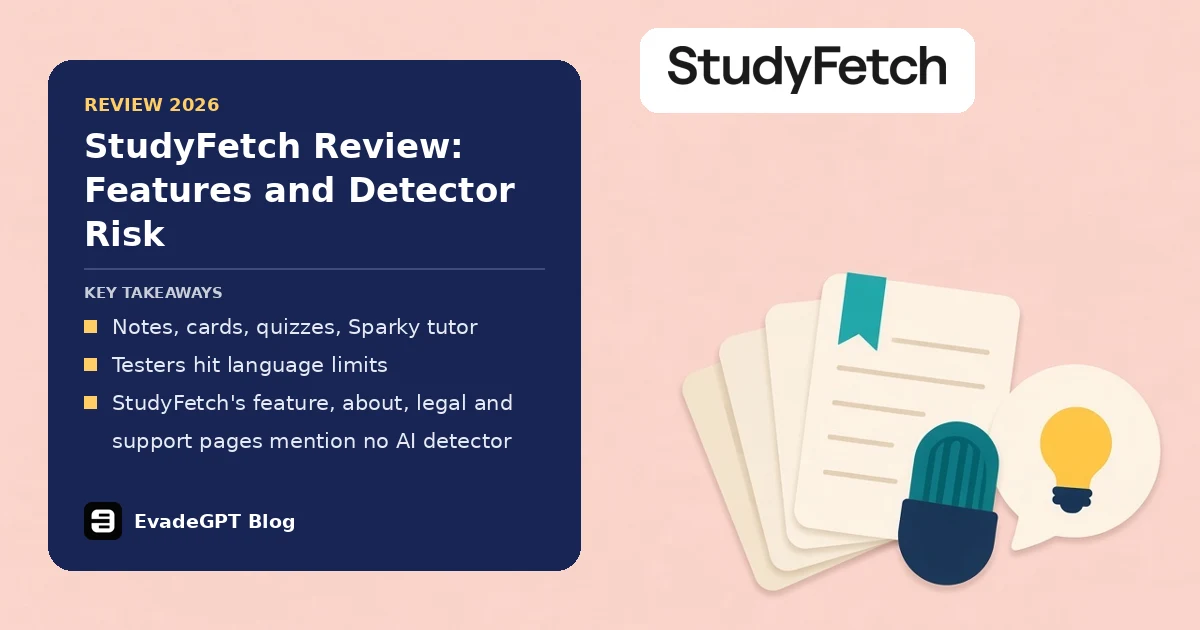
Short answer: StudyFetch turns your uploads into notes, flashcards, quizzes and practice tests, with a tutor called Sparky. Its homepage claims 8M+ users, but tl;dv's hands-on StudyFetch review found limits with languages and multi-speaker audio. StudyFetch's feature, about, legal and support pages mention no AI detectors.
Plenty of students turn slides into flashcards with StudyFetch, then wonder whether that writing could meet an AI detector. I read StudyFetch's feature, about, legal and support pages on 21 November 2026, plus two independent write-ups. I haven't signed up or run my own tests. This StudyFetch review has no detector scores, only what's documented and a way to check.
What does StudyFetch do for studying?
StudyFetch turns uploads such as PDFs, PowerPoints, videos and slides into notes, flashcards, quizzes and practice tests, with Sparky in a side panel. Its homepage claims 8M+ users and says 92% of regularly active users reported grade improvements, based on 1,000 of its own students in December 2024.
That 92% is a self-reported vendor figure, so read it as marketing, not a test. The feature pages are more concrete: Live Lecture records and transcribes a class, flashcards use spaced repetition, and quizzes explain a missed question.
Sparky has modes too: Socratic Tutor asks a question before it answers, and Essay Coach "pushes back on your argument structure".
What do independent testers say in a StudyFetch review?
I found 2 independent StudyFetch review sources. tl;dv's hands-on test found the notes thorough but imperfect: one run broke its markdown, and a two-person lesson came out as a monologue. Tested Intelligence's October 2026 StudyFetch review is research-based and advises checking maths and chemistry answers.
tl;dv sells AI transcription and notes, so weigh its findings on those features.
| Feature | What StudyFetch says | What testers found |
|---|---|---|
| Live Lecture | Records, transcribes, then enhances notes at 3 depths | tl;dv: suits single-speaker audio |
| Flashcards | 5 formats with spaced repetition | tl;dv: relevant cards, but you must pick 1 language; non-English audio struggled |
Can StudyFetch writing show up in an AI detector?
Study sets rarely look like detector input, because flashcards, quizzes and notes are lists and fragments. Turnitin's own FAQ says non-prose such as lists, headers, references and tables is dropped before scoring, and a file needs 300 words of qualifying sentences to be processed. An essay paragraph pasted from a tutor chat is a different story.
StudyFetch's about page says its engine helps students learn "rather than simply reach answers faster". The feature, about, legal and support pages I opened mention no AI detectors, and I found no published detector results for its output. That's an absence, not a clean bill of health, and no StudyFetch review I read fills the gap.
My reading: the risk isn't revising with flashcards. It's pasting a polished explanation into work you submit. Detectors disagree, as how accurate AI detectors are shows, and if one flags honest work, start with our Turnitin false positive guide. If a study tool helped, showing the work is yours covers the paper trail.
Who is StudyFetch right for, and who should look elsewhere?
In this StudyFetch review, lecture-heavy courses fit best: you upload slides and readings, or record a class, and get notes, cards and practice questions. tl;dv's hands-on test hit limits with bilingual vocabulary and multi-speaker recordings, so check those 2 first.
tl;dv calls the Essay Grader "not a replacement for a professor's feedback, but it's a solid first pass"; my reading is that this is not a detector result.
If tutor-style notes leave your essay sounding flat, how to stop your essay sounding like AI has fixes that need no tool.
How do you test whether StudyFetch writing gets flagged?
Every StudyFetch review I read stops short of detector testing, so run your own check on text you'd really submit. Turnitin's indicator needs 300 words of prose to score at all, so use 1 passage of that length or more.
- Ask Sparky to explain a topic from your uploaded notes.
- Write your own answer.
- Check both versions in 2 or 3 detectors, using passages of 300 words or more, and note each tool's name and version.
- Log the date and score for each run.
- Expect the tools to disagree; how AI detectors work explains why.
- Follow your course's AI policy.
Studying with AI and worried your essay gets flagged? Try EvadeGPT
A study tool can teach you the material in 1 evening, but the essay you write afterwards still meets detectors that disagree with each other and sometimes flag honest work. Tutor-style explanations also read stiff and robotic when they leak into your wording. EvadeGPT covers that last step.
EvadeGPT's AI detector marks lines in your own draft that still sound machine-written. The EvadeGPT humanizer is driven by our custom-trained model, smoothing awkward phrasing while your names and terms stay put. EVE chat helps you research the topic. Press the button below and try it on a paragraph you wrote last week.
FAQ
Can StudyFetch write my essay?
StudyFetch calls Sparky "An AI tutor that thinks with you, not for you", but it can still summarise a chapter. Check your course's AI rules before pasting anything into your work.
Does StudyFetch record lectures?
Yes. Live Lecture records and transcribes in real time, and Enhance Notes offers 3 depths.
What files does StudyFetch accept?
tl;dv lists PDF, DOC, PPT, TXT, PNG, JPEG, MP3, MP4, YouTube videos and Google Docs.
Does StudyFetch work for language learning?
Only partly, per tl;dv's hands-on StudyFetch review: transcription and flashcards need 1 language chosen in advance.
Is there an independent StudyFetch review with real tests?
tl;dv's is hands-on and Tested Intelligence's is research-based. I haven't tested StudyFetch myself, and neither reports AI detector results.