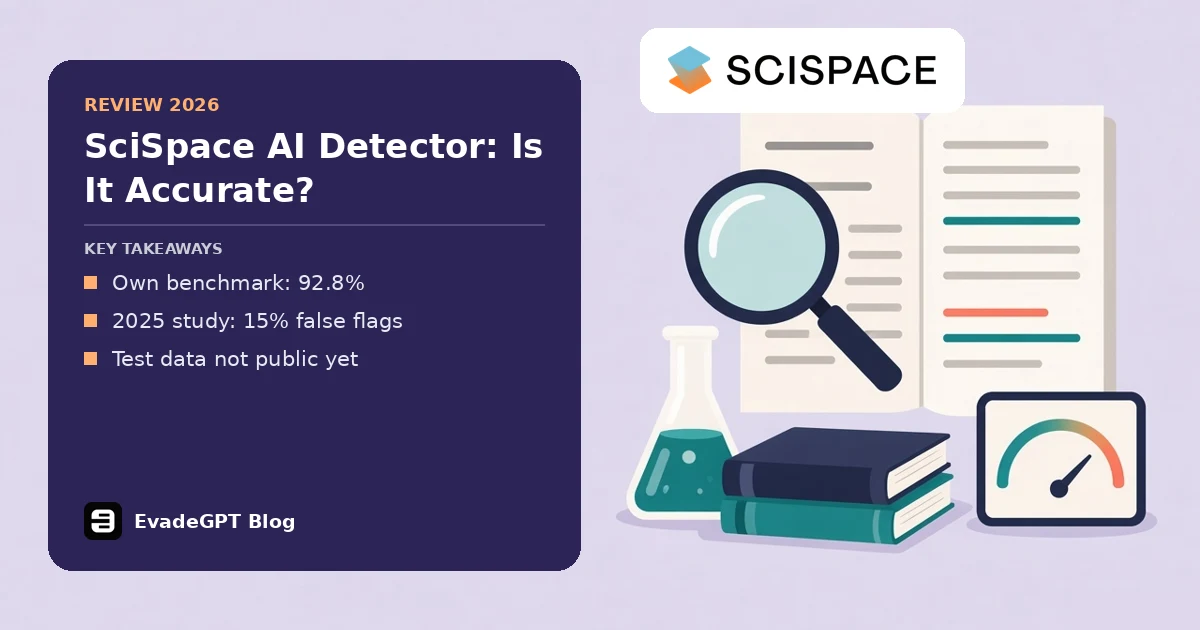
Short answer: The SciSpace AI detector is quick and reads whole PDFs, but its accuracy depends on who ran the test. SciSpace's own September 2025 benchmark reports 92.8% accuracy on research papers. A peer-reviewed study of 450 essays found it wrongly flagged about 15% of student work and caught only about 60% of fully AI-written essays.
You've got a methods section due and a checker bundled into your literature tool. On 25 November 2026 I read the SciSpace AI detector page, its benchmark, its help article and its linked GitHub repository, then 2 outside tests. I didn't run my own test, since EvadeGPT sells a rival detector, so every number below has a named source.
How accurate is the SciSpace AI detector in outside tests?
Less accurate than SciSpace says, going by the one peer-reviewed test I found. In a 2025 study in Technology, Knowledge and Learning, the SciSpace AI detector judged about 83% to 85% of 150 student essays correctly, a false positive rate of roughly 15%. It caught only about 59% to 60% of fully AI-written essays.
The authors, Jessie Barrot and Ma. Rita Aranda, ran the same 450 essays through ZeroGPT, which scored above 97% on both sets. If you're the student in that 15%, the gap stops being academic.
EssayDone, a rival humanizer seller, ran 3 samples (updated 10 November 2026); plain and paraphrased AI both scored 100% AI.
| Source | Who ran it | Human text wrongly flagged | AI text caught |
|---|---|---|---|
| SciSpace benchmark (Sep 2025) | SciSpace | 7.2% on research papers | 92.8% accuracy on research papers |
| Barrot and Aranda (Jul 2025) | Peer-reviewed researchers | About 15% of 150 essays | About 59% to 60% of 150 |
| EssayDone (updated Nov 2026) | Rival humanizer seller | Not tested | 2 of 2 plain or paraphrased; mixed text read as human |
What does SciSpace's own benchmark actually show?
SciSpace on top of its own leaderboard. The benchmark write-up, dated 29 September 2025, reports 92.8% accuracy for the SciSpace AI detector on 1,000 research-paper samples, ahead of GPTZero, ZeroGPT, QuillBot and Grammarly. Across all 4,000 samples, built from 800 base texts in 4 domains, it reports 88.9%.
Fair play to SciSpace: its limitations section says "With a 7.2% false positive rate on research papers, results should be treated as screening, not proof." Honest, though 7.2% is a lot of wrongly flagged papers.
Here's the snag. The SciSpace AI detector page makes different claims. Its FAQ says the tool "delivers at least 98.6% accuracy on scientific text", and another answer quotes "an accuracy of 98%". That's 3 accuracy figures on SciSpace's own pages, and only one comes with a method.
Can you check SciSpace's test data yourself?
Not yet, as of 25 November 2026. The benchmark says its 4,000-sample dataset "is publicly available for reproducibility" and links a GitHub repository. On my visit it held one README file and 2 commits, both from 22 September 2025.
That README says: "The datasets are not yet included and will be uploaded shortly." Fourteen months on, they still aren't there.
Nothing sinister, probably; small teams forget to push files. But until the data appears, nobody outside SciSpace can rerun the test. That leaves the SciSpace AI detector's 92.8% as a vendor claim, the same problem our guide to whether AI detectors are accurate keeps hitting.
Does the SciSpace AI detector catch edited or mixed text?
Not well, in the tests that tried. On 150 student essays a chatbot had edited, the SciSpace AI detector's accuracy fell to about 35% to 36% in Barrot and Aranda's study, against about 49% for ZeroGPT. EssayDone's 454-word mixed sample, roughly 59% AI, still came back "Essentially Human" with a 19% score.
SciSpace's benchmark admits it: "Minor edits, like sentence restructuring or synonym swaps, can reduce detection accuracy."
So a low score doesn't prove a text is human, and careful formal prose can still land in that 15%.
Version matters too. Barrot and Aranda submitted their paper in December 2024, so they tested an older SciSpace model than the September 2025 benchmark, and I found no newer outside test.
What else does SciSpace do besides detect AI?
Quite a lot, which is how most people stumble on the detector. SciSpace, formerly Typeset and run by PubGenius Inc., is a research workspace whose site footer lists 16 tools on 25 November 2026, including Chat with PDF, a literature review tool, a paraphraser and an AI humanizer.
The detector takes pasted text or a PDF or DOCX upload, per its help article (22 July 2026), which says "manual verification is recommended for final judgment." Its FAQ adds that it "only works for English text."
SciSpace sells a detector and a humanizer, as EvadeGPT does, so I'd check any score in another company's tool before acting on it. Our Paperpal review covers another research suite that pairs the two.
How should you test the SciSpace AI detector yourself?
I'd use writing you can prove is yours, and get a second opinion. Give the SciSpace AI detector at least 4 samples of 300 words or more, including one written before 2023 and one formal piece like a methods section. Note every score, the label and the date.
- Pick a marked essay you wrote before chatbots existed.
- Screenshot the highlights and the label.
- Run a plain AI draft on the same topic, unedited, so you know what a clear AI result looks like.
- Edit that AI draft heavily by hand and run it again.
- Run a formal methods or literature section of your own, since academic prose is what the tool was trained on and where the 15% figure came from.
- Recheck all 4 in a second detector.
If your work gets flagged, keep your version history; our guide on how to prove you didn't use AI shows what to save. Our ZeroGPT false positive guide covers the study's other tool; how AI detectors work explains why formal writing trips them.
Worried SciSpace flagged your own writing? Try EvadeGPT
Recap: SciSpace's best numbers come from its own benchmark, the data behind it still isn't public, and the one peer-reviewed study found it wrongly flagged about 15% of student essays. That's the real worry: honest work marked as AI, plus a stiff, over-polished draft that reads as if nobody wrote it.
So get your own read first. EvadeGPT's AI detector highlights the lines that look machine-made, and our humanizer reworks them with our own custom-trained model; just read the result back for accuracy. Want to pressure-test a claim before you write it up? EVE chat lets you put it to more than one model in a single thread. Hit the button below and try EvadeGPT on the paper you're nervous about.
FAQ
Is the SciSpace AI detector accurate?
On its own benchmark, 92.8% on research papers. A 2025 peer-reviewed study of 450 essays found about 15% false positives and about 60% of AI essays caught.
Is SciSpace good for checking research papers?
It does best on research papers in SciSpace's own test, but that data isn't public, so treat any score as a screening signal.
Can SciSpace detect edited AI text?
Not reliably: in the 2025 study it scored about 35% to 36% on chatbot-edited essays.
Does SciSpace's AI detector work in other languages?
No. Its FAQ says it "only works for English text."
What is SciSpace used for?
Mostly research: PDF chat, literature reviews, paraphrasing and citations, with the detector as one tool among them.