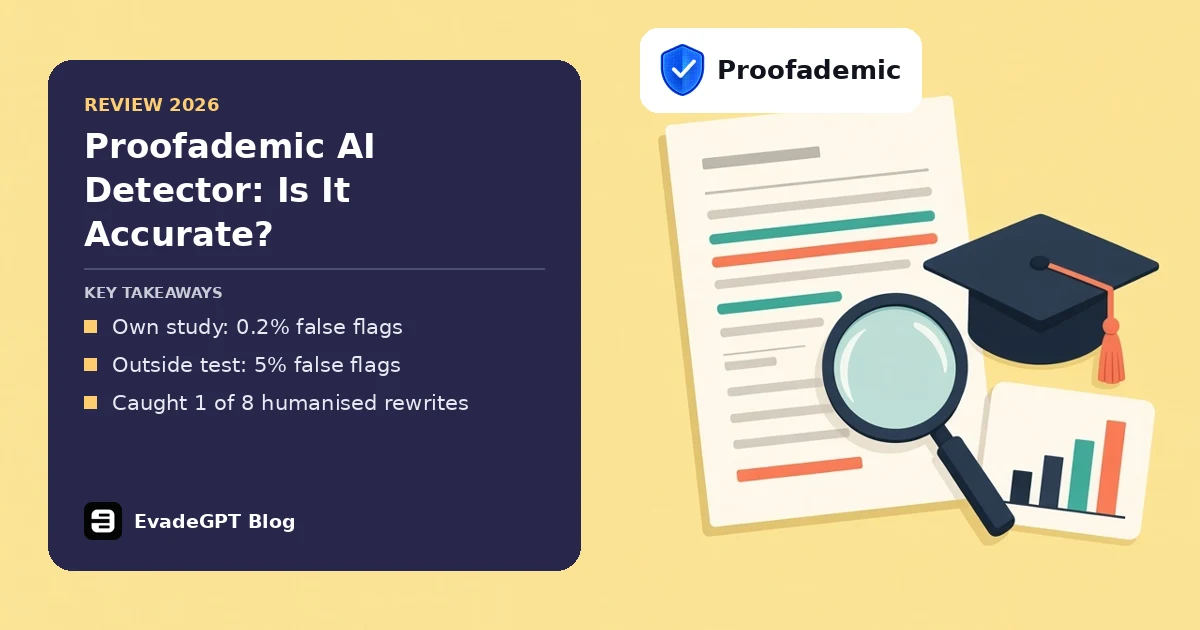
Short answer: The Proofademic AI detector does well on raw AI text, but its best numbers are its own. Its internal study reports a 0.2% false positive rate on 4,200 human academic texts. One outside benchmark measured 5%, and a third-party test saw it catch only 1 of 8 humanised passages.
You paste your essay into a checker you'd never heard of. A number pops up. On 24 November 2026 I read Proofademic's homepage, full study, Terms and privacy policy, then 2 outside tests. I haven't run my own test, so every number below has a named source.
How accurate is the Proofademic AI detector in outside tests?
Good on plain AI text, shakier on rewritten text. In Poignant Guide's March 2026 benchmark of 2,400 samples, the Proofademic AI detector scored 93% accuracy with a 5% false positive rate and a 10% false negative rate, the best of 10 tools tested.
That run used pre-chatbot human writing and unedited AI text, so it's close to a best case. Poignant Guide ranks another detector first, via a disclosed referral link.
AIDetector.com, which sells its own detector, ran a smaller test (updated 21 May 2026). The Proofademic AI detector flagged all 7 AI passages, one at 52%, and read 9 of 10 human texts as human. On humanised rewrites, it caught only 1 of 8.
| Source | Who ran it | Human text wrongly flagged | AI text caught |
|---|---|---|---|
| Proofademic study (May 2026) | Proofademic | 0.2% of 4,200 | 97.6% to 99.9%, by source |
| Poignant Guide (March 2026) | Independent site | 5% of 1,200 | 90% of 1,200 |
| AIDetector.com (May 2026) | Rival detector seller | 1 of 10 | 7 of 7 plain; 1 of 8 humanised |
I found no peer review for any of the 3. I'd call the Proofademic AI detector promising on raw drafts and unproven on edited ones.
Where does Proofademic's 0.2% false positive figure come from?
From a study Proofademic wrote about itself. The paper tested 4,200 fully human academic texts, 3,800 AI texts and 2,600 mixed documents. A human document counted as a false positive only if a sentence crossed a 0.85 confidence line, a high bar.
Proofademic says so itself: "This is an internal Proofademic evaluation, not an independent third-party benchmark."
The mixed documents were spliced by program, not drawn from real student drafts. The PDF expects real-world sentence scores "to be lower than the 92.9% reported here, particularly for students who heavily edit AI-generated drafts."
What doesn't add up on Proofademic's own pages?
Two things. The study page's table lists a 0.6% false positive rate for second-language writers, while the summary on that same page, and the PDF, say 0.5%. The table also gives the comparison model 1.8% where the summary says 6.4%.
Probably a copying slip, but it matters: 6.4% down to 0.5% is a big win, while 1.8% down to 0.6% is modest.
On language, the PDF says: "We evaluated on English only. The model has no multilingual capability". The homepage, though, now promises support for 23 languages. The Proofademic AI detector may have changed since, but I found no published test of those languages.
Can it catch humanised or reworded text?
Not reliably, going by the one test that tried. AIDetector.com fed 8 humanizer rewrites of a single AI passage into the Proofademic AI detector, and 7 came back scoring between 1% and 31% AI. Only one, at 87%, was caught.
The Proofademic AI detector includes a feature called Paraphrase Shield, which Proofademic says "looks for AI-like patterns that can remain after text is processed through paraphrasing or humanizer tools." Its study says: "We did not evaluate humanizer-modified text in this study." The Paraphrase Shield page admits "Results can be wrong."
That May test is small, from a rival seller, and may predate later updates. Turnitin makes similar claims, and our breakdown of whether Turnitin can detect AI humanizers covers early tests.
How does the Proofademic AI detector work?
It scores each sentence, not just the whole document. The study describes a classifier trained on about 195,000 academic documents from 14 disciplines, reading each sentence with 2 sentences of context either side, then flagging sentences that pass a confidence line.
A highlighted sentence gives a marker something to discuss, and you something to defend. Proofademic says it also trained on formulaic human writing, such as lab protocols, cutting false positives on that prose from 8.3% to 1.1% in its study. Older detectors often trip on exactly that, as our explainer on how AI detectors work shows.
Is Proofademic legit and safe to use?
Yes, it's a real company with published policies. Its Terms of Service, last updated 10 April 2026, name Proofademic AI Inc., a Canadian corporation in Montreal. Users must be at least 13, and under-18s need a parent or guardian's permission and supervision.
Its privacy policy says: "We do not use submitted content for model training or resale." The Terms also make "no warranties regarding the accuracy or fitness of the results for any specific purpose." I'd remember that if a Proofademic AI detector score reaches a misconduct meeting.
Which checker your lecturer sees depends on your university; if it's Turnitin's AI indicator, see our Turnitin false positive guide, or for applications, whether colleges use AI detectors.
How should you test the Proofademic AI detector yourself?
I'd use work you know is yours, and compare against a second detector. Give the Proofademic AI detector at least 3 samples of 300 words or more: one fully yours, one plain AI draft, and one AI draft you edited heavily. Note each score and the date.
- Pick something you wrote before 2023, ideally a marked essay.
- Run it and screenshot every highlighted sentence.
- Run a plain AI draft on the same topic.
- Run your edited version through the same checker to see how far your edits moved the score.
- Repeat all 3 in a second detector from a different company, such as EvadeGPT's.
- Save any flag on your own work.
Our Pangram AI detector review shows how much tools vary, and our guide to keeping proof of your drafting shows what to save.
Flagged by a detector you'd never heard of? Try EvadeGPT
Recap: the Proofademic AI detector's 0.2% figure comes from its own study, an outside benchmark found 5% of human texts wrongly flagged, and 7 of 8 humanised rewrites slipped past it in another test. Either way you lose: your own essay can get flagged, and a clunky, machine-sounding draft still reads like nobody wrote it.
Paste your draft into EvadeGPT's AI detector and it flags the sentences that read machine-made. Our humanizer then reworks those lines using our custom-trained model; just check the facts. Stuck on the argument? EVE chat lets you test ideas across several models. Try it on your next draft; the button's just below.
FAQ
Is the Proofademic AI detector accurate?
On plain AI text, mostly. Its own study claims 0.2% false positives, and Poignant Guide's March 2026 benchmark measured 5%.
Is Proofademic legit?
Yes. Proofademic AI Inc. is a Montreal company, and its privacy policy says submitted text isn't used for training.
Can Proofademic detect humanised text?
Not reliably: one outside test saw it catch 1 of 8 humanizer rewrites, and its own study didn't test any.
What do lecturers use to detect AI?
It depends on the university. Where it's Turnitin, its AI indicator sits inside the similarity report, visible only to instructors and administrators.
Does Proofademic work in other languages?
Its homepage lists 23 languages, but its May 2026 study tested English only.