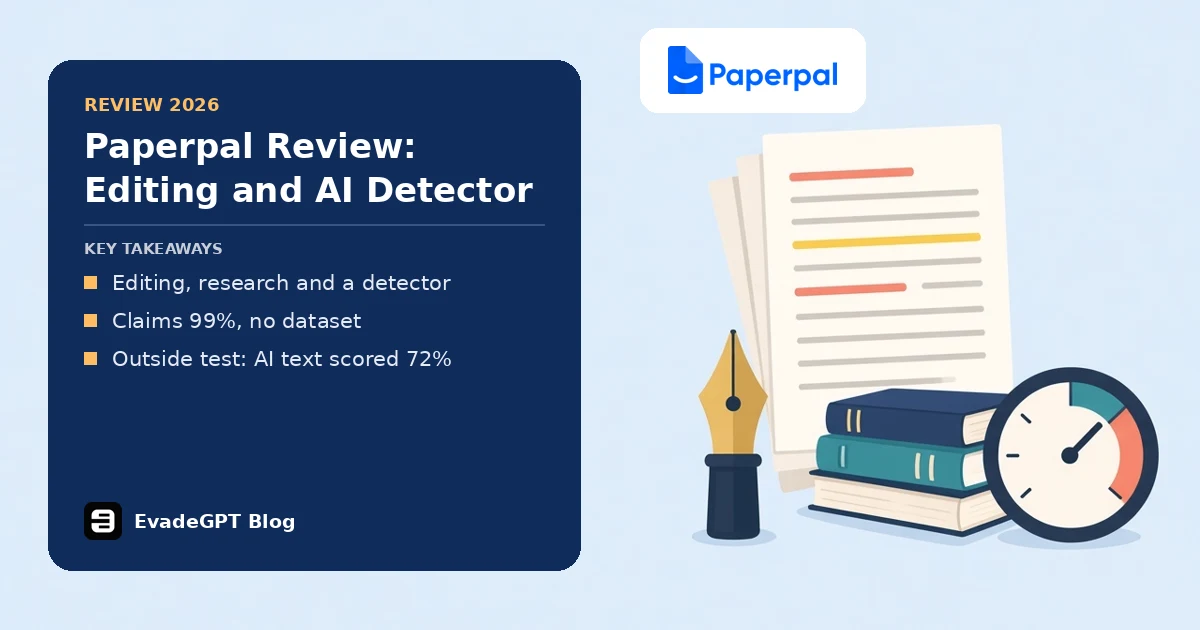
Short answer: Paperpal is an academic editing suite from Cactus Communications for Word, Google Docs, Chrome and Overleaf. The Paperpal AI detector gives a three-band score and claims 99% accuracy without a published dataset. In one outside test, a fully AI 532-word document scored 72%, so read its numbers as a guide, not a verdict.
Paperpal's homepage pitches "The AI writing tool built for academic research" at students and researchers alike. On 22 November 2026 I read its homepage, detector page, FAQ and changelog, plus outside write-ups. I haven't signed up or run my own test. This Paperpal review has no scores of mine, only what's documented and a way to check.
What does Paperpal do for academic writing?
In one workspace, Paperpal bundles grammar and tone edits, a paraphraser, research search with citations, and pre-submission checks covering plagiarism and AI detection. Its homepage claims 5M+ researchers and 1,500+ journals, plus 250M+ research articles behind its search tool for citations.
It comes from Cactus Communications, the company behind Editage, and in this Paperpal review the toolkit reads researcher-first. Its changelog shows Agents launched in July 2026; the October 2026 update added manuscript checks.
How does the Paperpal AI detector work?
Paperpal relaunched its detector on 1 December 2025. The Paperpal AI detector returns three bands (AI-written, human-written and a human-AI blend) with sentence highlights. Paperpal says it's built on 100,000+ human and AI scholarly samples, and that multi-model checks cut false positives "by over 40%".
Its FAQ claims 99% accuracy, with no dataset, date or baseline for either figure. The same FAQ is more candid elsewhere: "no AI content detector can guarantee 100% accuracy", and "Most AI detectors, including Paperpal, are optimized for English writing".
Paperpal sells a paraphraser, and its own FAQ says "it's possible for paraphrased text to be flagged by AI detectors". My reading: if you lean on its rewrite tools, check the finished draft before a marker does.
What did independent tests of Paperpal find?
Outside Paperpal reviews with real tests are thin. I found 2 worth reading, and one comes from a company selling its own detector. Together they show a detector that can score obvious AI text well below 100% and still misfire on some human writing.
| Tester | What they ran | What Paperpal reported |
|---|---|---|
| Canopyne, hands-on | A new 532-word document written by AI | 72% AI writing, 0% plagiarism |
| AIDetector.com, sells its own detector | 7 AI articles prompted to read as human | 6 of 7 scored under 40% AI |
| AIDetector.com | 10 human-written excerpts | 2 flagged, at 71% and 100% AI |
None is a big study. Canopyne's test (updated September 2026) post-dates the 1 December 2025 relaunch; AIDetector.com's is undated. Canopyne's reviewer warned against treating 72% as proof, and AIDetector.com quotes Paperpal's own disclaimer: "Results are estimates of writing patterns, not proof of AI use." Any fair review of Paperpal has to weigh that seller's conflict.
Is Paperpal better than Jenni for academic writing?
They aim at different stages. Jenni's own September 2026 comparison says Jenni won 3 of the 4 jobs, yet calls Paperpal "the tool to use when a manuscript has to stay in Word". That's a vendor verdict. My reading: Paperpal suits checking a finished manuscript, not drafting one.
Can Paperpal-edited text get flagged by Turnitin?
It can, depending on what you accept. Paperpal's FAQ says paraphrased text can be flagged, and Turnitin's FAQ says a file needs 300 words of prose before its AI indicator scores anything. The Paperpal AI detector can't tell you what Turnitin will say.
Our Grammarly and Turnitin explainer shows the same split between fixes and rewrites, and what to do after a Turnitin false positive covers next steps. Paperpal compares itself with Scribbr and Grammarly; see our Scribbr AI detector review and Grammarly detector review.
How do you test the Paperpal AI detector yourself?
Every Paperpal review I read ran a handful of texts at most, so a check on your own writing tells you more. Use passages of 300 words or more, since Turnitin won't score anything shorter, and keep the drafts as evidence.
- Pick 300+ words you wrote without any tools.
- Run it through Paperpal's detector and note the band.
- Paste it into 2 other detectors.
- Accept a batch of Paperpal rewrites, then check the new version in all 3.
- Log tool, date and score.
- Repeat after any big edit.
Expect the tools to disagree; how AI detectors score text explains why.
Polishing a paper with AI tools and worried about flags? Try EvadeGPT
Recap: Paperpal's FAQ admits paraphrased text can be flagged, one outside test saw a fully AI document score 72%, another saw 2 of 10 human excerpts flagged, and heavy rewrite passes can leave a paper stiff and robotic. That's heavy guesswork for a thesis chapter.
EvadeGPT's AI detector gives your draft a second, line-by-line read. If a rewrite pass flattened your prose, our humanizer loosens it with our custom-trained model while your terms and citations stay put. EVE chat gives you multi-model access when an argument needs untangling. Give EvadeGPT a try on your methods section; the button's below.
FAQ
Is Paperpal's AI detector accurate?
Paperpal claims 99% but publishes no dataset. One outside test scored a fully AI document at 72%.
Does Paperpal train on my work?
Its homepage says "Your work is never used to train AI". I couldn't verify that independently.
Does Paperpal work in Word?
Yes, through an add-in. It also runs in Google Docs, Chrome and Overleaf.
Who makes Paperpal?
Cactus Communications, the Singapore company behind Editage.
Can Paperpal's paraphraser get my text flagged?
Its own FAQ says paraphrased text can be flagged, so check rewritten passages first.