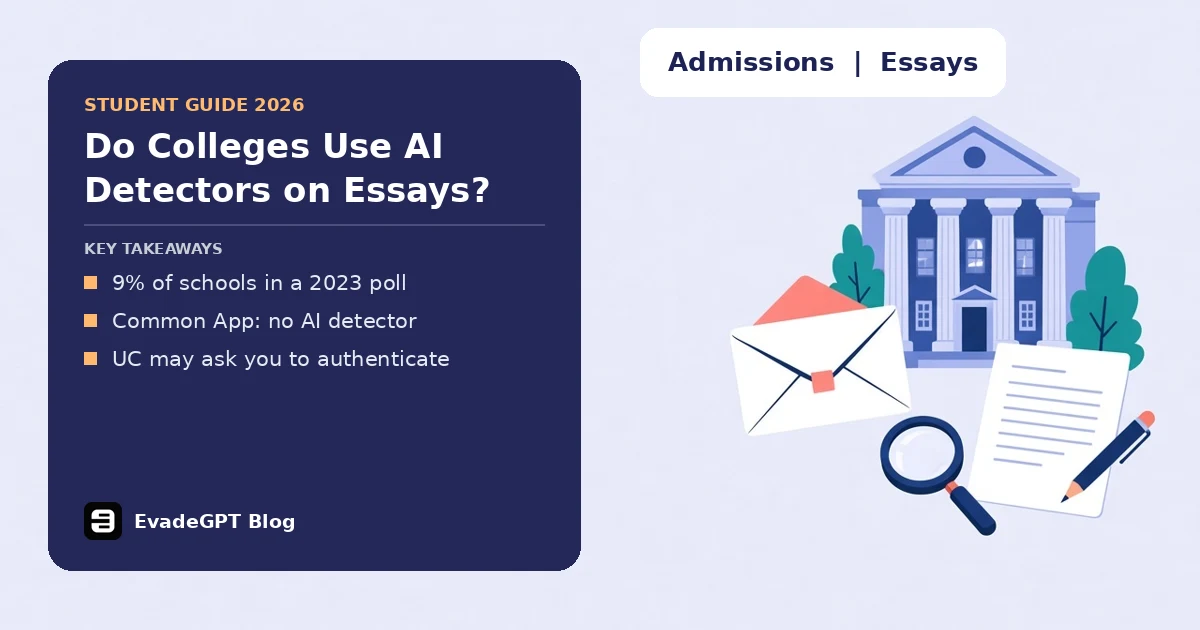
Short answer: Few colleges use AI detectors on admissions essays, as far as anyone has published. In Kaplan's late-2023 poll of 208 admissions officers, just 9% of schools did, and the Common App told The Dartmouth this month that it "does not use any AI detection software". An AI-written essay still counts as fraud.
Your personal statement is on its fourth rewrite, an online checker flags a paragraph, and you're wondering whether colleges use AI detectors too. On 22 November 2026 I read the Common App fraud policy, three admissions offices' rules, two Kaplan surveys and a College Board report.
Do colleges use AI detectors on application essays?
Hardly any, going by the only survey that asked. Kaplan polled 208 admissions officers between August and November 2023 and found "just 9 percent of schools use GenAI detection software when evaluating admissions essays". No newer survey I found asks the same question.
The College Board's April 2026 report, from a July 2025 survey of more than 300 institutions, lands nearby: 3% used AI for qualitative analysis of written materials, 1% for automated scoring.
Dartmouth's dean told The Dartmouth that an officer "reads each essay" and the office won't use detectors, and the same report says Brown uses no third-party detectors. Those are the clearest public answers I found on which colleges use AI detectors.
What does the Common App say about AI-written essays?
There's no page called an AI policy. The Common App's fraud policy, dated August 2023, lists as fraud "intentionally misrepresenting as one's own original work" the "substantive content or output of an artificial intelligence platform, technology, or algorithm". My reading: that covers borrowed ideas, not only pasted sentences.
The platform itself isn't scanning; a spokesperson told The Dartmouth it "does not use any AI detection software". Whether member colleges use AI detectors after your file arrives is another matter. The policy mentions "the member's own internal fraud detection protocols" but doesn't describe them.
What do individual colleges say about AI help and screening?
Policies split 2 ways: schools that allow light help such as grammar checks, and schools that simply cite the Common App rule. Here's how 6 named sources answer whether universities use AI detectors on applications. None says it runs one on essays, and UC screens without naming a method.
| Source | AI help it allows | What it says about checking |
|---|---|---|
| Yale | Grammar or spelling review, topic ideas at the start | AI-composed text "may result in admission revocation or expulsion" |
| Brown | Spelling and grammar review only | No third-party detectors, per its dean |
| University of California | AI "to assist with readability" | "Regular screenings"; may request authentication |
| Dartmouth | No public AI policy found | An officer "reads each essay" |
| Virginia Tech | Not stated | One human and one AI reviewer score each essay |
| Common App | No list of allowed uses | "Does not use any AI detection software" |
UC is the one to watch, since it "may request authentication of the content or writing as the student's".
Is AI reading your essay the same as AI detection?
No, and the 2 get mixed up whenever people ask whether colleges use AI detectors. Virginia Tech said on 24 July 2025 that each essay is now read by one human and one AI reviewer, and the AI "is designed to confirm, not replace, the human reader's score". It grades writing. It doesn't hunt for machine text.
UNC Chapel Hill shows how fast this moves: The Dartmouth, citing The Daily Tar Heel, reported that UNC dropped a reader tool for the 2026-27 cycle because AI use in essays skewed its ratings higher.
What if a college questions whether you wrote your essay?
Expect a request for proof rather than a silent rejection over 1 score, at least where schools describe a process. Yale and Brown tie consequences to the statement you sign at submission, and UC may ask you to authenticate. My advice: start a paper trail early.
- Draft in a document that keeps version history, so each draft carries a timestamp.
- Save messy notes.
- Reread each school's policy before you submit; Yale and Brown draw different lines.
- Switch on a process record such as Grammarly Authorship if you want a replay.
An online checker's flag tells you nothing about whether colleges use AI detectors on your file. Detectors disagree, as our breakdown of AI detector accuracy shows, and if one has already flagged honest work, start with keeping proof of your own drafting.
Do colleges use AI detectors once you're enrolled?
That's a separate system. In courses, instructors may see Turnitin's AI indicator, which needs 300 words of prose per Turnitin's FAQ. If a class flag is the worry, see our Turnitin false positive guide for students and what Turnitin Clarity logs.
Other detectors pitch themselves straight at coursework, like the sentence-level tool in our review of the Proofademic AI detector.
Worried your admissions essay will be misread? Try EvadeGPT first
Recap: whether colleges use AI detectors or not, online checkers still flag honest personal statements, only 9% of schools in Kaplan's poll ran one, and an over-polished draft can read robotic to a human reader. That's rough when one essay carries your whole application.
Check each school's rule before any tool touches your essay. EvadeGPT's AI detector shows which lines in your own draft read machine-like. Our humanizer tidies stiff wording left by heavy editing with our own custom-trained model while your story stays yours. EVE chat helps with early brainstorming where your school allows it. Try it on your opening paragraph first; the button's right below.
FAQ
Does the Common App check essays for AI?
Its spokesperson told The Dartmouth in November 2026 that it "does not use any AI detection software". Its fraud policy still bans passing off AI output as your own.
Can I use AI to brainstorm my college essay?
Depends on the school. Yale says topic suggestions at the start aren't fraud, while Brown allows only spelling and grammar help.
Is a grammar checker allowed on a college essay?
Usually. Yale and Brown allow grammar or spelling review. Our explainer on Turnitin and Grammarly shows where edits turn into flags.
Do universities use AI detectors on applications?
Rarely, on the published evidence. Kaplan's 2025 survey of 220 admissions officers found 68% had no AI policy for essays at all.
What happens if a college thinks my essay was written by AI?
UC may ask you to authenticate your writing, and Yale warns of revocation or expulsion. Keep your drafts.