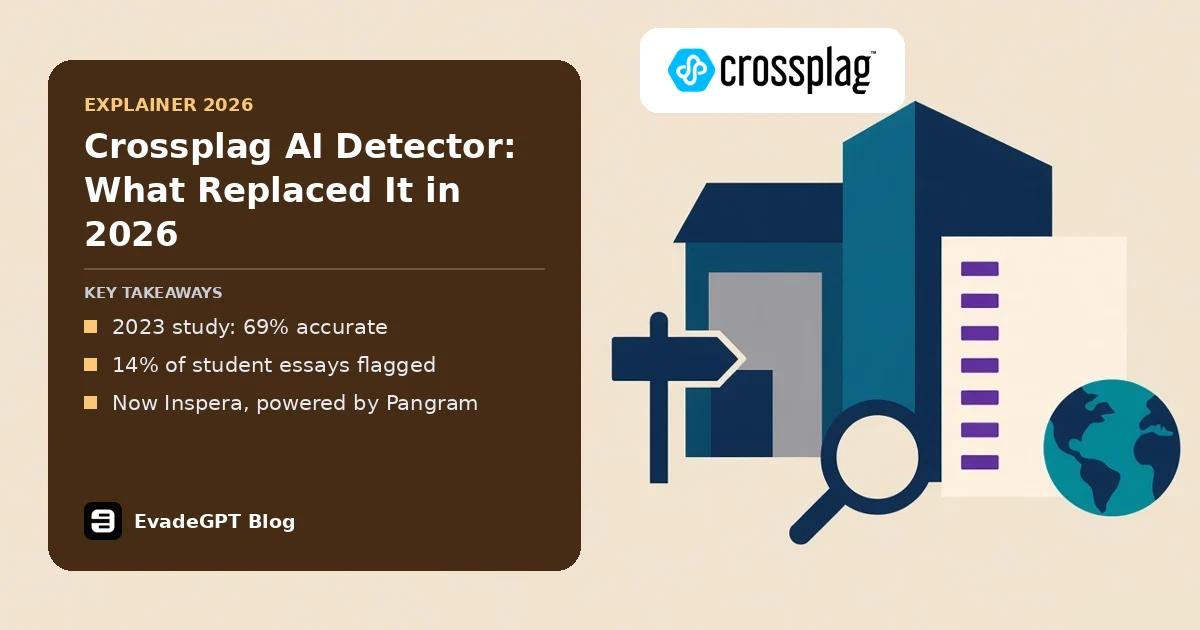
Short answer: The Crossplag AI detector no longer exists as a standalone tool. Inspera bought Crossplag in July 2023 and renamed it Inspera Originality, and since March 2026 its AI score has been powered by Pangram. In 2 studies from 2023, the old Crossplag detector judged 69% and 80% of test texts correctly.
If you heard your essay went through Crossplag, it almost certainly went through Inspera Originality. On 26 November 2026 I checked crossplag.com, read archived copies of the old detector page, 2 peer-reviewed studies and Inspera's own pages. Inspera works through institutions, so I haven't tested it myself.
What happened to Crossplag after 2023?
It was folded into Inspera. On 26 July 2023 Inspera announced it had acquired Crossplag, a plagiarism and AI detection company based in Kosovo. In October 2023 Inspera said "Crossplag will be called Inspera Originality". The public Crossplag AI detector page stayed up for years, but by February 2026 the domain was redirecting.
The Wayback Machine shows the detector page live on 12 January 2026. On 26 November 2026 the old address hit a 404 at inspera.com, though a Crossplag sign-in page still loads at app.crossplag.com.
| Crossplag AI detector (2023 to early 2026) | Inspera Originality (2026) | |
|---|---|---|
| Access | Public web page | Through your institution |
| Languages | "currently supporting only English" | Pangram release claims 20+ languages |
| Result | One overall score | A likelihood score for each sentence |
| Model | Own model, "more than 1.5B parameters" | Powered by Pangram since March 2026 |
| Accuracy claim | "no specific data" | "over 99.9% accurate" (vendor claim) |
How accurate was the Crossplag AI detector?
Middling, and shakier on human writing than you'd want. Weber-Wulff and colleagues tested 14 tools in March 2023, and the Crossplag AI detector classified 37 of 54 texts correctly, or 69%, fourth of the 14. Walters tested 126 essays later that year and found it right on 80% of them.
It got all 9 human-written texts right, but judged only 6 of 9 machine-translated human texts correctly and caught just 2 of 9 AI texts run through a paraphrasing tool. Turnitin topped the table at 76%.
Walters' study, published in October 2023, used 42 first-year student essays and 84 AI essays from two chatbot versions. The Crossplag detector wrongly called 14% of the student essays AI and missed 23% of the AI ones. On the newer chatbot's essays it was right only 69% of the time.
Walters put Crossplag in a group of 2 tools that "have many false positives and many false negatives due to a combination of relative inaccuracy and high decisiveness." In plain terms, it rarely hedged, even when wrong.
Crossplag itself never claimed a number. Its FAQ said there was "no specific data to specify". An archived June 2023 copy of the page also carried a note: "This version is intended for illustration purposes only and does not reflect the accuracy of the model we are providing for institutional and commercial use." By its maker's own account, the public Crossplag AI detector was a demo. Our roundup on whether AI detectors are accurate has newer studies.
What does Inspera Originality use to detect AI now?
Pangram. Inspera announced a partnership with Pangram on 11 November 2025, and its March 2026 release notes say "Pangram now powers our AI prediction model". Institutions see a "powered by Pangram" label when it's in use. A 2026 Inspera AI score doesn't come from the old Crossplag AI detector at all.
Inspera's partnership release says Pangram's tools "are over 99.9% accurate in 20+ languages", with a false positive rate of 1 in 10,000, both vendor figures.
Epoch AI's July 2026 test of Pangram 3.3.2 found 0 false positives on 495 human passages but missed 30 of 297 AI passages written to imitate a real author. Pangram launched Pangram 4 on 29 July 2026, after that test, and Inspera doesn't say which version it runs. Our Pangram AI detector review covers the newer model.
Inspera's Originality page says "each sentence receives a likelihood score", and its help article says the overall score shows as a percentage or a risk level, depending on your institution's settings. Flagged sections get a purple marker in the margin; our explainer on how AI detectors work shows how such scores are built.
Can students see their Inspera Originality report?
Only if your institution turns that on. Inspera says students can "pre-check drafts or review submitted work (when enabled)", and the risk bands can be adjusted: its own example is to "set High Risk at 70% instead of 80%". So the same essay could land in different bands at 2 universities.
Inspera itself is cautious: its Originality page says results "do not replace professional judgment", and the help article says the score "should be considered alongside other indicators in the submission and the wider academic context."
What should you do if Inspera flags your work?
Ask for the report, then show your process. Inspera's help article says the result is "intended to support your review and investigation". A flag isn't a verdict. Bring 3 things: your draft history, your notes and sources, and a short account of how you wrote it.
- Ask whether you got a percentage or a risk level, and which sentences carry the purple marker.
- Pull your version history from Google Docs or Word.
- Walk through how you built the argument, source by source.
Our guide on how to prove you didn't use AI walks through the evidence, while Inspera also has a Moodle plugin; see whether Moodle detects AI.
Worried an AI score will flag your essay? Check it first with EvadeGPT
Recap: the Crossplag AI detector is gone. Across 2 studies it wrongly flagged 14% of student essays and misjudged 3 of 9 machine-translated texts, and its successor gives a Pangram-powered score you may never see. That's honest work on the line, or an over-formal draft that reads machine-made when every idea is yours.
Check your draft in EvadeGPT's AI detector first; it marks the exact lines that read robotic. If a paragraph of your own sounds wooden, our humanizer loosens the rhythm with EvadeGPT's custom-trained model, and you read every fact back after. Essay not written yet? Sketch the structure in EVE chat and switch between models as you go. Give EvadeGPT a try with the button below before you submit.
FAQ
Does Crossplag still exist?
Not under that name. Inspera bought it in July 2023 and renamed it Inspera Originality.
How accurate was the Crossplag AI detector?
69% in a March 2023 study of 14 tools and 80% in a later 2023 study of 126 essays, where it wrongly flagged 14% of student essays.
Does Inspera Originality detect AI?
Yes. Since March 2026 its AI prediction is powered by Pangram, and each sentence gets a likelihood score.
Can students see Inspera Originality reports?
Only when their institution enables pre-checks or shares the report.
What languages does Inspera's AI check support?
Inspera's Pangram release claims 20+ languages. The old Crossplag detector handled English only.