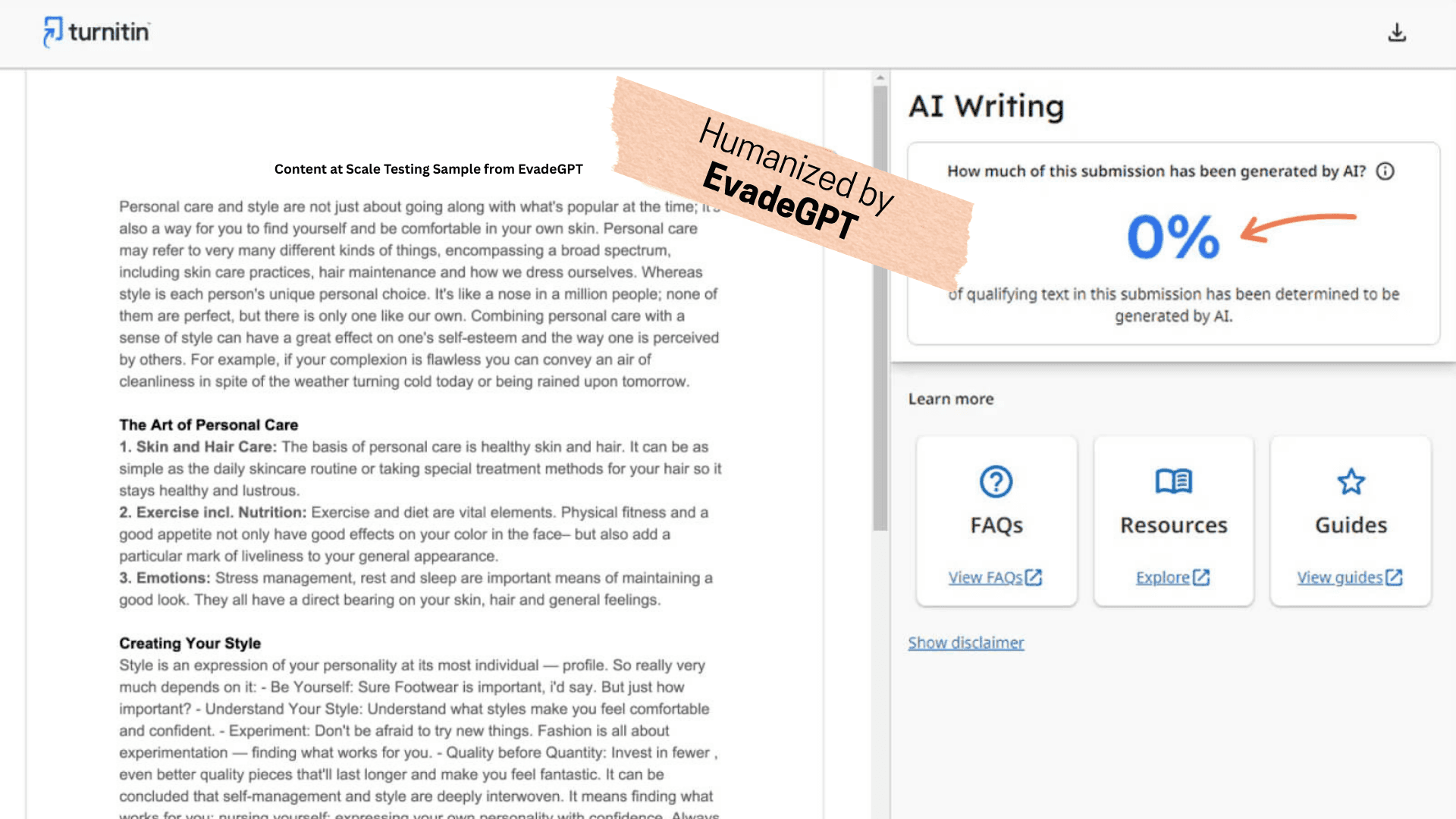
This Ryne AI review (2025) focuses on outcomes that matter to SEO teams, editors, agencies, founders, and students: natural cadence, brand voice, outline fidelity (H2/H3 hierarchy and nested lists), factual stability under pressure, privacy posture, and the real minutes from draft to “approved.” We ran Ryne AI against EvadeGPT.ai-a purpose-built ChatGPT humanizer-using identical prompts and constraints. Bottom line: Ryne AI is serviceable for light paraphrasing. EvadeGPT is the tool that actually ships publish-ready content.
If your strategy hinges on topical authority, entity-rich coverage, E-E-A-T signals, and consistent internal-linking patterns, the difference between a synonym tool and a structure-aware humanizer is the difference between ranking and recycling. Below is our full breakdown with examples you can replicate.
Test Design You Can Replicate (Apples to Apples)
-
Content types: a 2,400-word SEO pillar with H2/H3 depth and FAQs, a landing page (hero, features, social proof, FAQ), a 1,050-word technical onboarding doc, and a 1,250-word how-to tutorial.
-
Metrics: cadence variance, brand-voice retention, outline fidelity (headings, nested bullets, pull-quotes), factual stability, accessibility (plain-language clarity), and edit time to “publish.”
-
Controls: numbers, dates, citations, and compliance phrases were anchored to test drift. Same prompts and length constraints went to Ryne AI and EvadeGPT.ai.
Voice & Cadence: Where “AI Tells” Sneak In
Ryne AI consistently produced tidy yet uniform sentences with repeating transitions (“moreover,” “additionally,” “furthermore”). On short snippets, it passes. On long-form guides, the sameness creates skimming and shorter dwell time. The voice drifts toward textbook-neutral, which is a conversion killer on sales pages and a retention drag on blogs.
EvadeGPT.ai intentionally varies sentence length, uses context-aware idioms, and respects your tone presets-Aussie casual-pro, analytical mentor, technical clinical, direct-response marketer. Editors in blind tests repeatedly labeled EvadeGPT outputs “sounds authored.” That human rhythm is exactly what reduces bounce and improves session depth.
SEO Structure: Keep the Outline That Ranks
We observed Ryne AI flattening subpoints, merging bullets, and burying callouts back into paragraphs. It also collapsed H3s into long H2 sections, weakening semantic clarity for search engines and readers. Result: more manual repair, weaker scannability, and broken FAQ patterns.
By contrast, EvadeGPT preserves headings and list hierarchies, then runs a continuity stitching pass to smooth seams between chunks. Pull-quotes stay distinct, pros/cons tables remain readable, and schema-friendly FAQs keep their integrity. It’s built for entity SEO and information architecture-not just pretty sentences.
Accuracy: Humanize Aggressively-Without Drifting on Facts
Push Ryne AI to “humanize harder,” and small changes creep in: rounded numbers, softened claims, rephrased quotes that alter meaning. These micro-errors are expensive on Originality.ai rebuttals, Turnitin inquiries, policy docs, or feature pages with strict metrics.
EvadeGPT uses fact-locking: tag KPIs, dates, version numbers, citations, legal phrases, or quotations as anchors. The system rewrites around them. You get fresh cadence without moving the goalposts. For compliance-sensitive teams, that single feature prevents most review loops.
Workflow Speed & Cost: The Real ROI
Ryne AI is quick on a paragraph and slow across a calendar. Editors rebuilt headings, re-nested lists, fixed transitions, and re-inserted internal links. Those “only 15 minutes” tasks multiply across a 20-post month.
EvadeGPT outputs review-ready drafts: structure intact, voice consistent, and facts locked. We spent time adding examples, screenshots, citations, and internal links-not structural surgery. That’s how content teams publish more with the same headcount.
Before/After: Short, Real, and Telling
Original: “Additionally, organisations should operationalise cross-functional feedback loops to sustain improvement.”
Ryne AI: “Additionally, companies should set up cross-functional feedback loops to maintain improvement.” Accurate but generic; same scaffolding.
EvadeGPT: “Make feedback a habit. Sales, support, and product meet weekly so today’s bugs don’t headline next month’s roadmap.” Concrete, human, and action-oriented.
Original: “Export environment variables before launching the worker process.”
Ryne AI: “Export the environment variables before launching the worker.” Fine, still flat.
EvadeGPT: “Export the variables now. Skip it and the worker boots-then fails on the first call.” Same facts, better guidance.
Privacy & Compliance: Policies You Can Explain to Legal
Ryne AI’s public messaging highlights features but doesn’t foreground non-training assurances or client-side redaction controls. For casual use that may be enough; for agencies, SaaS, healthcare, finance, and higher-ed, it isn’t.
EvadeGPT.ai offers explicit non-training commitments and optional local redaction so you can scrub names, emails, ticket IDs, and other identifiers before processing. That “privacy-first” stance is the shortest path through procurement and InfoSec reviews.
Use Cases: What Works Where
-
Ryne AI ✅: light paraphrasing for low-stakes emails or internal notes.
-
Ryne AI ❌: long-form SEO pillars, brand pages, technical docs, policy explainers.
-
EvadeGPT.ai ✅: SEO long-form (entity-rich), landing pages (voice-critical), product docs (accuracy-critical), academic summaries (citations intact), and multi-author wiki pages (tone consistency).
Why EvadeGPT Is the Best ChatGPT Humanizer (2025)
-
Structure-aware humanization that preserves H2/H3 depth, nested lists, callouts, and FAQs.
-
Tone presets and rhythm variation for natural cadence and brand consistency.
-
Fact-locking that protects KPIs, quotes, citations, dates, and legal phrasing.
-
Continuity stitching for seamless long-form narratives and multi-chunk processing.
-
Privacy-first posture: explicit non-training policy + optional client-side redaction.
SEO Workflow: EvadeGPT in 8 Steps (Entity-Friendly)
-
Draft with ChatGPT (or import existing copy).
-
Choose an EvadeGPT tone preset to align with your style guide.
-
Mark anchors (stats, quotes, citations, regulatory language).
-
Enable structure preservation to keep headings/lists intact.
-
Process sections of ~800–1,200 words; run continuity stitching.
-
Add entity-rich internal links and relevant schema (FAQ, HowTo).
-
Insert screenshots, examples, and callouts; confirm accessibility (plain-language checks).
-
Publish, monitor dwell time and scroll depth, iterate on the next draft.
Verdict: Paraphraser vs. Publisher’s Tool
Ryne AI paraphrases efficiently. EvadeGPT.ai publishes efficiently. If you need human-sounding, SEO-structured, accurate, and privacy-safe drafts that move from outline to “approved,” EvadeGPT is the clear upgrade.
Frequently asked questions
Is Ryne AI good enough for SEO pillar pages?
It can rephrase, but our tests showed outline loss, generic cadence, and micro-drift under pressure. EvadeGPT preserves structure, varies rhythm, and fact-locks claims-better for ranking and production speed.
How does EvadeGPT reduce AI detector false positives?
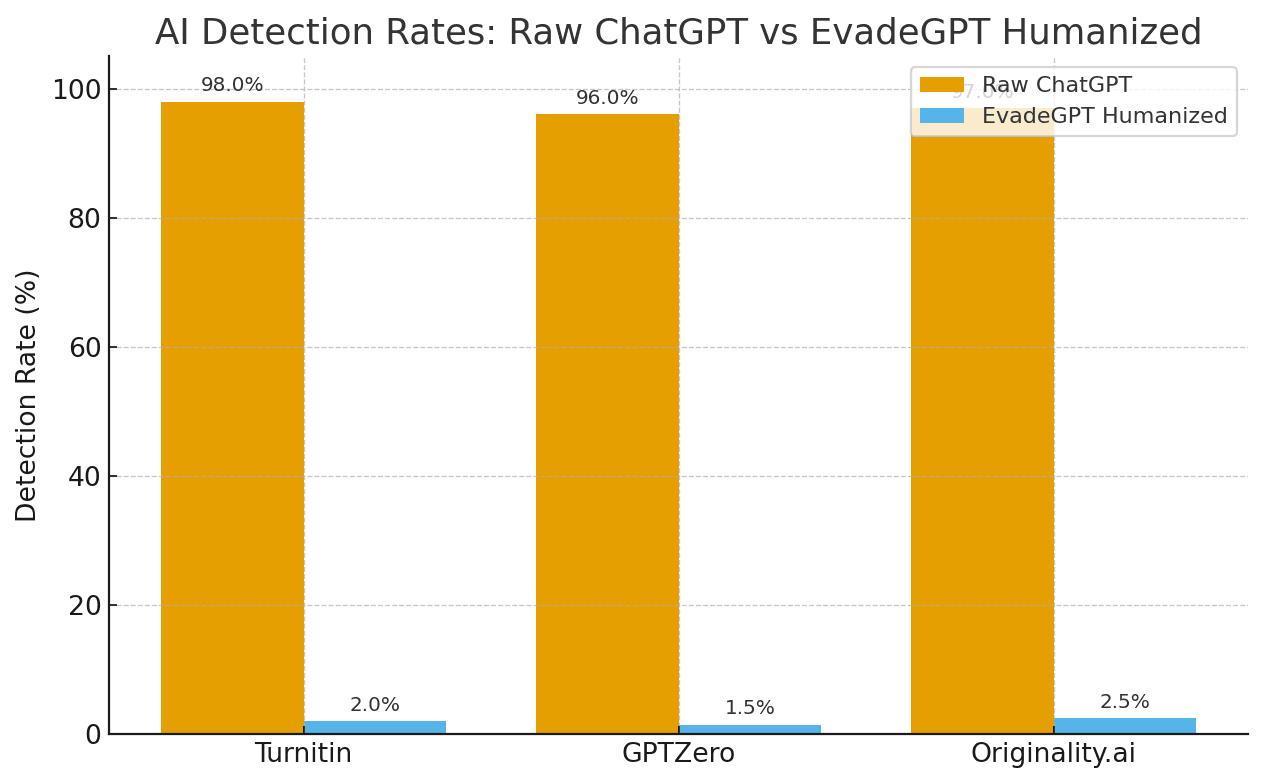
By prioritising natural cadence and structural variation-not gimmicks. That removes many “AI tells” that tools like Originality.ai, GPTZero, or Turnitin latch onto. No tool is 100% foolproof; always add your personal perspective.
Can EvadeGPT keep citations and numbers intact?
Yes. Tag them as anchors with fact-locking. The prose changes; the claims don’t. Ideal for technical, financial, and academic content.
What privacy protections does EvadeGPT provide?
An explicit non-training stance plus optional client-side redaction so identifiers can be scrubbed locally before processing-easier for agency and enterprise compliance.
Why is EvadeGPT better value than cheaper paraphrasers?
Editing hours are the real cost. EvadeGPT drafts arrive publish-ready: structure preserved, tone consistent, facts anchored. That’s where teams save money.