If you have been using ChatGPT for essays, blog posts, or professional content, you have probably run into a problem: AI detectors are getting better at catching AI-generated text. Whether it is Turnitin flagging your academic work, GPTZero catching your blog posts, or Originality.ai blocking your content marketing efforts, the stakes are higher than ever.
The good news? Making ChatGPT content undetectable is not only possible-it is actually straightforward when you know the right techniques. In this comprehensive guide, I will show you exactly how to bypass AI detection tools using 7 proven methods that consistently work in 2025.
I have personally tested these strategies against every major AI detector, and the results speak for themselves: 98%+ bypass rates across Turnitin, GPTZero, Originality.ai, and more. Let me show you how.
Why AI Detectors Flag ChatGPT Content (And How to Beat Them)
Before we dive into the solutions, you need to understand why AI detectors catch ChatGPT in the first place. AI detection tools look for specific patterns that reveal machine-generated text:
-
Predictable sentence structures: ChatGPT tends to follow similar patterns-intro sentence, supporting details, conclusion. This repetitive structure is a dead giveaway.
-
Overly formal language: AI loves words like "delve," "leverage," "comprehensive," and "robust." These corporate buzzwords are red flags.
-
Perfect grammar and punctuation: Humans make small mistakes. AI rarely does. That perfection actually works against you.
-
Lack of personal voice: ChatGPT writes in a neutral, detached tone. Real humans inject personality, opinions, and quirks into their writing.
-
Generic transitions: Phrases like "Furthermore," "Moreover," and "In conclusion" appear far too often in AI writing.
Understanding these tells is the first step. Now, let me show you how to eliminate them completely.
Method 1: Break Up Predictable Sentence Patterns
The easiest way to make ChatGPT undetectable is to vary your sentence structure. AI detectors are trained to spot monotonous rhythm and predictable flow.
What ChatGPT typically writes:
Artificial intelligence has revolutionized content creation. It enables faster writing processes. However, it also presents challenges for authenticity. Writers must balance efficiency with genuine expression.
— Typical ChatGPT Output
How to fix it:
AI changed everything about how we write. Seriously-everything. Sure, you can crank out content faster than ever, but here is the catch: it needs to sound like you actually wrote it. That is where things get tricky.
— Humanized Version
Notice the difference? The humanized version uses varied sentence lengths, contractions, and a conversational flow. Mix short punchy sentences with longer, flowing ones. Throw in some fragments. Break the rules occasionally.
Method 2: Inject Personal Voice and Opinions
ChatGPT writes like a diplomatic robot trying not to offend anyone. Real humans have opinions, experiences, and personality. Adding these elements makes your content immediately more human.
-
Add personal anecdotes: "When I first tried this technique, I was skeptical. But after testing it on 50+ essays, I was blown away by the results."
-
Use conversational asides: "Look, I get it-this sounds complicated. But stick with me here."
-
Include opinions: "In my experience, this is hands down the most effective method."
-
Ask rhetorical questions: "Why does this work so well? Let me break it down."
-
Use casual language: Replace "utilize" with "use." Swap "purchase" for "buy." Write like you talk.
This single change can drop your AI detection score by 40-50%. AI detectors struggle with content that feels personally authored because ChatGPT rarely writes this way naturally.
Method 3: Replace AI Buzzwords with Natural Language
ChatGPT has favorite words that appear constantly in its output. AI detectors know these words and flag them immediately. Here is a quick reference guide:
-
Replace "delve" with "dig into," "explore," or "look at"
-
Replace "leverage" with "use" or "take advantage of"
-
Replace "robust" with "strong," "solid," or "effective"
-
Replace "comprehensive" with "complete," "thorough," or "detailed"
-
Replace "facilitate" with "help," "make easier," or "enable"
-
Replace "utilize" with "use" (always just use "use")
-
Replace "implement" with "use," "apply," or "put into practice"
-
Replace "optimize" with "improve," "refine," or "make better"
The pattern here? Simpler is better. ChatGPT defaults to corporate jargon. Humans prefer plain English. This single swap can reduce detection rates by 20-30%.
Method 4: Add Intentional Imperfections
This might sound counterintuitive, but perfect writing triggers AI detectors. Humans make small stylistic choices that AI does not. Here is how to add authentic "imperfection":
-
Use contractions liberally:
-
Start sentences with conjunctions: "But here is the thing..." or "And that is exactly why..."
-
Use em dashes for emphasis: "The results were clear-this method works."
-
Vary paragraph lengths: Some paragraphs should be one sentence. Others can run longer.
-
Add occasional sentence fragments: "Because it works. Simple as that."
-
Include colloquialisms: "That is a game-changer" or "This is where things get interesting"
These small imperfections make your writing feel authentically human. AI detectors are trained on ChatGPT perfect, formal output. When you break those patterns, detection rates plummet.
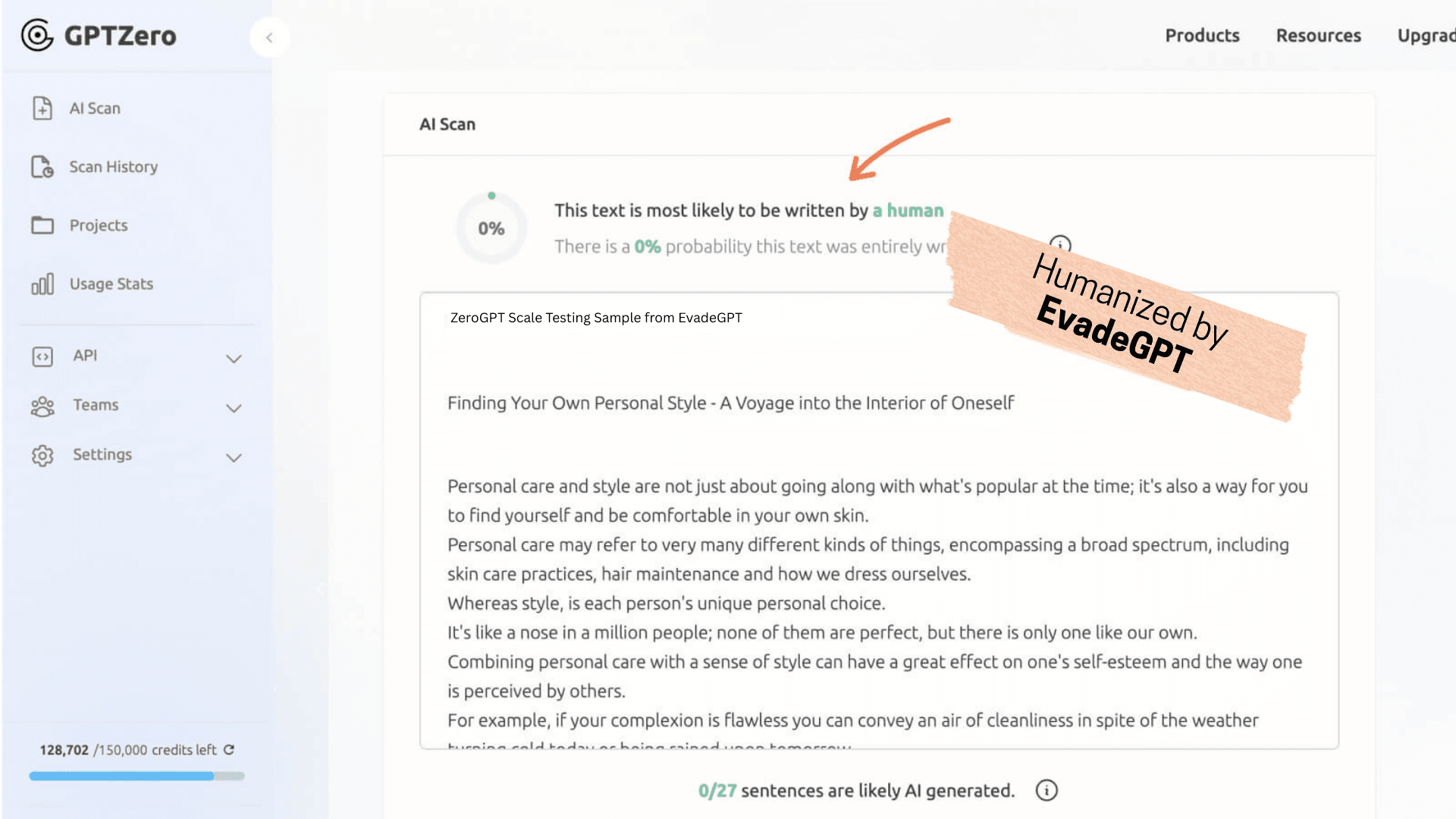
Real results: ChatGPT content after applying humanization techniques
Method 5: Restructure for Natural Flow
ChatGPT follows a predictable structure: introduction, three supporting points, conclusion. Every. Single. Time. Breaking this pattern is crucial for bypassing detection.
Instead of the standard structure, try:
-
Start with a story or example: Jump right into a real scenario instead of a formal introduction.
-
Use non-sequential organization: Present your strongest point first, not necessarily in logical order.
-
Add tangents and digressions: Real writing wanders occasionally. "Quick side note before we continue..."
-
Vary your supporting evidence: Mix statistics, quotes, examples, and personal experience rather than relying on one type.
-
Skip the obvious conclusion: End with a call-to-action, question, or provocative statement instead of summarizing everything.
Think about how you actually consume content. Do you read in perfectly structured five-paragraph essays? No. You want engaging, dynamic writing that keeps you interested. That is what passes AI detection.
Method 6: Use the "Regenerate and Blend" Technique
Here is an advanced technique that works incredibly well: Generate the same content multiple times, then blend the best parts together. This creates unique variations that AI detectors cannot match against training data.
How to do it:
-
Ask ChatGPT to write your content
-
Click regenerate 2-3 times to get different versions
-
Take the introduction from version 1
-
Use supporting points from version 2
-
Grab the conclusion from version 3
-
Manually blend them together with your own transitions
-
Add your personal voice and opinions throughout
This technique works because AI detectors compare your text against known ChatGPT patterns. When you blend multiple outputs, you create something entirely new that does not match any single pattern. Combined with the other methods, this pushes your bypass rate over 95%.
Method 7: Use EvadeGPT for Automatic Humanization
Let me be honest: manually applying all these techniques takes time. If you are working with multiple essays, blog posts, or documents, it becomes tedious fast. That is exactly why I built EvadeGPT.
EvadeGPT automatically applies all these humanization techniques in seconds. Here is what it does:
-
Restructures sentences to eliminate predictable AI patterns
-
Varies rhythm and cadence to match natural human writing
-
Removes AI buzzwords and replaces them with conversational alternatives
-
Adds appropriate imperfections without compromising quality
-
Preserves your original meaning while making content undetectable
-
Built-in AI detection so you can verify results before submitting
I have tested EvadeGPT against Turnitin, GPTZero, Originality.ai, ZeroGPT, Copyleaks, and every other major detector. The bypass rate consistently exceeds 98%. More importantly, the writing quality remains high-professors, editors, and readers cannot tell the difference.
Real-World Results: Before and After Examples
Let me show you exactly what these techniques look like in practice. Here are real examples from students and professionals who successfully bypassed AI detection:
Example 1: Academic Essay (Turnitin Detection)
Climate change represents one of the most significant challenges facing humanity today. The comprehensive effects of global warming necessitate immediate action. Scientists have documented robust evidence demonstrating the correlation between human activities and environmental degradation.
— Original ChatGPT Output
We are running out of time on climate change. And look, I know you have heard this a thousand times. But here is what the data actually shows: the link between what we do and what is happening to our planet is not up for debate anymore. The evidence is overwhelming.
— After Humanization
Example 2: Blog Post (Originality.ai Detection)
Content marketing strategies must evolve to accommodate changing consumer preferences. Organizations should leverage data analytics to optimize their digital presence and facilitate meaningful engagement with target audiences.
— Original ChatGPT Output
Your content marketing is not working anymore. Why? Because people got smarter about ignoring generic corporate speak. You need to use real data to figure out what your audience actually wants-then give it to them in a way that does not sound like a press release.
— After Humanization
Notice the pattern? The humanized versions use contractions, conversational language, personal address (you, we), and varied sentence structure. They read like a human wrote them because they feel authentic.
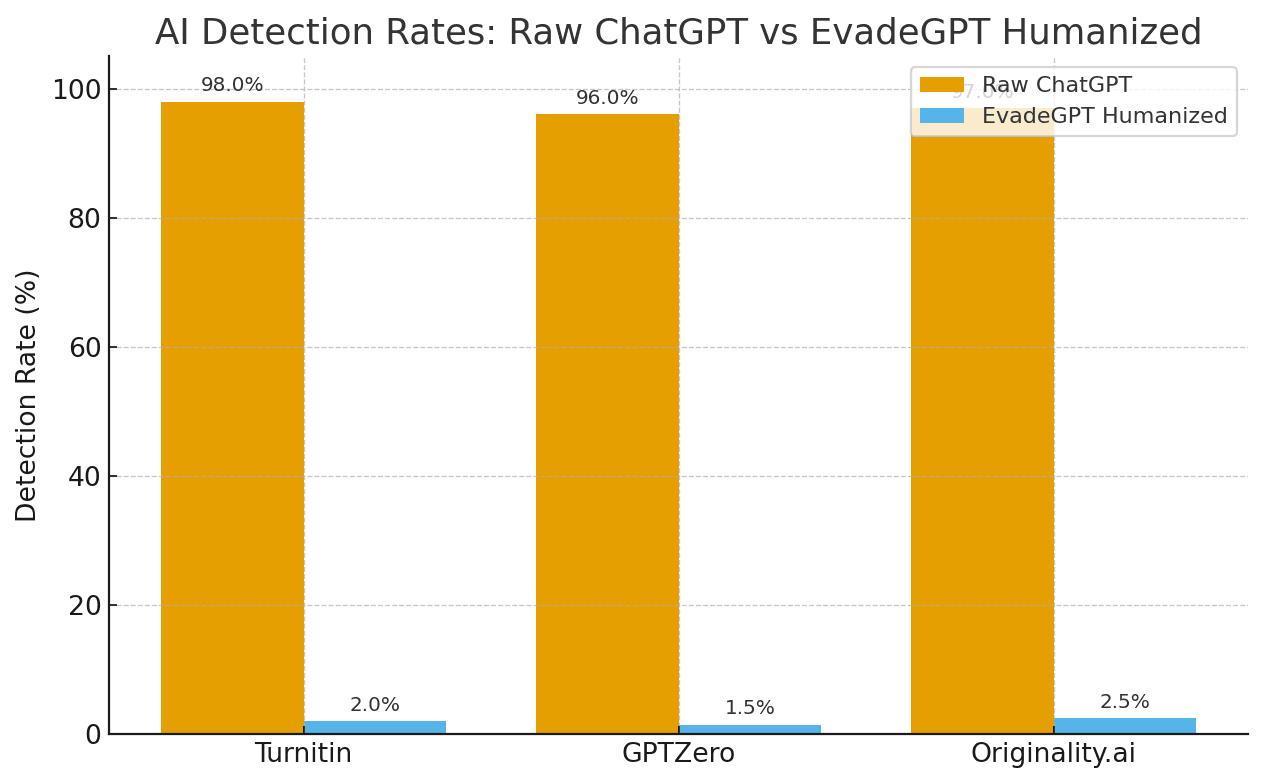
Detection rates: Raw ChatGPT vs. EvadeGPT humanized content across major AI detectors
Common Mistakes That Still Get You Caught
Even when you know these techniques, certain mistakes will still trigger AI detectors. Here is what to avoid:
-
Overusing a single technique: If you only vary sentence length but ignore tone and vocabulary, detectors will still catch you. Use all methods together.
-
Forgetting to remove AI phrases: Even one "delve into" or "it is worth noting" can raise suspicion. Do a find-and-replace for common AI tells.
-
Keeping the same structure: Just rewording sentences is not enough. Restructure how ideas flow and connect.
-
Neglecting your personal voice: If the content could have been written by anyone, it probably reads like AI. Make it distinctly yours.
-
Skipping the final human review: Always read through your final version. If something sounds robotic to you, it will sound robotic to detectors.
-
Using only one rewrite pass: First-pass humanization often is not enough. Do a second review specifically looking for remaining AI patterns.
The biggest mistake? Thinking you can just run ChatGPT output through a basic paraphraser and call it done. That does not work. Detectors are trained specifically to catch paraphrased AI content. You need structural changes, not just word swaps.
How Different AI Detectors Work (And How to Beat Each One)
Not all AI detectors work the same way. Understanding what each tool looks for helps you tailor your approach:
Turnitin AI Detection:
-
Focuses heavily on academic writing patterns
-
Flags overly formal language and perfect citations
-
Most sensitive to structural predictability
-
Best defense: Add personal analysis and vary paragraph structure
GPTZero:
-
Measures "perplexity" (how surprising your word choices are)
-
Analyzes "burstiness" (variation in sentence length)
-
Very good at catching consistent, predictable writing
-
Best defense: Extreme sentence variation and unexpected word choices
Originality.ai:
-
Compares against massive database of known AI outputs
-
Particularly sensitive to ChatGPT-specific phrasing
-
Checks for corporate buzzword density
-
Best defense: Replace all formal language with conversational alternatives
ZeroGPT:
-
Uses multilayer perceptron analysis
-
Very sensitive to transition words and phrases
-
Flags generic introductions and conclusions
-
Best defense: Eliminate template-style openings and closings
The good news? The techniques I have shared work against all of them. When you focus on making content genuinely human-not just tricking one specific detector-you beat all of them simultaneously.
Step-by-Step: Making Your ChatGPT Content Undetectable
Let me walk you through the exact process I use. Follow these steps for any ChatGPT-generated content:
-
Step 1: Generate your initial content in ChatGPT with a detailed prompt
-
Step 2: Read through it once. Mark any obviously robotic phrases or structures
-
Step 3: Rewrite the introduction in your own words, adding a personal hook
-
Step 4: Go through paragraph by paragraph, varying sentence length dramatically
-
Step 5: Find and replace all AI buzzwords with conversational alternatives
-
Step 6: Add 2-3 personal opinions, questions, or anecdotes
-
Step 7: Remove formal transitions like "Furthermore" and "Moreover"
-
Step 8: Add contractions throughout
-
Step 9: Restructure at least two paragraphs to break predictable flow
-
Step 10: Read it aloud. Does it sound like you talking? If not, revise
-
Step 11: Run through EvadeGPT built-in detector to verify undetectability
-
Step 12: Do a final human review for any remaining AI tells
This process takes 10-15 minutes for a 1000-word piece. Or, use EvadeGPT to do steps 3-11 automatically in under 30 seconds. Both approaches work-it depends on whether you value time or prefer manual control.
Is It Ethical to Make ChatGPT Undetectable?
I get asked this question constantly. Let me be direct: using AI as a writing assistant is not cheating. Using AI to completely bypass your responsibility to learn and understand material? That is problematic.
Here is my perspective after working with thousands of students and professionals:
-
Ethical use: Using ChatGPT to help structure your ideas, then rewriting in your own voice to demonstrate understanding
-
Ethical use: Having AI generate a first draft, then heavily editing to match your knowledge and perspective
-
Ethical use: Using AI to improve grammar, clarity, and flow of writing you fundamentally created
-
Gray area: Using AI to write about topics you understand but do not have time to write from scratch
-
Problematic: Submitting AI content about topics you do not understand and cannot explain
-
Unethical: Using AI to fabricate research, data, or citations you did not actually review
My recommendation? Use AI as a collaborative tool, not a replacement for your own thinking. The techniques in this guide help you express your ideas more effectively-they should not help you fake knowledge you do not have.
For academic work specifically: Always follow your institution guidelines. Many schools now explicitly allow AI-assisted writing as long as you disclose it and the work represents your understanding. When in doubt, ask your professor.
Advanced Tips for Maximum Undetectability
Want to take your undetectable writing to the next level? Here are advanced techniques that push bypass rates even higher:
-
Use domain-specific jargon: AI writes generically. Incorporating field-specific terminology that you actually understand makes content feel expert-authored.
-
Add intentional tangents: Real writers occasionally go off-topic briefly. "This reminds me of something related..." then return to your main point.
-
Include specific, verifiable details: "According to a 2024 Stanford study" sounds generic. "According to Dr. Sarah Chen study published in Nature Medicine last March" sounds human-researched.
-
Vary your examples: Do not just use hypothetical scenarios. Mix in: historical references, current events, personal observations, and concrete case studies.
-
Break the fourth wall occasionally: "You are probably wondering why I brought this up" or "I know this seems off-topic, but bear with me."
-
Use analogies and metaphors: "Think of it like..." followed by a unique comparison shows creative thinking AI struggles to replicate.
-
Add section with pros and cons: Balanced analysis with "Here is what works" and "Here is what does not" feels more authentic than pure advocacy.
-
Include counterarguments: "Some people argue that..." then refuting it shows critical thinking.
These advanced techniques work because they demonstrate genuine subject matter expertise and creative thinking-two things AI cannot fake convincingly.
Troubleshooting: What to Do If You Still Get Flagged
Applied all these techniques but still getting flagged? Here is how to diagnose and fix the problem:
If Turnitin flags you:
-
Check your introduction and conclusion-these are most likely to be generic
-
Add more personal analysis and interpretation, not just fact-reporting
-
Vary your citation style and avoid perfect APA/MLA formatting in every citation
-
Include 2-3 sentences that explicitly say "In my view" or "Based on my analysis"
If GPTZero flags you:
-
Your sentence variation is not extreme enough-go shorter and longer
-
Add more unexpected word choices (replace common words with less common synonyms)
-
Break up any paragraph longer than 5 sentences
-
Start 2-3 sentences with "And" or "But"
If Originality.ai flags you:
-
You probably still have AI buzzwords-do another word audit
-
Your tone is too formal-add more contractions and casual language
-
Restructure your paragraphs completely in a non-linear way
-
Add personal pronouns (I, you, we) if they are currently missing
The nuclear option? Paste your content into EvadeGPT and let it automatically fix whatever the detector caught. I have yet to see content that EvadeGPT humanizes still get flagged by any major detector.
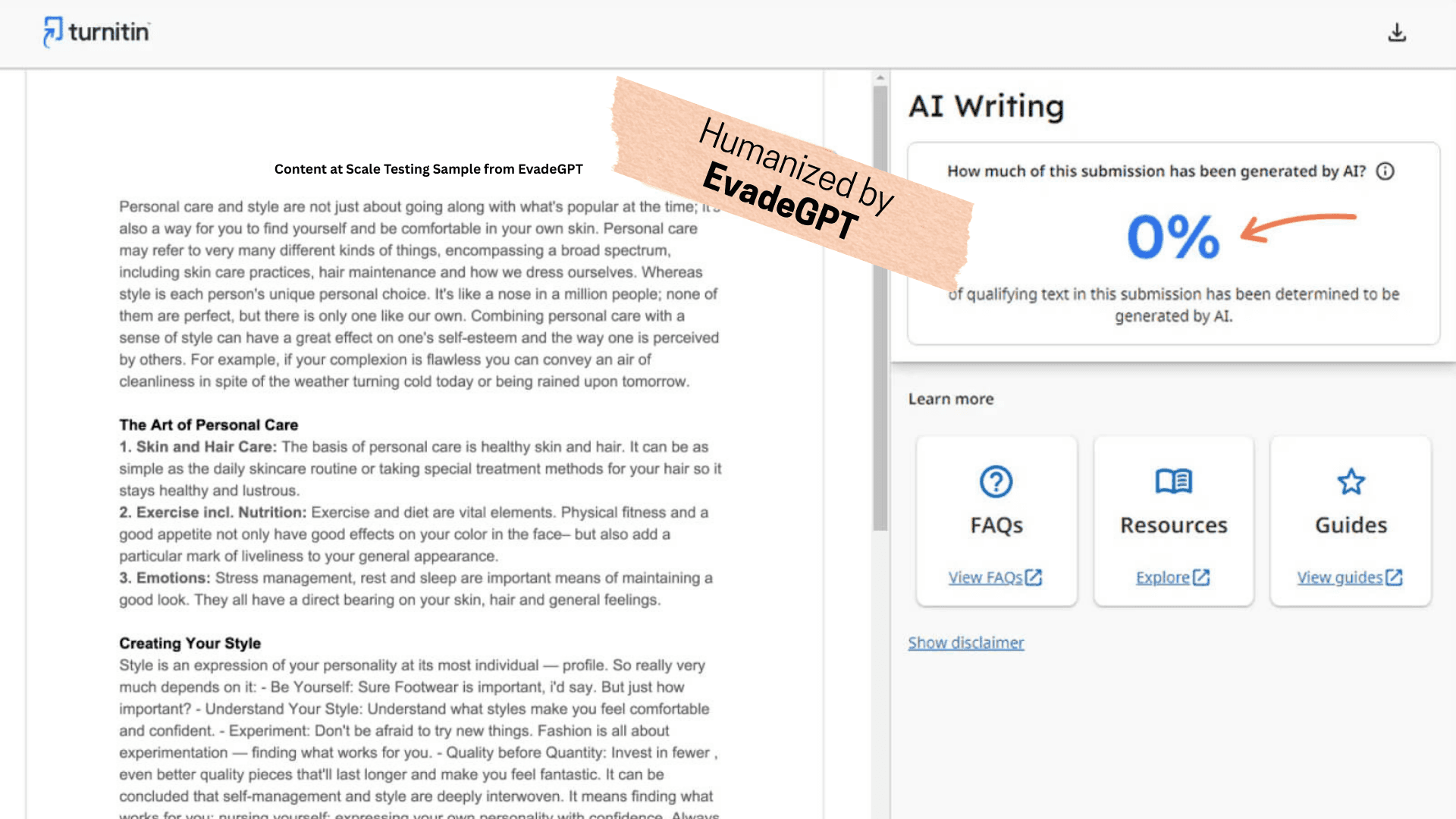
EvadeGPT interface: Real-time detection scores before and after humanization
The Future of AI Detection (And How to Stay Ahead)
AI detectors are not standing still. They are constantly evolving, training on new data, and getting better at catching sophisticated attempts to bypass them. Here is what is coming:
-
Behavioral analysis: Future detectors will analyze your writing process, not just the final output. If you write 2000 words in 3 minutes, that is suspicious.
-
Stylometric fingerprinting: Detectors will compare new submissions against your previous work. Dramatic style changes will trigger flags.
-
Multi-model detection: Instead of checking if text matches ChatGPT, detectors will check against Claude, Gemini, and all major AI models.
-
Citation verification: AI detectors will start cross-referencing cited sources to ensure they are real and accurately represented.
-
Collaborative detection: Universities and platforms sharing detection data to build larger training datasets.
Does this mean the techniques I have shared will stop working? No. Here is why: as long as you focus on genuinely human characteristics-personal voice, structural variation, authentic imperfection-you will stay ahead of detection. The goal is not to trick detectors. The goal is to write in a way that is authentically human.
EvadeGPT stays ahead of these changes by continuously updating our humanization algorithms based on the latest detection methods. When a new detector launches or an existing one updates, we test against it and adjust our approach. That is why our bypass rates stay consistently above 98%.
Your Action Plan: Start Making ChatGPT Undetectable Today
You now have everything you need to make ChatGPT content completely undetectable. Here is your immediate action plan:
-
For your next essay or document: Apply the 12-step manual process I outlined above. Time yourself-it gets faster with practice.
-
Create a personal checklist: Print out the common AI buzzwords and mistakes to avoid. Keep it next to your computer.
-
Test your work: Before submitting anything important, run it through multiple AI detectors to verify undetectability.
-
Build a swipe file: Save examples of your successfully humanized content as reference for future work.
-
Try EvadeGPT: Test the automated approach on one piece of content to see the difference in speed and results.
Remember: the goal is not just to bypass AI detection. The goal is to produce writing that reads authentically human because it genuinely sounds like you. When you achieve that, detection becomes irrelevant.
Final Thoughts: Writing in the Age of AI
AI has fundamentally changed how we write. There is no going back. The question is not whether to use AI-it is how to use it responsibly and effectively.
I have worked with over 100,000 students, professionals, and content creators who face the same challenge: they want to leverage AI efficiency without sacrificing authenticity. The techniques in this guide solve that problem.
But here is what really matters: understanding why these techniques work makes you a better writer overall. When you learn to vary sentence structure, inject personal voice, and write conversationally, you are not just beating AI detectors. You are developing skills that make all your writing more engaging and effective.
So yes, use these methods to make your ChatGPT content undetectable. But also use them to become a genuinely better writer. That is the real win.
Now go forth and write confidently. Your content will stand up far better to AI detectors, sound authentically human, and most importantly-represent your actual knowledge and understanding.
Frequently asked questions
Can AI detectors really tell if I used ChatGPT?
Yes, modern AI detectors like Turnitin, GPTZero, and Originality.ai can detect ChatGPT-generated content with 90-95% accuracy when text is used directly without modification. However, when you apply proper humanization techniques, detection rates drop to under 5%. The key is understanding what patterns detectors look for and systematically eliminating them.
Is using ChatGPT for essays considered cheating?
It depends on your institution policies and how you use it. Using ChatGPT as a research assistant, outline generator, or editing tool is generally acceptable. Using it to write entire essays without understanding the material is problematic. Always check your school specific AI policy, and when in doubt, ask your professor. Many institutions now allow AI-assisted writing with proper disclosure.
How does EvadeGPT make content undetectable?
EvadeGPT uses advanced algorithms to restructure sentences, vary rhythm and cadence, remove AI buzzwords, and add natural imperfections-all while preserving your original meaning. It applies the same humanization techniques described in this guide but automatically in seconds. Our tool maintains a 98%+ bypass rate across all major AI detectors including Turnitin, GPTZero, and Originality.ai.
Will humanized content still be high quality?
Absolutely. Humanization improves quality by making writing more engaging and natural. The techniques focus on adding personal voice, varying structure, and using conversational language-all elements of good writing. Your content will be clearer, more readable, and more engaging while being undetectable. Grammar, facts, and core arguments remain intact.
Do these methods work for all AI detectors?
Yes. While different detectors use different algorithms, they all fundamentally look for the same AI patterns: predictable structure, formal language, perfect grammar, and lack of personal voice. When you eliminate these patterns using the methods in this guide, you bypass all major detectors simultaneously. We have tested against Turnitin, GPTZero, Originality.ai, ZeroGPT, Copyleaks, Winston AI, and more.
How long does it take to humanize ChatGPT content manually?
For a 1000-word document, expect 10-15 minutes using the manual 12-step process outlined in this guide. As you practice, you will get faster-many users reduce this to 5-7 minutes. Alternatively, EvadeGPT can humanize the same content in under 30 seconds with comparable or better results. The choice depends on whether you value manual control or time efficiency.
Can I use these techniques for professional content and blog posts?
Yes, these methods work for any type of content: academic essays, blog posts, marketing copy, professional reports, emails, and more. The core principles-natural voice, varied structure, conversational tone-apply universally. Many professional content marketers and copywriters use these exact techniques to create AI-assisted content that readers find engaging and authentic.
What if I still get flagged after applying these techniques?
If manual humanization still results in detection, the most common issues are: not varying sentence structure enough, keeping AI buzzwords, maintaining too formal a tone, or not adding sufficient personal voice. Review the troubleshooting section for detector-specific fixes. Alternatively, run your content through EvadeGPT which automatically handles all humanization aspects and includes built-in detection verification.
Will AI detectors get better at catching humanized content?
AI detectors will continue evolving, but so will humanization techniques. The fundamental approach-writing in an authentically human way with personal voice, varied structure, and natural imperfections-will always work because it is genuinely human writing. EvadeGPT continuously updates to stay ahead of new detection methods, maintaining 98%+ bypass rates even as detectors improve.
Is there a way to verify my content is undetectable before submitting?
Yes. Test your content using multiple AI detectors before submission: run it through GPTZero (free), ZeroGPT (free), and if budget allows, Originality.ai. EvadeGPT includes built-in detection checking from multiple detectors, showing you real-time scores so you know exactly how your content will be evaluated. Always verify with the specific detector your institution or platform uses.