You paste ChatGPT's output into Turnitin, confident your essay is solid. Two hours later, you get the email: 92% AI-generated. Your heart sinks. The content is good, but it sounds like a robot wrote it. Because, well, one did.
AI detection tools are getting smarter, but so are the methods to humanize AI-generated text. This isn't about cheating-it's about using AI as a writing assistant while maintaining your authentic voice. Think of it like using spell-check or grammar tools, just at a higher level.
This comprehensive guide reveals exactly how to transform robotic AI text into natural, human-sounding content that passes detection while preserving quality and meaning. Whether you're a student, content creator, or professional writer, these techniques will help you leverage AI effectively and ethically.
Understanding Why AI Text Sounds Robotic
Before we dive into solutions, you need to understand the problem. AI language models like ChatGPT generate text by predicting what word comes next based on patterns in their training data. This creates several telltale characteristics that detection tools hunt for.
AI writing typically exhibits uniform sentence structure, predictable word choices, and a lack of personal voice. It follows grammatical rules perfectly-sometimes too perfectly. Real humans make occasional mistakes, use contractions inconsistently, and inject personality. AI doesn't, at least not naturally.
-
Repetitive sentence patterns - Every paragraph starts with similar structures, creating a monotonous rhythm that screams AI
-
Generic vocabulary - AI overuses words like "delve," "comprehensive," "leverage," and "utilize" instead of simpler alternatives
-
Perfect punctuation - No comma splices, no fragments, no run-ons-ironically, perfection raises red flags
-
Lack of personal anecdotes - AI cannot draw from lived experience, so content feels detached and theoretical
-
Overly balanced structure - Every point gets equal weight, every paragraph has the same length, creating artificial symmetry
-
Hedging language - Excessive use of "may," "might," "could," and "potentially" to avoid making definitive statements
Detection algorithms analyze thousands of data points including perplexity (text unpredictability) and burstiness (variation in sentence length). Low perplexity and low burstiness equal AI. High scores in both equal human. Your goal is to increase both metrics without sacrificing content quality.
The Psychology Behind Human Writing Patterns
Human writing reflects how we think, and thinking isn't linear or perfectly organized. We jump between ideas, make associative leaps, and express emotions that color our word choices. We also reflect our individual backgrounds, reading habits, and communication styles.
When you write naturally, you might start a sentence one way, change direction mid-thought, then circle back to your original point. You use words you heard in conversation last week. You reference things that happened to you. This organic messiness creates the signature of authentic human writing.
AI lacks this experiential foundation. It generates text by mathematical probability, not lived experience or emotional response. Understanding this fundamental difference helps you identify what to change when humanizing AI content.
Method 1: The Personal Touch Technique
The single most effective way to humanize AI text is adding personal elements that AI simply cannot fabricate. This goes beyond light editing-it requires injecting your unique perspective and experiences into the content.
Start by reading the AI-generated text and identifying places where personal examples would strengthen the point. Replace generic statements with specific anecdotes. Instead of "Students often struggle with time management," write "Last semester, I watched my roommate pull three all-nighters in one week because he couldn't balance his course load."
-
Replace abstract examples with concrete ones - "Many businesses benefit from AI" becomes "My uncle's hardware store increased efficiency by 30% using AI inventory management"
-
Add sensory details - Instead of "The coffee was hot," try "The coffee scalded my tongue, that bitter-burnt taste lingering even after the first sip"
-
Include dialogue - Real conversations break up exposition and add authenticity: "My professor actually said, 'This reads like a chatbot wrote it,' and honestly, he wasn't wrong"
-
Show your thought process - "At first, I thought this approach would work, but after testing it three times, I realized the limitations"
-
Reference current events or recent experiences - "Just last week, I saw a TikTok about this exact problem" grounds your writing in real time
The personal touch technique works because AI detectors cannot verify whether your experiences are real. More importantly, genuine personal elements create the natural variation and specificity that characterizes human writing. Your unique perspective is your strongest defense against detection.
Method 2: Sentence Structure Variation
AI loves consistency. Humans love variety-or at least, we create it unconsciously. One of the fastest ways to humanize text is restructuring sentences to create varied rhythm and flow. Think of it like music: nobody wants to hear the same beat repeated for three minutes straight.
Look at your AI-generated content and analyze sentence length. If every sentence hovers around 15-20 words, you have a problem. Human writers naturally alternate between short, punchy sentences and longer, more complex ones. Some sentences might be just three words. Others meander through multiple clauses, building ideas progressively, connecting thoughts with conjunctions and dependent phrases.
See what I did there? That last paragraph demonstrated the technique. Short sentence. Long sentence. This creates rhythm.
-
Start sentences differently - Don't begin every sentence with the subject. Try "Although many students struggle," "In contrast to AI," or "What surprised me most was..."
-
Mix simple and complex sentences - Follow a 25-word sentence with a 4-word one. The contrast creates emphasis and improves readability
-
Use sentence fragments occasionally - "Wrong? Maybe. Effective? Absolutely." Fragments mirror how people actually think and speak
-
Vary your punctuation - Dashes can interrupt-like I just did-to add asides. Semicolons connect related ideas; they show sophisticated thinking
-
Ask rhetorical questions - "But does this actually work?" breaks the declarative pattern and engages readers directly
-
Try one-sentence paragraphs - For emphasis.
This technique increases burstiness, one of the key metrics AI detectors measure. When your text shows high variation in sentence structure, it signals human authorship. Bonus: varied sentence structure also makes your writing more engaging and easier to read.
Method 3: Strategic Word Swapping and De-Genericizing
AI has favorite words. Learn to recognize and replace them. Certain vocabulary choices scream "chatbot wrote this" louder than a megaphone at a library. You need to develop an eye for these AI tells and swap them for more natural alternatives.
The most obvious culprits include "delve," "leverage," "utilize," "comprehensive," "robust," "facilitate," and "moreover." While these aren't inherently AI words, AI overuses them to the point of parody. Real people generally choose simpler words: "explore" instead of "delve," "use" instead of "utilize," "and" instead of "moreover."
But strategic word swapping goes deeper than just replacing overused terms. It means choosing words that reflect how you actually speak and think. If you wouldn't say "facilitate" in conversation, don't write it. If "furthermore" feels stuffy and formal, use "also" or "plus" instead.
-
Replace formal words with casual ones - "Commence" → "start," "terminate" → "end," "ascertain" → "find out"
-
Add contractions naturally - "Do not" → "don't," "it is" → "it's," but inconsistently like humans do
-
Use colloquialisms and informal phrases - "Let's be real," "Here's the thing," "Honestly," "No joke"
-
Include industry-specific jargon appropriately - If you're writing about marketing, use terms like "CTR" or "organic reach" naturally
-
Replace generic adjectives - "Good" → "solid," "effective," "worthwhile," "bad" → "problematic," "frustrating," "disappointing"
-
Vary your transition words - Don't use "however" three times in five paragraphs. Mix in "but," "still," "that said," "on the flip side"
One powerful technique: read your text aloud. If something sounds awkward or overly formal when spoken, it probably sounds AI-generated on paper. Your ear often catches what your eye misses. Trust your instincts about what sounds natural.
Method 4: Controlled Imperfection Strategy
This might sound counterintuitive, but perfect writing triggers AI detectors. Human writers make small mistakes, have occasional typos, and sometimes construct sentences that technically violate grammar rules but sound perfectly natural. Strategic imperfection humanizes your text.
I'm not suggesting you intentionally butcher your writing or submit sloppy work. The goal is introducing subtle, natural variations that mimic how humans actually write. Think of it as adding texture to otherwise smooth, perfect text.
-
Use informal punctuation occasionally - "Wait... what?" or "This is huge!!!" shows emotional response that AI lacks
-
Try comma splices sparingly - "I tried it, it worked" is technically incorrect but common in casual writing
-
Split infinitives when natural - "To really understand" feels more natural than "really to understand"
-
End sentences with prepositions - "This is what I'm talking about" sounds human, not "about which I am talking"
-
Include run-on thoughts occasionally - "I was thinking about this problem and it reminded me of something my teacher said and honestly I think she was onto something"
-
Vary contraction usage - Use "don't" in one paragraph and "do not" in another, just like humans do inconsistently
The controlled imperfection strategy works because AI is trained on formal, edited text. It produces grammatically correct output by default. When you introduce natural human variations-the kind that appear even in published articles-you create a signature that detectors cannot easily flag as artificial.
Important caveat: Know your audience and context. A doctoral thesis requires different treatment than a blog post. Adjust your level of informality accordingly, but even academic writing contains human touches that AI lacks.
Method 5: The Contextual Rewrite Approach
Sometimes the best way to humanize AI text is starting over with the AI's ideas as inspiration rather than trying to edit robotic sentences. This method requires more effort but produces the most authentically human results.
Here's how it works: Use AI to generate initial content or outlines. Extract the key points, facts, and structure. Then close the AI output and write the actual content yourself, incorporating those ideas in your own words and style. You're using AI as a research assistant, not a ghostwriter.
This approach takes longer than simple editing but creates content that genuinely reflects your voice because you wrote it. The AI provided the framework-you built the house. No detector can flag text you actually wrote yourself, even if AI helped you organize your thoughts.
-
Use AI for brainstorming - Generate topic ideas, outline structures, or key points to address
-
Extract facts and statistics - Let AI gather data, then present it in your own way
-
Get multiple perspectives - Ask AI for different angles on a topic, then synthesize them with your viewpoint
-
Create a hybrid outline - Combine AI suggestions with your own ideas and experiences
-
Write section by section - Read AI's take on each point, then write your version without looking
-
Add your unique insights - Every paragraph should contain something only you could write
The contextual rewrite approach works particularly well for academic papers, professional reports, and creative content where your unique voice matters most. Yes, it takes more time than copying and pasting AI output, but the result is genuinely yours with AI as a supportive tool.
Advanced Technique: Emotional Intelligence Integration
AI lacks emotional intelligence. It can't feel frustration, excitement, disappointment, or triumph. When you inject genuine emotional response into your writing, you create an authenticity marker that AI cannot replicate convincingly.
Emotional intelligence in writing means showing how you feel about the topic, not just explaining it objectively. It means acknowledging complexity, admitting uncertainty, or expressing strong opinions. AI hedges and equivocates. Humans take stands.
Consider these transformations: AI writes "This approach may have certain advantages." You write "Honestly? This approach changed everything for me." AI says "Some individuals might find this challenging." You say "I struggled with this for weeks before it finally clicked."
-
Express genuine opinions - "I disagree with the common view that..." or "This might be controversial, but I think..."
-
Acknowledge your biases - "I'll admit, I was skeptical at first" or "Look, I have a bias here because..."
-
Show vulnerability - "I made this mistake three times before learning" or "This part still confuses me sometimes"
-
Include emotional responses - "This frustrated me," "I was surprised to discover," "It was genuinely exciting when..."
-
React to your own points - "Wild, right?" or "I know that sounds extreme" or "Stay with me here"
-
Address the reader directly - "You've probably experienced this" or "Think about the last time you..."
Emotional intelligence also means varying your tone throughout the piece. Maybe you start enthusiastic, hit a point of concern, then end with cautious optimism. This emotional arc creates a journey that AI's consistent tone cannot match. Real humans don't maintain the same emotional register for 2,000 words straight.
Using EvadeGPT to Automate the Humanization Process
All these manual techniques work, but they're time-consuming. What if you need to humanize content quickly without spending hours on manual edits? This is where specialized tools like EvadeGPT become invaluable.
EvadeGPT uses advanced algorithms to automatically apply many of the humanization techniques discussed above. It analyzes your AI-generated text and restructures it at the sentence level, not just swapping words but fundamentally rewriting passages to increase perplexity and burstiness.
The tool identifies AI tells-uniform sentence structure, generic vocabulary, predictable transitions-and transforms them. It varies sentence length, replaces overused AI phrases, and introduces natural variation in rhythm and flow. The result passes Turnitin, GPTZero, Originality.ai, and other major detection tools with high human scores.
-
Instant processing - Paste your text, click humanize, and get results in seconds instead of hours of manual editing
-
Maintains meaning - Unlike simple paraphrasers, EvadeGPT preserves your original message while restructuring expression
-
Multiple modes - Choose between different humanization levels depending on your needs and risk tolerance
-
Bulk processing - Humanize multiple documents or long-form content efficiently
-
Bypass multiple detectors - Optimized to pass Turnitin, GPTZero, Originality.ai, Winston AI, and others
-
No registration required - Start humanizing immediately without creating accounts or subscriptions
The most effective approach combines EvadeGPT with your personal touch. Use the tool to handle the technical restructuring, then add your personal examples, emotional responses, and unique insights. This hybrid method gives you speed without sacrificing authenticity.
Common Mistakes When Humanizing AI Text
Even with the right techniques, people make critical errors that undermine their humanization efforts. Avoid these common pitfalls to ensure your content passes detection while maintaining quality.
The biggest mistake is superficial editing-changing a few words here and there while leaving the underlying AI structure intact. Detectors analyze patterns at the sentence and paragraph level. Swapping "utilize" for "use" helps, but it won't fool algorithms if your sentence structure still screams AI.
-
Over-relying on thesaurus replacements - Just swapping synonyms creates awkward phrasing and doesn't address structural AI tells
-
Ignoring tone consistency - Jumping between formal and casual randomly instead of maintaining an appropriate, consistent voice
-
Adding irrelevant personal details - Personal touches should enhance your point, not distract from it
-
Making too many intentional errors - One or two natural imperfections work; five spelling mistakes look like carelessness
-
Forgetting to verify facts - AI sometimes makes up statistics or references; always fact-check before submitting
-
Leaving AI's generic examples - "Consider a company that implements this strategy" should become your actual example
Another critical mistake is neglecting to read your final version aloud. Your ear catches awkward phrasing, unnatural word choices, and rhythm problems your eyes miss. If you can't read it smoothly out loud, readers will stumble over it too-and detectors will flag it.
Finally, some people try to humanize content without understanding the subject matter. If you can't explain the topic in your own words, you can't effectively humanize writing about it. Use AI to understand complex topics, but make sure you actually understand them before humanizing the content.
Testing Your Humanized Content
Before submitting humanized content, test it with AI detection tools. Free versions of Turnitin aren't publicly available, but several alternatives let you check your text's likelihood of being flagged.
GPTZero offers free detection with daily limits. Originality.ai provides limited free scans. Writer.com's AI Content Detector is entirely free. Run your humanized text through multiple detectors because different tools use different algorithms and may catch different patterns.
Aim for detection scores below 20% AI. Some tools show percentage likelihood of AI generation, others show probability scores. A score showing 85% human is good; 95% is excellent. If you're getting 60% human or lower, additional humanization work is necessary.
-
Test multiple tools - Don't rely on a single detector; different tools have different strengths and weaknesses
-
Check individual paragraphs - Sometimes one section flags higher than others, revealing where AI patterns remain strongest
-
Compare before and after - Run your original AI text and humanized version to see improvement
-
Look for specific flagged sections - Some tools highlight which parts triggered AI detection so you can target improvements
-
Test similar content - If you're humanizing multiple pieces, test samples to verify your techniques work consistently
Remember that no detector is 100% accurate. False positives happen-even human-written content sometimes gets flagged. Your goal is passing detection while maintaining quality and authenticity, not achieving a perfect score through manipulation.
Ethical Considerations and Best Practices
Let's address the elephant in the room: Is humanizing AI text ethical? The answer depends on context, how you use AI, and whether you're transparent about your process.
Using AI as a writing assistant-for brainstorming, outlining, research, or initial drafts-is no different ethically than using spell-check, grammar tools, or writing guides. The key is that you're adding substantial value through editing, personal insight, and unique perspective. You're not just copying and pasting AI output.
In academic contexts, check your institution's AI policy. Some schools prohibit all AI use; others allow it for research and drafting with disclosure. Professional contexts vary too-some companies embrace AI tools, others restrict them. Know your environment's rules and follow them.
-
Disclose AI use when required - If your school or workplace requires disclosure, do it. Transparency matters.
-
Add substantial original content - Don't submit pure AI output. Your ideas, examples, and voice should dominate.
-
Fact-check everything - AI makes mistakes. You're responsible for accuracy, so verify claims and citations.
-
Understand what you submit - If you can't explain or defend the content, you shouldn't claim it as yours.
-
Use AI to enhance, not replace, thinking - Let AI handle grunt work so you can focus on analysis and insight.
-
Consider the spirit, not just the letter - Ask yourself: Am I learning and adding value, or just gaming the system?
The most ethical approach treats AI as a collaborator, not a replacement for your own thinking. Use it to overcome writer's block, organize ideas, or speed up research. Then apply your knowledge, experience, and critical thinking to create something genuinely yours.
Ultimately, humanizing AI text should result in better content than the raw AI output-more personal, more insightful, more engaging. If you're just trying to pass detection without improving quality, you're missing the point of both AI assistance and human creativity.
Future-Proofing Your Humanization Skills
AI detection technology will continue improving. What works to bypass detection today might not work tomorrow. Similarly, AI writing will become more sophisticated, making current tells less obvious. How do you stay ahead?
Focus on genuinely improving your writing skills rather than just learning tricks to fool detectors. The techniques in this guide-varying sentence structure, adding personal touches, injecting emotional intelligence-make you a better writer regardless of AI detection.
The writers who thrive in the AI age will be those who use AI to enhance their capabilities while maintaining their unique human perspective. Learn to collaborate with AI effectively. Develop your voice. Cultivate expertise that AI cannot replicate. Build a writing style so distinctive that humanization becomes natural, not forced.
-
Read widely and actively - Exposure to various writing styles helps you develop your own authentic voice
-
Practice writing regularly - Daily writing builds instincts that make humanization effortless
-
Study what makes writing compelling - Understand storytelling, rhetoric, and persuasion at a deeper level
-
Experiment with different formats - Try creative writing, journalism, academic papers to build versatility
-
Analyze both AI and human writing - Learn to spot differences and understand what makes each effective
-
Stay updated on detection methods - Understand what algorithms look for so you can adapt techniques
The goal isn't outsmarting AI detectors forever-it's becoming such a strong writer that the distinction between AI-assisted and human-written becomes irrelevant. When your voice dominates the content, when your insights drive the analysis, when your experiences provide the examples, the question of AI involvement becomes secondary.
Conclusion: Mastering Human-AI Collaboration
Humanizing AI text isn't about deception-it's about collaboration. AI provides structure, speed, and initial ideas. You provide voice, experience, insight, and authenticity. Together, you create content better than either could produce alone.
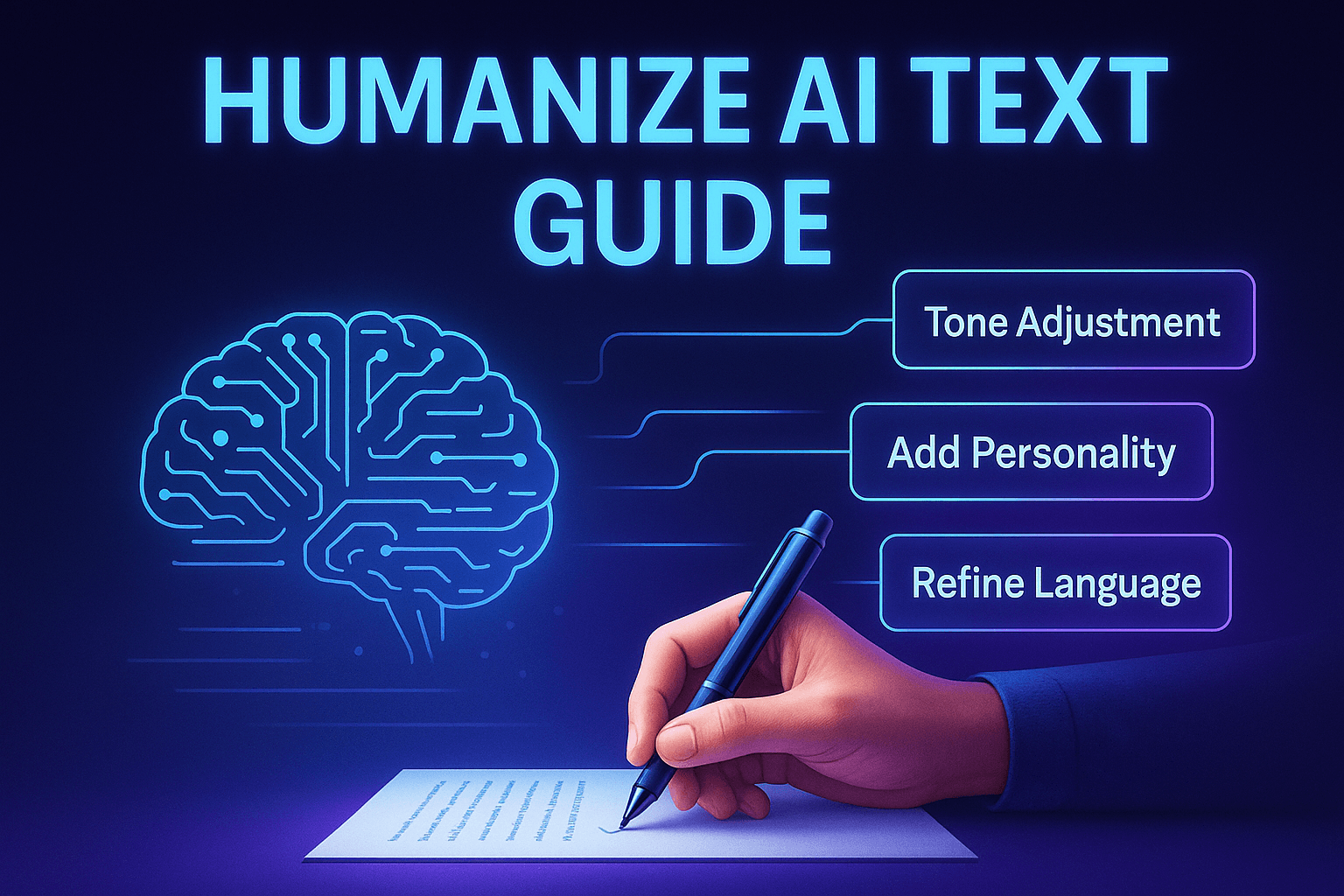
The techniques in this guide give you multiple approaches: personal touch, sentence variation, strategic word swapping, controlled imperfection, contextual rewriting, and emotional intelligence integration. Use them in combination for best results. And when time is limited, tools like EvadeGPT automate the technical restructuring while you focus on adding human elements.
Remember that detection bypass is secondary to content quality. If your humanized text is poorly written or lacks substance, passing detection is meaningless. Focus on creating valuable content that serves your audience while maintaining your authentic voice.
The future of writing involves AI collaboration. The sooner you master these humanization techniques-both manual and automated-the better positioned you'll be to thrive in this new landscape. Start practicing these methods today, and you'll develop instincts that make humanization second nature.
Frequently asked questions
Will humanizing AI text make it undetectable by all AI detectors?
While effective humanization significantly reduces detection scores, no method guarantees 100% undetectability across all tools. Different detectors use different algorithms, and detection technology constantly evolves. The techniques in this guide typically reduce AI detection scores to below 20%, which passes most academic and professional scrutiny. Combining multiple humanization methods with tools like EvadeGPT provides the best results.
Is it cheating to humanize AI-generated text for school assignments?
This depends on your institution's specific AI policy and how you use AI. Using AI for brainstorming, outlining, and initial drafts-then extensively editing and adding your own insights-is similar to using any writing tool. However, submitting pure AI output without substantial personal contribution violates academic integrity. Always check your school's AI policy and use AI as an assistant, not a replacement for your own thinking.
How long does it take to manually humanize AI-generated text?
Manual humanization typically takes 30-60 minutes per 1,000 words, depending on the complexity of the content and your skill level. You need to restructure sentences, add personal touches, vary vocabulary, and inject emotional intelligence. Tools like EvadeGPT reduce this to seconds for the technical restructuring, though you should still add personal elements. For best results, budget time for both automated and manual humanization.
Can professors tell if I used AI even after humanizing the text?
Experienced professors sometimes detect AI usage through inconsistent voice, sudden quality changes, lack of personal examples, or content that doesn't match your typical style. The best protection is genuinely understanding your topic and adding substantial personal contribution. If you can discuss and defend every point in your paper, humanized AI-assisted content becomes indistinguishable from content you wrote with traditional research tools.
What's the difference between humanizing and paraphrasing AI text?
Paraphrasing simply rewrites sentences using different words, often maintaining the AI's structure and patterns. Humanizing is deeper-it restructures text to increase variation, adds personal voice, introduces emotional intelligence, and creates natural imperfections. Paraphrasers might change "utilize" to "use," but humanization changes the entire sentence structure and adds elements AI cannot generate. Humanizing produces authentically human-sounding text; paraphrasing often remains detectably AI-generated.
Do AI detection tools have false positive rates?
Yes, AI detectors frequently flag human-written content as AI-generated, with false positive rates ranging from 10-40% depending on the tool and content type. Formal, well-structured writing with consistent tone often triggers false positives. This is why humanization techniques like adding personal anecdotes and varying sentence structure help-they introduce elements detectors associate with human writing, reducing both true and false positives.
Should I use multiple humanization methods together?
Absolutely. Combining techniques produces the best results. For example, use EvadeGPT for initial restructuring, then add personal examples, vary vocabulary, and inject emotional responses. Think of humanization methods as layers-each layer adds authenticity and makes detection harder. Using just one technique might reduce your AI score from 90% to 60%, but combining methods can reduce it to 10% or less.